Pressure Washer Pump Replacement: Signs, Cost and Step-by-Step Swap

Some links in this guide are affiliate links. If you buy through them we may earn a commission, at no extra cost to you. This never affects what we recommend or how we rank equipment. Read our disclosure.
Pressure washer pump replacement is worth doing when the engine still runs well and the pump has failed: low pressure that a new nozzle and a good water supply do not fix, water or oil leaking from the pump, milky pump oil, or a manifold cracked by frost. On Amazon in November 2026, a replacement pump cost about $55 to $100 for a homeowner vertical-shaft machine, about $170 to $330 for a horizontal 1 inch triplex, and about $485 to $725 for a brand-name commercial pump. The swap itself takes about an hour with basic tools if you match the pump to the engine correctly.
Replace the pump when it leaks, loses pressure after you have ruled out the nozzle, supply and unloader, or is cracked from freezing. Match the new pump to the engine: shaft orientation (vertical or horizontal), shaft diameter (7/8 inch or 1 inch on most machines), engine RPM, PSI and GPM, bolt pattern and hose connections. Expect about $55 to $100 for a vertical axial pump, $170 to $330 for a horizontal triplex, and $485 or more for a commercial brand pump.
Signs your pressure washer pump needs replacing
- Low or no pressure even with a new nozzle, a strong water supply and a clean inlet filter. Our guide to a pressure washer losing pressure covers those checks first.
- Water dripping from under the pump while it runs, which points to worn seals.
- Milky or watery pump oil, which means water is getting past the seals into the crankcase.
- A cracked manifold or burst fitting after a cold night. Water left in the pump freezes, expands and splits the housing.
- Knocking, grinding or heavy pulsing that does not stop after the valves are cleaned. See pressure washer surging or pulsing.
Repair or replace?
| Pump type | Found on | Repairable? | Usual answer |
|---|---|---|---|
| Axial cam (wobble plate), vertical shaft | Most homeowner gas machines | Rarely worth it | Replace the pump |
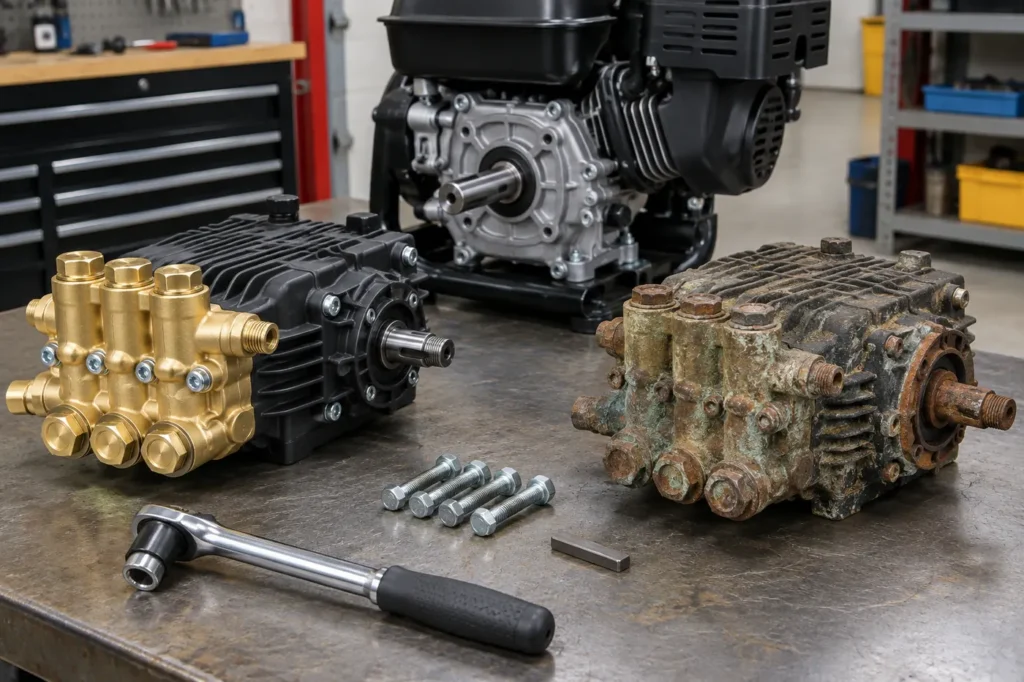
| Triplex plunger, direct drive | Better homeowner and light commercial machines | Yes, seal and valve kits exist | Repair if the crankcase is fine; replace if cracked or worn out |
| Triplex plunger, belt drive | Commercial machines | Yes, built to be rebuilt | Rebuild with kits; replace only after major damage |
Seal and valve kits for a commercial triplex pump cost far less than a new pump, so commercial owners usually rebuild. On cheap axial pumps, a kit plus your time can cost close to a new pump, so replacing is simpler.
How much does it cost to replace a pressure washer pump?
| Pump | Typical machine | Amazon price (Nov 2026) |
|---|---|---|
| Vertical axial pump, 7/8 inch shaft, 2,400 to 3,400 PSI | Homeowner gas machines on a vertical-shaft engine | About $55 to $100 |
| Horizontal triplex, 1 inch shaft, 4,000 to 4,400 PSI, 4 GPM | Contractor-style direct-drive machines | About $170 to $330 |
| General Pump EZ4040, 4,000 PSI, 4 GPM, 1 inch hollow shaft | Commercial direct-drive machines | About $485 |
| 66DX40GG1 (66DX series), 4,000 PSI, 4 GPM | Commercial direct-drive machines | About $725 |
If a shop does the swap, add their labor, usually around an hour for a direct-drive pump. Belt-drive commercial pumps cost more and take longer, because the pulleys and belts have to be set up as well.
Replacement pumps and protection on Amazon

OEM Technologies 90025 vertical pump kit, 2,400 PSI, 2.0 GPM, 7/8 inch shaft
Axial cam pump kit with hardware and a thermal relief valve. Match PSI, GPM and the hose connection.
Check price on Amazon
AAA 90039 horizontal triplex pump kit, 4,000 PSI, 3.5 GPM, 1 inch shaft
Triplex plunger pump with an oil sight glass, adjustable pressure knob and hardware.
Check price on Amazon
General Pump EZ4040, 4,000 PSI, 4.0 GPM, 1 inch hollow shaft
Triplex pump with an unloader, rated at 3,400 RPM for direct-drive engines.
Check price on Amazon
66DX40GG1 triplex pump (66DX series), 4,000 PSI, 4.0 GPM
Listed by BE Pressure. Direct-drive triplex rated at 3,400 RPM with a 1 inch shaft.
Check price on Amazon
STA-BIL Pump Protector, 4 oz
Antifreeze and lubricant for storage. Stops freeze cracks and dried-out seals.
Check price on AmazonAs an Amazon Associate we earn from qualifying purchases. Prices and availability change, so check the current price on Amazon.
How to choose the right replacement pump
Most failed swaps come from a pump that does not match the engine. Check every item on this list against your old pump and engine before you order.
- Shaft orientation: vertical-shaft engines (common on homeowner machines) need a vertical pump; horizontal-shaft engines need a horizontal pump.
- Shaft diameter: measure the engine shaft. 7/8 inch is common on vertical homeowner engines and 1 inch on many horizontal engines from about 9 to 15 hp, such as the Honda GX270 to GX390.
- Engine speed: direct-drive pumps are rated for about 3,400 RPM. Belt-drive pumps run slower and are not a direct swap.
- PSI and GPM: stay close to the original rating. A pump that needs more horsepower than the engine has will bog it down.
- Bolt pattern: most pumps use the standard SAE pattern, but confirm the number and spacing of bolts.
- Connections: garden hose inlet, and an M22 threaded or 3/8 inch quick-connect outlet to match your hose.
- Unloader and thermal relief: many replacement pumps include them. If yours does not, move the old ones over if they are in good condition.
How to replace a pressure washer pump, step by step
These steps cover the common direct-drive pump that bolts to the engine. Always check your pump’s instructions as well.
- Make it safe. Turn the engine off, let it cool, and pull the spark plug wire so it cannot start. Squeeze the gun to release trapped pressure.
- Disconnect the hoses. Remove the garden hose, the high-pressure hose and the detergent tube from the pump.
- Remove the mounting bolts. Most pumps are held by three or four bolts into the engine flange. Support the pump as the last bolt comes out.
- Slide the pump off the shaft. If it is stuck, use penetrating oil and patience, or a puller. Do not hammer on the pump or engine. Keep the shaft key.
- Clean the shaft. Remove rust and old grease, and put a light coat of anti-seize on the shaft so the next removal is easy.
- Fit the new pump. Line up the keyway, slide the pump on without forcing it, and tighten the bolts evenly in a cross pattern.
- Check the pump oil. Many pumps ship pre-filled, but some do not. Fill to the mark or sight glass before you run it.
- Reconnect and purge air. Connect the hoses, turn on the water, and squeeze the trigger until a steady stream flows before you start the engine.
- Test and set the pressure. Run it with the correct nozzle, check for leaks, and if the pump has an adjustable unloader, set it with a gauge. Our guide on how to adjust a pressure washer unloader valve shows how.
How to make the new pump last
- Never run the pump without water flowing to it. Even a minute dry damages the seals.
- Do not leave it in bypass with the trigger released for long periods. The water heats up and wears the seals.
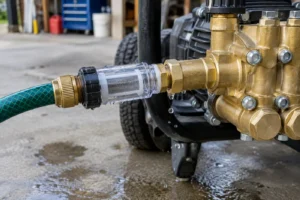
- Use an inlet filter and a supply that delivers more water than the pump’s rated GPM.
- Change the pump oil on the maker’s schedule on pumps that have a drain.
- In freezing weather, drain the pump and fill it with pump protector or antifreeze before storage.
Frequently asked questions
Is it worth replacing the pump on a pressure washer?
Usually yes if the engine runs well. A new homeowner pump costs about $55 to $100 and a triplex replacement about $170 to $330, far less than a new machine. On commercial machines with a triplex pump, rebuilding the old pump with a seal and valve kit is often cheaper still.
How much does it cost to replace a pressure washer pump?
Parts ran from about $55 for a basic vertical axial pump to about $485 to $725 for a commercial General or 66DX series pump in November 2026. A shop usually adds around an hour of labor for a direct-drive swap.
Can you fix a pressure washer pump?
Triplex plunger pumps can be rebuilt with seal, valve and plunger kits. Most cheap axial cam pumps are not designed to be rebuilt, and replacing them is easier.
Will any pump fit my pressure washer?
No. The shaft orientation, shaft diameter, engine speed, bolt pattern, PSI and GPM and hose connections all have to match. Check each one against your old pump before ordering.
What causes a pressure washer pump to fail?
The most common causes are running it without water, freezing with water left inside, long periods in bypass that overheat the water, dirty water that wears the seals and valves, and pressure set above the pump’s rating.
Bottom line: rule out the nozzle, water supply and unloader first, then match the new pump to your engine’s shaft, speed and rating. A direct-drive swap takes about an hour, and pump protector before winter is the cheapest way to avoid doing it again.