What Is a HEPA Vacuum? Standards, Sealed Systems and When a Job Needs One

Some links in this guide are affiliate links. If you buy through them we may earn a commission, at no extra cost to you. This never affects what we recommend or how we rank equipment. Read our disclosure.
A HEPA vacuum is a vacuum cleaner whose filter meets the HEPA standard, capturing at least 99.97% of particles 0.3 microns in size under the US definition, and whose body is sealed so that all of the air it pulls in passes through that filter. The second part matters as much as the first. A vacuum with a HEPA filter that leaks air around it is not a HEPA vacuum, and for some jobs, such as lead-safe renovation work, the law requires the real thing.
A HEPA vacuum combines a true HEPA filter (99.97% capture at 0.3 microns, or H13/H14 under the European standard) with a sealed body so no air escapes around the filter. Labels like “HEPA-type” or “HEPA-style” do not meet that standard. Jobs that need a real HEPA vacuum include lead-safe renovation under EPA rules and silica dust cleanup under OSHA rules, and it is the right choice for mold cleanup and for healthcare and allergy-sensitive spaces.
What does HEPA mean?
HEPA stands for high-efficiency particulate air. It is a filter performance standard, not a brand or a type of vacuum. There are two common versions:
| Standard | Where it is used | What it requires |
|---|---|---|
| US DOE HEPA | United States | At least 99.97% capture of 0.3 micron particles |
| EN 1822 class H13 | Europe and many imported machines | At least 99.95% capture at the most penetrating particle size |
| EN 1822 class H14 | Europe, healthcare, cleanrooms | At least 99.995% capture at the most penetrating particle size |
Why 0.3 microns? It is close to the particle size that filters find hardest to catch. Larger particles are trapped by the fibers directly, and very small ones bounce around and stick to them, so a filter that stops 0.3 micron particles performs even better on most other sizes.
The European classes test at the “most penetrating particle size” for that filter instead of a fixed 0.3 microns, so an H13 rating and the US 99.97% figure are close but not identical. H14 lets through about ten times fewer particles than H13.
HEPA filter vs HEPA vacuum
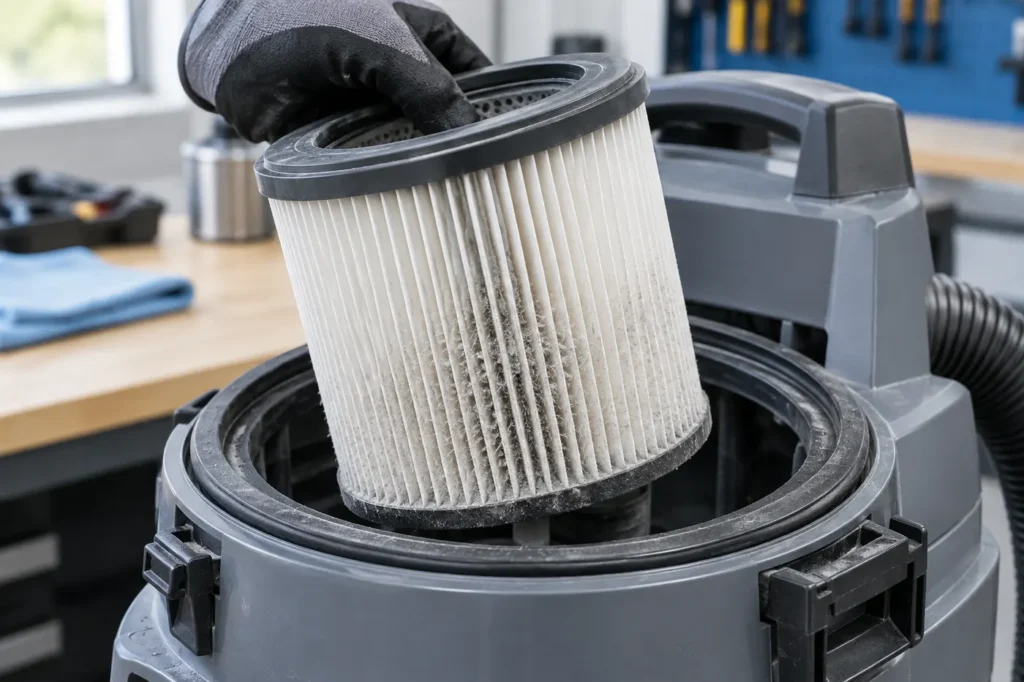
A HEPA filter only works if the air goes through it. In many vacuums, some air escapes through gaps around the filter housing, the bag seat or the motor cover, and that air carries the finest dust straight back into the room.
That is why the US Environmental Protection Agency’s lead renovation rule (40 CFR 745.83) defines a HEPA vacuum as a machine designed with a HEPA filter as its last filtration stage, built so that all the air drawn into the machine is expelled through that filter with none leaking past it. The EPA has also said that a vacuum retrofitted with a HEPA filter, such as an ordinary shop vac with a HEPA cartridge, does not count.
Some commercial makers go a step further and test the whole machine, not just the filter. ProTeam, for example, rates its backpack vacuums to ASTM F3150, a test of how much dust the complete vacuum lets out.
When does a job need a HEPA vacuum?
| Job | Why HEPA | Required or recommended |
|---|---|---|
| Lead-safe renovation in pre-1978 homes and child-occupied facilities | EPA’s Renovation, Repair and Painting rule requires HEPA vacuums for cleanup | Required |
| Construction work that creates silica dust | OSHA’s silica standard (29 CFR 1926.1153) bars dry sweeping where wet methods or HEPA-filtered vacuuming are feasible | HEPA vacuum or wet methods required |
| Mold cleanup | Fine spores spread easily; EPA guidance for schools and commercial buildings recommends HEPA vacuuming | Recommended |
| Hospitals, clinics, schools | Fine dust and allergens affect people with asthma and allergies | Recommended |
| Daily office and hotel cleaning | Better indoor air quality and fewer complaints | Good practice |
For lead and silica work, check the exact rule that applies to your job and keep records of the equipment you used. A vacuum that says HEPA on the box is not automatically a compliant machine.
How do you know if a vacuum is really HEPA?
- Look for numbers. A real HEPA claim states 99.97% at 0.3 microns, or an H13 or H14 class. “Allergen filter”, “HEPA-type”, “HEPA-like” and “HEPA-style” are not the same thing.
- Look for “sealed system” or a whole-machine rating. The best commercial makers state that the whole vacuum is sealed or tested, not just the filter.
- Check where the HEPA filter sits. For EPA lead work it must be the final stage before the air leaves the machine.
- Read the spec sheet, not the box. Commercial makers publish the filter standard and test method in their spec sheets.
Commercial vacuums with HEPA filtration

ProTeam Super Coach Pro 6 backpack vacuum
ProTeam rates it at 99.6% capture at 0.3 to 0.5 microns, tested to ASTM F3150.
Check price on Amazon
Sanitaire FORCE QuietClean SC5815E
15 inch commercial upright listed with a sealed HEPA system.
Check price on Amazon
Hoover Commercial HushTone 13 inch
HEPA filtration with a two-speed quiet motor and a 40 ft cord.
Check price on AmazonAs an Amazon Associate we earn from qualifying purchases. Prices and availability change, so check the current price on Amazon.
These are general cleaning vacuums. For EPA lead or OSHA silica work, confirm with the maker that the exact model meets the rule you work under. Our guides to the best commercial backpack vacuums and best commercial upright vacuums cover them in more detail.
What are the downsides of a HEPA vacuum?
- Cost. HEPA machines and replacement filters cost more than standard ones.
- Airflow. A dense filter resists airflow, and a clogged HEPA filter cuts suction fast. Change bags and pre-filters on time so the HEPA filter lasts.
- Maintenance. A damaged or badly seated filter stops being HEPA. Never wash a HEPA filter unless the maker says it is washable, and check the seal every time you replace it.
Frequently asked questions
What is the difference between a HEPA vacuum and a regular vacuum?
A HEPA vacuum has a filter that captures at least 99.97% of 0.3 micron particles and a sealed body so all air passes through it. A regular vacuum catches large dirt but lets more fine dust out with the exhaust.
Can I put a HEPA filter in a shop vac and use it for lead work?
Not for EPA lead renovation work. The EPA has said that vacuums retrofitted with a HEPA filter do not meet the definition of a HEPA vacuum. Use a machine designed and sold as a HEPA vacuum.
Do HEPA vacuums remove mold spores and allergens?
They capture the fine particles that standard vacuums blow back out, including most mold spores, pollen and dust mite debris. They do not fix the moisture problem behind mold, so the source still has to be dealt with.
How often should a HEPA filter be replaced?
Follow the maker’s schedule, which is often based on hours of use, and replace it sooner if suction drops after changing the bag and pre-filter or if the filter is damaged.
Is H13 the same as HEPA?
Close, but not identical. H13 is a European class rated at 99.95% at the filter’s most penetrating particle size, while the US HEPA definition is 99.97% at 0.3 microns. Both are high-grade filters; H14 is stricter than both.
Bottom line: a HEPA vacuum needs a true HEPA filter and a sealed body. For lead renovation and silica work, the rules require it, so buy a machine designed as a HEPA vacuum; for schools, clinics and offices, it is the simplest way to keep fine dust out of the air.
[…] That matters in schools, clinics and offices where dust and allergens are a complaint. Our guide to what a HEPA vacuum is explains why the whole-machine rating […]