How to Strip and Wax a Floor: Step-by-Step for Commercial VCT

Some links in this guide are affiliate links. If you buy through them we may earn a commission, at no extra cost to you. This never affects what we recommend or how we rank equipment. Read our disclosure.
To strip and wax a floor, clear and dust mop the room, apply stripper diluted to the label’s ratio in small sections, let it dwell, scrub with a black stripping pad on a 175 RPM floor machine, pick up the slurry with a wet/dry vacuum, neutralize and rinse, let the floor dry, then lay several thin coats of floor finish with a clean flat mop, letting each coat dry before the next. Keep traffic off for at least 8 hours, and wait 24 to 48 hours before burnishing. These steps follow floor care maker Hillyard and distributor Imperial Dade.
Work in 100 to 300 square foot sections (Hillyard), apply stripper at the label’s dilution and let it dwell 3 to 10 minutes without drying, scrub with a black pad on a low-speed floor machine, pick up the slurry with a wet/dry vacuum (Hillyard says not with an auto scrubber), neutralize and rinse, then apply thin coats of finish with a clean microfiber flat mop. Imperial Dade recommends keeping foot traffic off for at least 8 hours after the last coat and not buffing or burnishing for 24 to 48 hours.
What you need
| Item | Why |
|---|---|
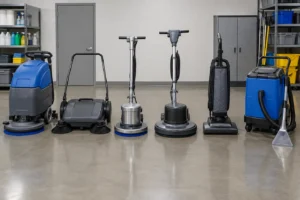
| Floor machine (175 RPM) with a pad driver | Agitates the stripper; Hillyard uses a 20 inch machine |
| Black stripping pads, plus a hand pad for edges | Cut through old finish; Hillyard uses a small edge pad near baseboards |
| Floor stripper and neutralizer | Remove old finish, then reset the floor’s pH so new finish bonds |
| Wet/dry vacuum with defoamer | Picks up the slurry; defoamer stops foam tripping the shutoff float |
| Mop buckets, wet mops, a clean microfiber flat mop for finish | Apply stripper and rinse; flat mop lays finish evenly |
| Floor finish | The new protective coat |
| Wet floor signs, stripping boots, gloves and eye protection | Stripped floors are extremely slippery; stripper is caustic |
Choose a stripper that is safe for your floor. Hillyard says to check the label, avoid strippers not recommended for the surface, and pretest for colorfastness if the label suggests it. Most strippers are for vinyl composition tile (VCT) and similar resilient floors; many must not be used on linoleum, rubber, asphalt tile, wood or painted floors.
Step 1: Prepare the room
- Make sure the area is well ventilated. Hillyard warns that vapors from stripping can be harmful; read the product labels and safety data sheets.
- Remove all furniture and objects.
- Sweep along the baseboards, pulling dirt away from the wall, then dust mop the whole floor.
- Put out wet floor signs and close off the area.
- Optional: Hillyard applies a thin coat of finish to the baseboards with a cloth first, so stripper splashes wipe off more easily later.
Step 2: Mix and apply the stripper
Dilute the stripper exactly as the label says. Imperial Dade notes that too strong a mix can damage or bleach the floor, while too weak a mix will not remove the old finish and means doing the job twice. It also recommends mixing with cool water, because hot water raises odors and evaporates faster, so the stripper dries too soon.
- Work in sections. Hillyard uses 100 to 300 square feet at a time; Imperial Dade suggests about 10 by 10 feet, or only what you can strip within 20 to 25 minutes.
- Apply the solution generously with a mop. Hillyard’s coverage rate is 250 to 300 square feet per diluted gallon.
- Let it dwell 3 to 10 minutes; the more layers of old finish, the longer it needs.
- Never let the stripper dry. If it starts to dry, add more solution. Dried stripper is very hard to remove and can damage the floor.
Step 3: Scrub with the floor machine
Fit a black stripping pad to a low-speed floor machine. Hillyard’s technique:
- Start near the wall and work away from it, moving right to left at about two feet per second.
- Overlap each pass by about half.
- Use a hand pad on a pole for the edges and corners the machine cannot reach.
- For heavy build-up, apply more stripper and scrub again in a direction at right angles to the first pass.
- Flip or change the pad when it clogs with slurry.
Our guide to floor buffer vs burnisher explains why stripping needs a low-speed machine, not a burnisher.
Step 4: Pick up the slurry
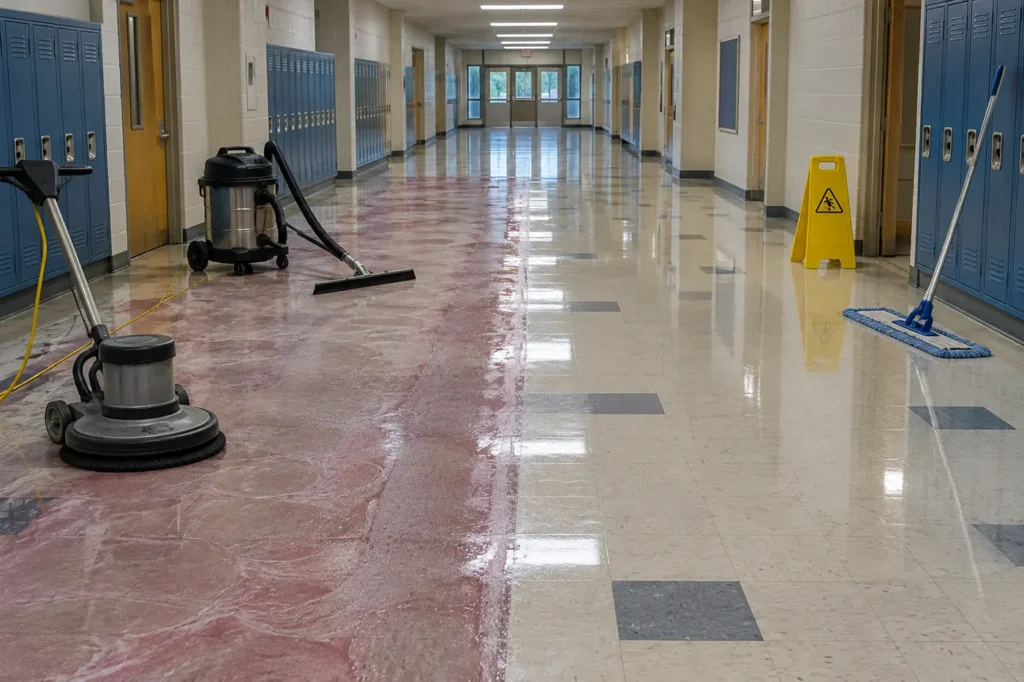
Remove all the slurry with a wet/dry vacuum fitted with a floor squeegee tool. Hillyard says not to use an automatic scrubber for the stripping and slurry steps. Add defoamer to the vacuum’s recovery tank so foam does not trip the shutoff float. If two people are working, keep some distance between the floor machine and the vacuum so the machine does not sling slurry back onto clean floor.
Look for patches where old finish is still there; they show as dull or uneven areas. Hillyard says to stop and remove them now, because they are hard to spot later.
Step 5: Neutralize and rinse
Stripper is alkaline, and residue left on the floor stops new finish from bonding and can cause hazing or powdering. Apply a neutralizer diluted per its label, at about 250 to 300 square feet per gallon in Hillyard’s procedure, then pick it up. Rinse with clean water, using a wet/dry vacuum or an auto scrubber with a clean pad. Let the floor dry completely.
Step 6: Apply the floor finish
- Line the bucket. Imperial Dade suggests lining the mop bucket with a clean trash liner before pouring in finish, so no residue contaminates it.
- Use a clean microfiber flat mop. Imperial Dade says cotton mops leave lint and soak up too much finish; flat mops give a more even coat and keep finish off the baseboards.
- Lay thin, even coats. Cut in along the edges first, then fill the middle. Thin coats dry harder and clearer than one thick coat.
- Let each coat dry before the next. The finish label gives the number of coats and the dry time between them.
- Do not aim fans at the floor. Imperial Dade says a fan may move air but must point at the ceiling, because air blown at the floor ripples wet finish.
Step 7: Let it cure
- Keep foot traffic off for at least 8 hours after the last coat (Imperial Dade).
- Do not buff or burnish for at least 24 to 48 hours, or you can distort or remove the new coats.
- Rinse all equipment the same day and let it air dry, as Hillyard advises.
Supplies for a strip and wax

3M 7200 black stripper pad, 20 inch, 5 pack
For use with water-based strippers on a rotary floor machine.
Check price on Amazon
Rubbermaid Commercial finish flat mop kit
Finish bucket with lid and sieve, six pads and a frame.
Check price on Amazon
Clarke CFP Pro 20HD floor machine, 20 inch, 175 RPM
Low-speed machine for stripping and scrubbing.
Check price on AmazonAs an Amazon Associate we earn from qualifying purchases. Prices and availability change, so check the current price on Amazon.
Common mistakes
- Letting the stripper dry before it is picked up.
- Mixing stripper by eye instead of at the label ratio.
- Skipping the neutralizer and rinse, which leaves residue that ruins the new finish.
- Applying finish too thick or before the floor is fully dry.
- Using a dirty bucket or cotton mop for finish.
- Opening the floor or burnishing too soon.
How long does it take?
It depends on the room size, how many coats of old finish there are, the crew size and the finish dry time. Hillyard suggests splitting a team into roles, one person applying stripper, one running the machine, one on the wet vacuum and one neutralizing and rinsing, so the work runs continuously. Most of the time goes into drying between finish coats, which is why many crews strip during the day and lay finish into the evening, or plan the work over a weekend.
Frequently asked questions
What is the proper way to strip and wax a floor?
Prepare and dust mop the room, apply diluted stripper in small sections, let it dwell, scrub with a black pad on a low-speed floor machine, pick up the slurry with a wet/dry vacuum, neutralize and rinse, then apply thin coats of finish with a clean flat mop, letting each coat dry.
What equipment do you need to strip and wax a floor?
A 175 RPM floor machine with black stripping pads, floor stripper and neutralizer, a wet/dry vacuum with defoamer, mop buckets and mops, a clean microfiber flat mop for finish, floor finish, wet floor signs, and gloves, eye protection and stripping boots.
Do you mop after stripping floors?
Yes. After picking up the slurry, apply a neutralizer, pick it up, and rinse with clean water. Stripper residue left on the floor stops the new finish from bonding properly.
How long should floor wax dry before walking on it?
Imperial Dade recommends keeping foot traffic off for at least 8 hours after the last coat, and not buffing or burnishing for 24 to 48 hours.
Can you use an auto scrubber to strip a floor?
Hillyard says not to use an automatic scrubber for the stripping and slurry pickup steps; use a floor machine and a wet/dry vacuum. An auto scrubber can be used for the final rinse.
Bottom line: mix stripper at the label ratio, never let it dry, scrub with a black pad, pick up every bit of slurry, neutralize and rinse, then lay thin coats of finish with a clean flat mop and give it time to cure before traffic and burnishing.