Floor Scrubber Leaving Streaks: How to Fix Squeegee Problems

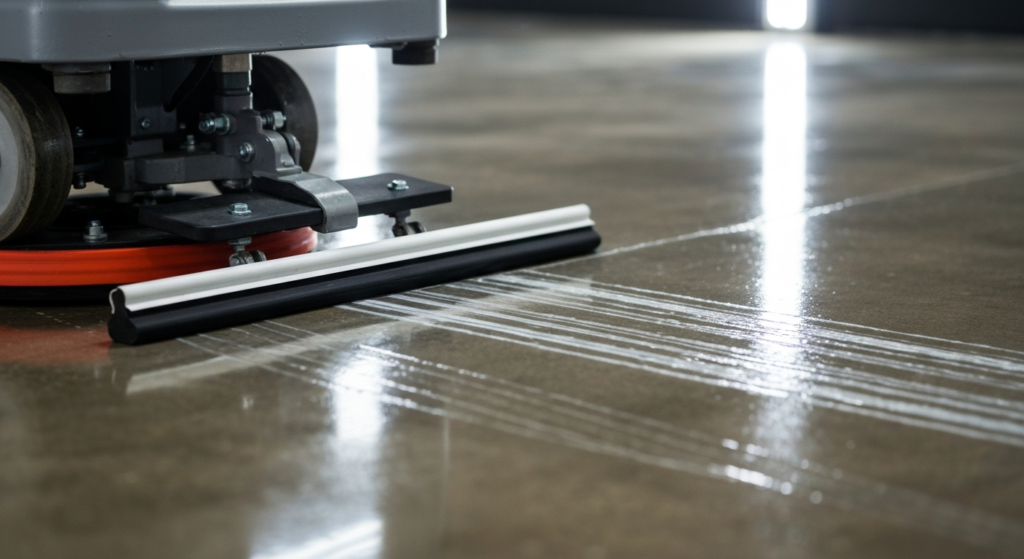
A floor scrubber leaving streaks is a different problem from a scrubber that will not pick up water at all. The machine is working. The vacuum is pulling. But you are still looking at thin lines of water, or a dull film, or dirty smears across a floor you just cleaned.
The distinction matters, because it points you somewhere specific: streaking is almost always a squeegee contact problem or a chemistry problem, not a vacuum failure. (If your machine is leaving broad areas of standing water rather than streaks, you have a different fault, see floor scrubber not picking up water instead.)
Here is how to tell which one you have.
First: What Kind of Streak Is It?
Look at the floor after a pass. The pattern tells you where to go.
- Thin lines of standing water, evenly spaced. Squeegee blade damage, nicks or cuts. Each nick leaves its own line.
- Water along one side of the pass only. The squeegee is not level. One end is contacting; the other is not.
- A continuous wet band across the full width. The blade is not contacting at all, too high, worn flat, or folded under.
- Dry floor but hazy, dull, or filmy. Not a squeegee problem. This is chemical residue.
- Dirty smears, not water. You are dragging soil around. Recovery water is being redeposited, or your pads are loaded.
Those five patterns map to five different fixes. Diagnose before you start swapping parts.
1. Nicked or Torn Squeegee Blades
This is the most common cause of evenly spaced water lines, and it is the easiest to confirm.
Pull the rear squeegee blade and run it through your fingers along its full length. You are feeling for notches. A 2mm nick from a screw head, a pallet nail, or a piece of metal swarf will leave a continuous line of water on every single pass, forever, until you fix it.
Hold the blade up to a light. Nicks that you cannot feel will show as gaps.
The fix: Rotate or flip the blade. Most rubber squeegee blades have four usable edges, two faces, two orientations. If the nicked edge is spent, present a fresh one. If all four edges are damaged, replace the blade. (Step by step: how to replace floor scrubber squeegee blades.)
One thing worth saying plainly: a nicked blade cannot be repaired. People try to trim them flush or sand them smooth. It does not work, you end up with a shorter blade that no longer reaches the floor evenly.
2. The Blade Has Worn Round
A squeegee blade wipes on a corner, not a face. That sharp 90-degree edge is what breaks the water film and directs it into the vacuum path.
Once the edge rounds over, it stops cutting the water and starts riding over it. The result is a thin uniform film left behind, not a distinct line, more like the floor never quite dried.
How to check: Pull the blade and look at it edge-on, from the end. A serviceable blade has a crisp corner. A spent one has a visible radius, often shiny and polished from wear.
Blades wear faster on abrasive floors, bare concrete, quarry tile, anything with grit. On a warehouse floor you may be flipping blades weekly. On sealed vinyl in an office, they may last for months.
3. The Squeegee Is Not Level
If water is being left along one side of the pass and not the other, the squeegee assembly is not sitting parallel to the floor.
Run the machine forward a few feet, stop, and look at the blade from behind. It should show an even curl across its full width, the same deflection at the left end as the right.
If one end is deflecting hard and the other is barely touching:
- Check the squeegee mount for a bent bracket or a loose fastener.
- Check the caster or wheel on the squeegee assembly, a flat spot or a worn wheel will drop one end.
- Check the levelling adjustment. Most machines have one; many operators have never touched it.
Bent squeegee frames are common on machines that get driven into walls and racking. If the frame is bent, no amount of blade replacement will fix the streak.
4. The Squeegee Is Adjusted Too Low
This is the counterintuitive one, and I see it constantly.
An operator sees streaking, assumes the blade is not pressing hard enough, and cranks the squeegee down. The streaking gets worse.
Here is why. Push a rubber blade too hard into the floor and it does not wipe harder, it folds under itself. Instead of dragging on its sharp edge, it curls back and rides on its flat face. A folded blade is functionally a squeegee with no edge at all.
How to spot it: Stop mid-pass and look at the blade. If it is bent back on itself rather than showing a gentle even curl, you are too low. Back the adjustment off.
Correct deflection is modest, the blade should lean back slightly under drag, not fold.
5. Blades Installed in the Wrong Position
Front and rear squeegee blades are usually not the same part.
The rear blade is typically slotted, notched, or grooved to let air pass through to the vacuum port. The front blade is usually solid, its job is to contain the water, not to pass air.
Swap them, and the machine will streak no matter how new the blades are or how perfectly they are adjusted. The rear blade cannot direct water because it has no airflow, and the front blade cannot contain it because it is perforated.
If you have just replaced blades and streaking appeared immediately afterwards, this is the first thing to check. Pull up the parts diagram for your model rather than guessing.
6. Hazy, Filmy Floor, This Is Chemistry, Not Squeegee
Before you touch the dilution, read the label and the safety data sheet. OSHA’s hazard communication standard requires your employer to hold an SDS for every hazardous chemical in the building and keep it accessible to you during your shift. That sheet carries the manufacturer’s dilution ratio, and it is the only figure that means anything. Guessing is how you end up with film.
If the floor is dry but dull, cloudy, or leaves footprints, stop looking at the squeegee. Nothing is wrong with it.
A hazy film after scrubbing means detergent residue is being left on the floor. There are three usual causes:
Over-dosing detergent. By a wide margin the most common. Doubling the dose does not double the cleaning, it leaves twice the residue. It also foams the recovery tank, which can trip the float and kill your suction as a bonus.
Wrong detergent for the floor. A high-alkaline degreaser on a sealed or finished floor will dull it and can attack the finish. Match the chemical to the surface.
Not rinsing after a heavy scrub. After a deep clean or a finish strip, a rinse pass with clean water is not optional. Skip it and the residue stays.
The diagnostic here is simple: mop a small test patch with clean water only. If the haze lifts, it is residue, and the answer is in your chemical dosing, not in a new set of blades.
7. Dirty Smears, You Are Redepositing Soil
Smears of visible dirt, rather than clean water, mean soil is going back down onto the floor.
- The pad or brush is loaded. A saturated pad stops absorbing and starts spreading. Flip it or change it. On a heavily soiled floor you may go through several in a single job.
- The solution tank is contaminated. If someone has filled the solution tank from a dirty source, or the tanks have been cross-connected, you are laying down dirty water and wiping it around.
- You are scrubbing too fast for the soil load. One slow pass beats two fast ones. A heavily soiled floor needs dwell time, the chemical has to work before the pad can lift the soil.
A Faster Way to Isolate It
Two tests, thirty seconds each:
- Is the streak wet or dry? Wet means squeegee. Dry haze means chemistry. This single question eliminates half the possibilities.
- Is it the full width or just part of it? Full width means the blade is not contacting at all, worn, folded, or too high. Partial means damage or levelling.
Answer those two, and you have narrowed seven causes to one or two.
How to Stop It Coming Back
- Wipe the squeegee blades at the end of every shift and run your fingers along the edge while you do it. You will catch nicks the day they happen instead of a week later.
- Flip and rotate blades on a schedule, not when someone finally complains about streaks. Four edges per blade is money you have already paid for.
- Measure your detergent. Do not eyeball it. Over-dosing is the single most common cause of hazy floors and foamed recovery tanks, and it costs you money in chemical on top of that.
- Check the squeegee for level once a week. Thirty seconds. It catches bent frames and worn casters before they ruin a shift.
- Keep spare blades on the shelf. A machine sitting idle because nobody stocked a $30 part is an expensive machine.
When It Is Not the Squeegee
If you have replaced the blades, confirmed they are in the correct positions, levelled the assembly, and set the deflection correctly, and it still streaks, then look upstream:
- Weak vacuum. Marginal suction will pick up most of the water and leave a thin trail. Check the recovery tank lid gasket and the tank filter, both are covered in detail in our guide to a floor scrubber not picking up water.
- A bent squeegee frame. Common on machines that have been driven into things. The blade cannot be levelled because the frame it mounts to is not straight.
- A worn squeegee mount or pivot. If the assembly has play in it, it will float and skip rather than track.
At that point it is worth a service call, but work through the list above first, because in the large majority of cases the answer is a $30 blade and a five-minute adjustment.