Floor Scrubber Solution Not Dispensing: 6 Common Causes

A floor scrubber solution not dispensing means you are dry-scrubbing, and that is worse than not scrubbing at all. The pad glazes over, the floor does not get clean, and you burn through consumables for nothing.
The good news is that the solution system is the simplest circuit on the machine. Tank, valve, line, filter, floor. Six things can go wrong, and five of them are free to fix.
Understand the Circuit First
Solution flows by one of two methods, and which one you have changes the diagnosis:
- Gravity feed. The tank sits above the deck and solution simply falls through a valve and a line onto the floor. No pump. Most walk-behinds work this way.
- Pump feed. A solution pump pushes the liquid through. Common on ride-ons and on machines with metered chemical dosing.
If you do not know which you have, listen. A solution pump makes a distinct clicking or buzzing when the flow is switched on. Silence means gravity feed, or a dead pump, which is exactly the distinction you are trying to make.
1. The Solution Valve Is Closed or Not Actuating
Start here. It is free, it takes five seconds, and it is the answer more often than anything else on this list.
Every machine has some form of flow control:
- A manual lever or knob, check it is actually open. Also check it has not been left set to minimum, which on some machines is barely a trickle.
- An electric solenoid valve, on many machines the solution only flows when the brush is running and the deck is down. If the brush is not turning, you will get no solution, and the solution is not the fault. Fix the brush first.
- A cable-operated valve, cables stretch, seize, and snap. If the lever moves but nothing happens, the cable has failed.
On machines with a solenoid, listen for a click when you engage flow. A click means the solenoid is being energised and is moving. No click means either no power reaching it, or the solenoid itself is dead.
2. The Solution Filter Is Clogged
This is the second most common cause, and it is the one people never think to check.
There is a filter or screen between the solution tank and the line. Its job is to stop debris reaching the valve and the floor jets. It clogs with:
- Detergent residue, undissolved powder, or chemical that has precipitated out of solution
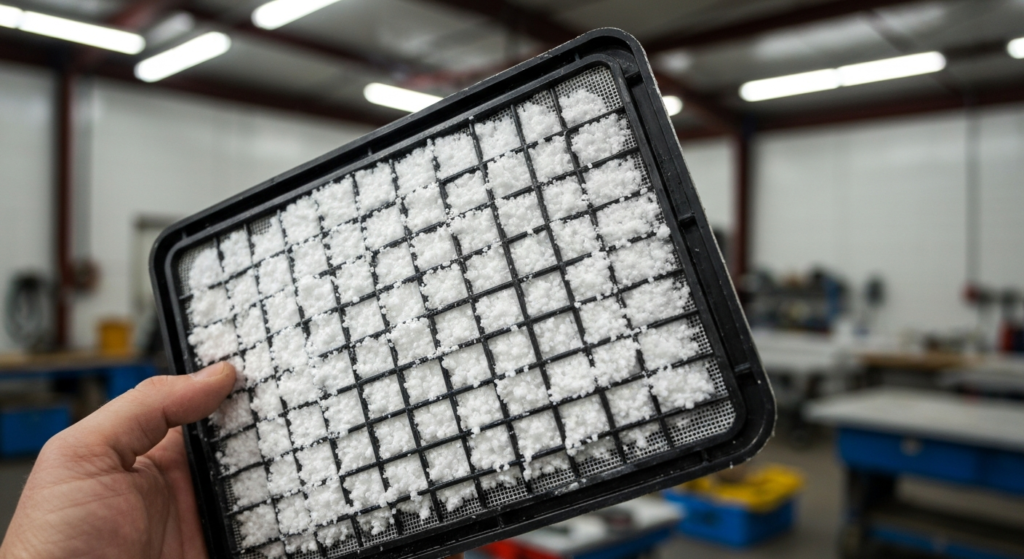
- Hard water scale, if you are on hard water, this is inevitable and progressive
- Debris from the tank, grit, lint, and anything that has been poured in with the water
The symptom is a gradual reduction in flow rather than a sudden stop, which is why it goes unnoticed. Operators compensate by opening the valve further, until one day it is fully open and still not enough.
Pull it and look at it. If it is furred with white scale or packed with residue, you have found your problem. Rinse it, or descale it if it is scaled, and put it back.
This should be part of routine maintenance, not a repair. Once a week, minimum.
3. The Solution Line Is Blocked
If the valve is open and the filter is clean but nothing reaches the floor, the line between them is blocked.
Same causes as the filter, scale, precipitated chemical, debris, but now it is inside the tube where you cannot see it.
How to check: Disconnect the line at the deck end and open the valve. If solution comes out of the disconnected line, the blockage is downstream in the distribution manifold or the jets. If nothing comes out, the blockage is in the line or upstream of it.
This one test splits the problem in half in about thirty seconds.
A blocked line can often be cleared by flushing with clean water, or with a descaler if the blockage is scale. Compressed air works, but be sensible about pressure, you can burst a line.
4. The Distribution Jets Are Blocked
Solution reaches the deck and then has to be distributed evenly across the brush. Small holes or jets do this. Small holes block.
The tell here is distinctive: solution is reaching the floor, but unevenly. One side of the brush is wet and the other is dry. Or you get solution in the middle and nothing at the edges.
Blocked jets are almost always scale or chemical residue. Clear them with a piece of wire or a pin, carefully, because you can enlarge the hole and end up with a jet that flows too much.
If you are getting repeated jet blockages, look at your water and your chemical. Hard water plus a chemical that precipitates is a combination that will keep doing this to you.
5. The Solution Tank Is Empty (Or Not Where You Think It Is)
Two versions of this, and the second one catches people out.
The obvious version: the tank is empty. Check it. It happens more than anyone admits, particularly on machines where the solution and recovery tanks look similar.
The less obvious version: someone has filled the recovery tank instead of the solution tank. Now the solution tank is empty, the recovery tank is full of clean water, and the float has risen and killed your vacuum as well. Two faults, one mistake.
If you have both no solution and no suction at the same time, check this before anything else. It is a five-second fix and a very common one on machines shared between shifts.
6. The Solution Pump Has Failed
Only applies to pump-fed machines. Last, because it is the least likely and the only one that costs real money.
Signs of a failed pump:
- No sound at all when flow is engaged. A working pump is audible, clicking, buzzing, or humming. Silence means no power reaching it, or a dead pump.
- The pump runs but nothing comes out. It has lost its prime, or the diaphragm has failed. Diaphragm pumps do fail, it is the wear part.
- The pump is running dry. Running a solution pump with an empty tank is how you kill it. Do not do it, and do not let anyone else do it.
Before condemning the pump, check that it is actually getting power. A pump on a machine that also has a solenoid valve may share a circuit with it, and a blown fuse or a failed interlock will silence both.
A Fast Diagnostic Order
Work down this list. Each step eliminates a chunk of the possible causes:
- Is there solution in the solution tank? (And is it the solution tank, not the recovery tank?)
- Is the valve open, and does the solenoid click? No click means an electrical fault, not a plumbing one.
- Is the brush running? On many machines, no brush means no solution by design. Fix the brush first, see floor scrubber brush not spinning.
- Pull the solution filter. Scaled or packed with residue? That is your answer.
- Disconnect the line at the deck and open the valve. Flow means the blockage is downstream in the jets. No flow means it is upstream.
- Uneven flow across the brush? Blocked jets.
Five of those six cost nothing and need no tools.
Why This Keeps Happening
Almost all of it comes back to dosing. The correct ratio is on the product label and on its safety data sheet, which OSHA’s hazard communication standard requires your employer to keep accessible to you on every shift. Nobody reads it, everyone eyeballs the pour, and the residue that results is what blocks the filters and jets you have just spent an hour clearing.
If you are clearing scale out of the solution system regularly, the underlying problem is not the machine. It is water and chemistry:
- Hard water. Scale is calcium and magnesium precipitating out. It will keep happening, in the filter, the line, and the jets, indefinitely. Descaling on a schedule is the only realistic answer unless you are prepared to treat the water.
- Over-dosing detergent. Chemical that cannot fully dissolve precipitates out and blocks things. It also foams the recovery tank and trips the float, which will kill your suction. Over-dosing is the most expensive habit in commercial cleaning, it wastes chemical, blocks your solution system, and disables your vacuum, all at once.
- Powdered detergent that has not fully dissolved. Mix it properly, in warm water, before it goes in the tank. Undissolved powder goes straight to the filter.
Prevention
- Flush the solution system with clean water at the end of every shift. Run clean water through until it comes out clear. This single habit prevents most of what is on this page.
- Rinse the solution filter weekly. Descale it if you are on hard water.
- Never leave chemical sitting in the tank overnight. It precipitates, it settles, and it corrodes.
- Measure your chemical. Do not eyeball it.
- Never run a solution pump dry.
Related Faults
If solution is reaching the floor but the machine is not picking it back up, that is the vacuum path rather than the solution system, see floor scrubber not picking up water. If it is picking up but leaving a hazy film, over-dosed chemical is the usual culprit, covered in floor scrubber leaving streaks.