Floor Scrubber Brush Not Spinning: Diagnosis and Repair

A floor scrubber brush not spinning is a more serious fault than most squeegee problems, because it can be anything from a two-second reset to a dead motor. But there is a logical order to work through, and most of it costs nothing to check.
Before you start pulling panels, be clear about what the machine is actually doing. There is a difference between a brush that will not turn at all, a brush that turns and then stops, and a brush that turns but does no work.
What Exactly Is It Doing?
Three distinct symptoms, three different diagnostic paths:
- Brush does not turn at all, no sound from the motor. Electrical, no power reaching the motor. Start at Section 1.
- Motor hums or you hear it working, but the brush does not turn. Mechanical, the drive is disconnected, or something is jammed. Start at Section 4.
- Brush turns freely but does not clean. Not a fault at all, the deck is not lowering, brush pressure is not being applied, or the pad is finished. Start at Section 6.
Getting this right saves you an hour. A motor that hums is not an electrical problem, and chasing fuses will get you nowhere.
1. Safety Interlocks and Operator Presence
Start here, because it is the answer more often than anyone likes to admit.
Commercial scrubbers are covered in interlocks designed to stop the brush turning when it should not. Any of them will silently disable the brush motor:
- Operator presence bar or handle switch. On walk-behinds, the brush will not run unless the presence bar is squeezed. These switches wear out, and when they fail they fail off.
- Seat switch. On ride-ons, no weight in the seat means no brush. A failed seat switch is common.
- Deck must be lowered. Many machines will not spin the brush in the raised transport position. Sounds obvious. Gets missed daily.
- Recovery tank must be seated. Some machines interlock on the tank being properly in place.
- Emergency stop. Check it has not been left latched down.
Work through every interlock on your machine before you touch anything electrical. If the brush suddenly starts working when someone sits properly in the seat, you have your answer, and it is a seat switch, not a motor.
2. Battery Charge
Low battery voltage is the second most common cause, and it produces a confusing symptom.
The machine will often still drive, still lay water, and still run the vacuum, because those draw less current. The brush motor is typically the largest load on the machine, and it is the first thing to drop out when voltage sags.
So an operator reports “everything works except the brush,” and it looks like a brush motor fault. It is a battery fault.
Check: The state-of-charge indicator, and if you can, the actual voltage under load. A battery pack that reads fine at rest can collapse the moment the brush motor tries to draw current.
Old batteries do this. A pack near the end of its life will show a healthy resting voltage and then sag hard under load. If your machine has been progressively losing run time before this happened, the batteries are the first suspect, and the full diagnosis is in floor scrubber battery not charging.
3. Circuit Breaker, Fuse, or Overload
Most machines protect the brush motor circuit with a resettable breaker or a fuse.
A tripped breaker means the motor drew more current than it should have. That matters, resetting it is fine, but you need to know why it tripped:
- Something jammed the brush. String, wire, plastic banding wrapped around the brush hub. The motor stalled, current spiked, breaker tripped. This is the good outcome, the breaker did its job.
- Brush pressure set far too high. Overloads the motor continuously.
- The motor is failing. A motor with a shorted winding or seized bearings will draw excess current and trip the breaker repeatedly.
Reset it once and see what happens. If it holds, find and remove whatever caused the overload. If it trips again immediately, stop resetting it, you have a real fault, and repeatedly resetting a breaker into a short is how you turn a repairable motor into a fire.
4. Something Is Jammed in the Brush
If the motor hums but nothing turns, this is where to look.
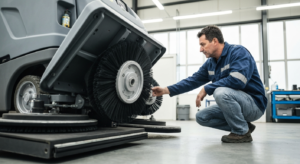
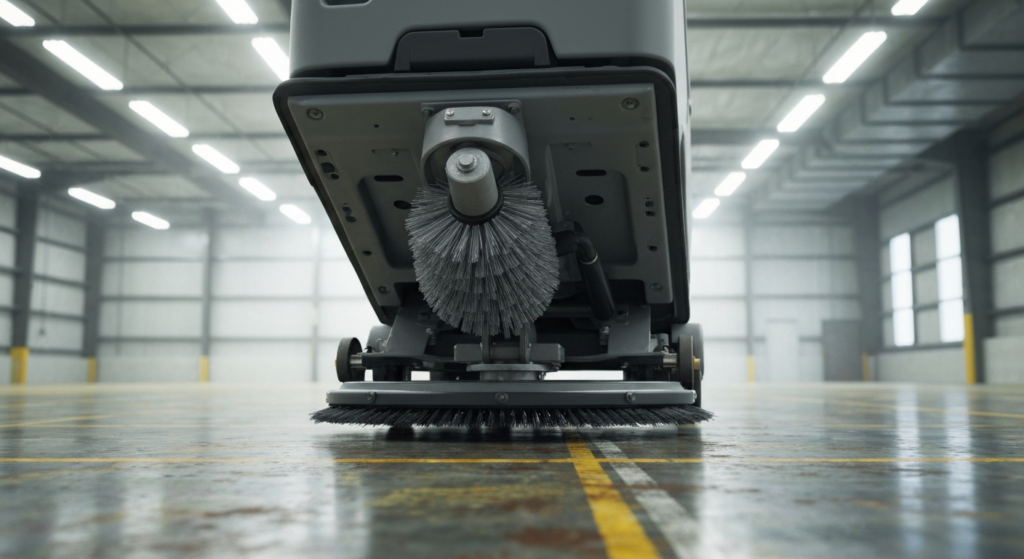
Power the machine off and remove the key. Then raise the deck and get underneath.
Look for anything wrapped around the brush hub or the drive shaft:
- String, twine, and mop strands, by far the most common
- Plastic strapping and shrink wrap, especially in warehouses
- Wire, cable ties, and banding
- Long hair, in healthcare and hospitality settings
This material winds tighter with every rotation until the brush physically cannot turn. Cut it away, do not try to pull it, or you will damage the seal it has usually worked its way into.
While you are there, spin the brush by hand. It should turn freely with light resistance. If it feels tight, notchy, or grinds, the bearing is going.
5. The Drive Coupling or Belt
Motor runs, nothing jammed, brush still does not turn. The drive between the motor and the brush has failed.
How it fails depends on the machine:
- Belt-driven decks: the belt has broken, slipped off, or glazed and is now slipping. A slipping belt often squeals and smells hot.
- Direct-drive decks: the coupling or drive lug that engages the brush has sheared or worn round. On many machines this is deliberately a soft part, it is designed to fail before the motor does. Which is good design, and cheap to replace.
- Gearbox: a gearbox that has run dry or been overloaded can strip. This is the expensive outcome.
Quick check: With the machine off, try to turn the brush by hand. If it spins with no resistance at all, freely, like it is not connected to anything, the drive has disconnected. A brush connected to a healthy motor will resist being turned by hand.
6. Brush Turns But Does Not Clean
This is not a brush motor fault. Something else is wrong.
The deck is not lowering fully. If the actuator, cable, or linkage that lowers the scrub deck is failing, the brush spins in the air or barely kisses the floor. Watch the deck as you lower it and confirm it is actually coming down and taking weight.
Brush pressure is set too low. Many machines have adjustable down-pressure. Set to minimum, the brush will turn beautifully and clean nothing.
The brush or pad is worn out. Bristles wear down and go soft; pads load up and glaze over. A glazed pad is smooth and shiny and does no cutting at all. Look at it, if it is polished rather than open and textured, it is finished.
You are using the wrong pad. A white polishing pad will not remove ground-in soil no matter how long you run it over the floor. Match the pad to the job.
No solution reaching the floor. If the solution flow has failed, you are dry-scrubbing, which cleans poorly and wrecks the pad. Check the tank is full, the flow control is open, and the solution lines and filter are not clogged, see floor scrubber solution not dispensing for the full diagnosis.
7. The Brush Motor Itself
Last, because it is the least likely and the most expensive.
Signs of an actual motor failure:
- It trips the breaker repeatedly with no jam and correct brush pressure.
- Worn carbon brushes. On brushed motors these are consumables. Symptoms are intermittent running, weak running, or the motor cutting out under load. Replacing brushes costs a fraction of a new motor and is a routine service item, worth checking before condemning anything.
- Seized or failing bearings. Grinding, rumbling, or a motor that is hot to the touch after a short run.
- Burnt smell. A distinctive acrid electrical smell means a winding has cooked. That motor is finished.
- No continuity through the motor windings when tested, but this requires a meter and the knowledge to use it safely.
A Word on Safety
“Power off, key out” has a formal name in a workplace: lockout/tagout. OSHA’s control of hazardous energy standard (29 CFR 1910.147) covers exactly this situation, servicing a machine where an unexpected start-up could injure you. It requires the energy source to be isolated and locked before anyone puts a hand into the machine, not merely switched off.
For a scrubber, that means the key comes out and stays in your pocket. It does not sit in the ignition where a passing colleague can turn it.
I will be direct here, because this is where people get hurt.
Battery-powered scrubbers carry serious current. A 36V pack can deliver hundreds of amps into a short circuit. That is enough to vaporise a spanner, throw molten metal, and cause severe burns. Battery banks also produce hydrogen while charging, which is explosive.
Everything in sections 1 through 6 above is safe for an operator to do, provided the machine is off and the key is out.
Do not open the electrical enclosure, test live circuits, or work on the motor wiring unless you are trained and equipped to do it. This is not a liability disclaimer, it is a genuine hazard, and it is not worth an injury to save a service call.
Working Order, Summarised
- Interlocks, presence bar, seat switch, deck position, tank seated, e-stop. Free, thirty seconds, and frequently the answer.
- Battery charge, especially if everything else on the machine works.
- Breaker or fuse, reset once. If it trips again, stop and find out why.
- Jam, power off, look under the deck, cut away anything wrapped around the hub.
- Drive, if the motor runs and the brush spins freely by hand, the drive has failed.
- Deck and pad, if the brush turns but does not clean, the fault is deck height, pressure, pad, or solution.
- Motor, last, and usually a technician’s job.
The first four cost nothing and resolve the large majority of cases. Work through them before you call anyone.
Related Faults
If your brush is spinning correctly but the machine is leaving water behind, that is a vacuum path problem rather than a scrub deck problem, see floor scrubber not picking up water. If it is picking up most of the water but leaving lines or a film, see floor scrubber leaving streaks.