Floor Scrubber Battery Not Charging: What to Check First

A floor scrubber battery not charging is the fault that costs the most money to get wrong. A replacement battery pack runs from around $800 for a small walk-behind to over $2,500 for a ride-on. People replace packs that were never dead.
Before you spend that, work out what is actually failing. There are only four things it can be: the supply, the charger, the connections, or the batteries. In that order, because that is the order of increasing cost.
First, What Is the Charger Telling You?
Every charger has some form of status indication, and it is the cheapest diagnostic you have.
- No lights at all. The charger is not getting mains power, or the charger itself is dead. Not a battery problem yet.
- Charging light on, but the pack never reaches full. The charger is working. The batteries are not accepting charge. This is where it starts to look like a real battery fault.
- Charger goes straight to “complete” in minutes. This is not good news. The charger has detected a voltage it interprets as full, or it has detected a fault and given up. A pack that charges in ten minutes has not charged.
- Fault or error light. Get the manual and look up the code. Chargers distinguish between “battery voltage too low to start”, “battery not connected”, and “charge timeout”, and those mean completely different things.
That single observation eliminates half the possibilities before you have picked up a tool.
1. Mains Supply and the Charger Itself
Start here because it costs nothing and it is embarrassingly often the answer.
- Is the socket live? Plug something else into it. Cleaning cupboards and charging bays are frequently on circuits that get switched off, or on RCDs that have tripped.
- Is the charger’s own fuse or breaker intact?
- Is the charging lead damaged? These get run over, trapped in doors, and yanked out by the cable. Look at the full length of it.
- Is the charger plugged into the machine properly? Charging connectors are usually a heavy-duty two-pin type, and they need to be fully seated. Half-in looks connected and is not.
If the charger shows no sign of life on a socket you have proven is live, the charger is dead. That is a few hundred dollars, not a few thousand.
2. The Connections
This is the one people skip, and it is the one that most often turns a working pack into an apparently dead one.
Power off. Key out. Then look at the battery terminals.
What you are looking for:
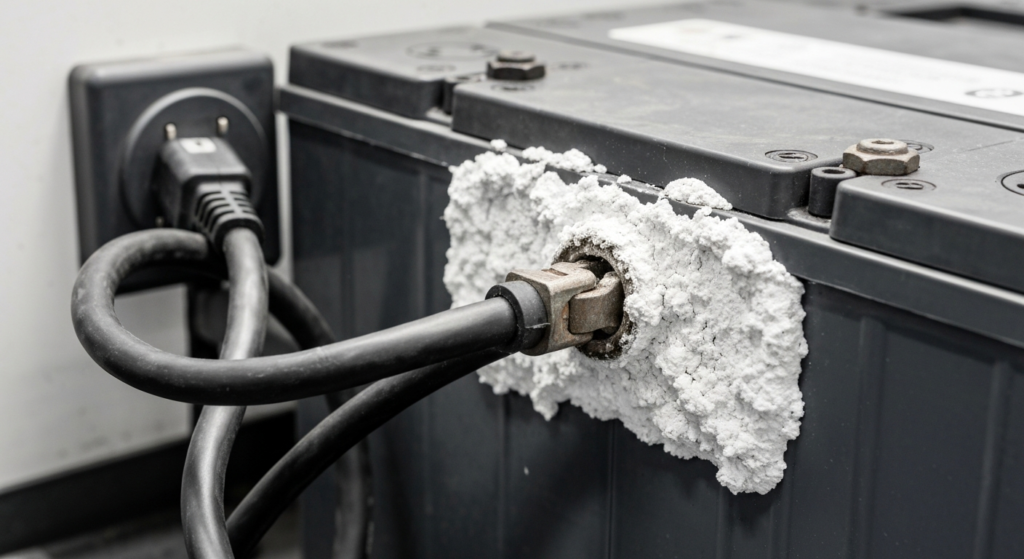
- Corrosion. White or blue-green crusty deposit on the terminals. This is an insulator. Enough of it, and current cannot flow, and the charger sees an open circuit.
- Loose terminals. Vibration works them loose over months. A loose terminal has high resistance, gets hot, and can weld itself into a mess.
- Damaged or burnt links. The straps between individual batteries carry the full pack current. If one is damaged, the pack is broken in the middle.
- A disconnected or blown main fuse. Most packs have one. It is usually large, obvious, and inline near the positive terminal.
Clean corroded terminals, tighten what is loose, and try again before you conclude anything about the batteries.
Safety: Read This Before You Touch the Pack
I am going to be blunt, because this is the section that matters.
A 36V battery pack can deliver several hundred amps into a short circuit. That is enough to vaporise the metal of a spanner, throw molten metal, and cause severe burns. A dropped tool across two terminals is a genuinely dangerous event, not a spark.
Lead-acid batteries produce hydrogen while charging. Hydrogen is explosive. Charge in a ventilated area. Do not create sparks near a charging pack.
The electrolyte is sulphuric acid. It will burn skin and blind you.
This is not caution for the sake of it. These hazards are regulated. OSHA’s general industry standard on powered industrial trucks, section (g), sets out the requirements for battery charging areas: adequate ventilation for the gases, facilities to flush and neutralise spilled electrolyte, fire protection, and no ignition sources. The construction standard on batteries and battery charging goes further, requiring eye and body drenching facilities within 25 feet of battery handling areas, and face shields, aprons, and rubber gloves for anyone handling acid.
If your site charges scrubbers in a cupboard with no ventilation and no eyewash, that is not just unsafe. It is very likely non-compliant.
So:
- Remove rings, watches, and metal bracelets before working near a pack.
- Use insulated tools if you have them.
- Wear eye protection.
- Never rest a tool on top of a battery.
- If you are not confident, stop. A service call costs less than a hospital visit.
Everything in sections 1 and 2 above is safe to do with the machine off. Beyond that, if you are not trained, get someone who is.
3. Water Level (Flooded Lead-Acid Only)
If your machine has flooded lead-acid batteries with removable caps, low electrolyte will stop them charging properly and will destroy them permanently.
The plates must be covered. If the tops of the plates are exposed to air, that part of the plate is being damaged every time you charge, and the damage is not reversible.
The rules that people get wrong:
- Top up with distilled water only. Tap water contains minerals that will poison the plates. This is not a fussy preference, it genuinely ruins batteries.
- Top up after charging, not before. The electrolyte level rises during charge. Fill to the correct level before charging and it will overflow, which loses acid and makes a corrosive mess.
- Do not overfill. To the indicator, not to the brim.
- Never add acid. Only water evaporates. Adding acid changes the concentration and wrecks the battery.
If you have sealed or AGM batteries, there is nothing to check here and no caps to open. Do not try.
4. The Batteries Themselves
Last, and only after the above.
Signs the pack is genuinely finished:
- Progressively shorter run time over months. This is the normal, expected end of life. If the machine used to run four hours and now runs ninety minutes, the pack is worn out and no amount of charging will fix it.
- The charger completes in a fraction of the normal time. The pack cannot hold charge.
- One battery reads significantly lower than the rest. In a series pack, one bad battery drags the whole pack down. The charger sees the pack voltage and behaves accordingly.
- Visible swelling or a distorted case. That battery is finished and is a hazard. Stop.
- A rotten-egg smell. Hydrogen sulphide. The battery is being overcharged or is failing internally. Ventilate and stop charging.
The Thing Nobody Tells You About Replacing Batteries
If one battery in the pack has failed, replace the whole pack, not the one battery.
This feels wasteful and expensive, and people fight it constantly. Here is why it is correct:
Batteries in a series pack are only as good as the weakest one. A new battery next to five worn ones will be dragged down to their level and will age at their rate. Within months you have spent money on a new battery that now performs like an old one, and you still have the same problem.
The one exception is a pack that is nearly new and where one battery has failed early for an identifiable reason (a manufacturing fault, or physical damage). In that narrow case, matching a single replacement can work. Outside it, you are throwing money away.
Why Batteries Die Early
Most commercial scrubber packs should last three to five years. If yours are not making it, the cause is almost always one of these:
- Partial charging. Plugging in for an hour between shifts, over and over, without ever completing a full charge cycle. This is the single most destructive habit, and it is extremely common in multi-shift operations. Lead-acid batteries need to reach full charge regularly or they sulphate.
- Leaving the pack flat. A discharged lead-acid battery left sitting will sulphate, and sulphation is largely irreversible. Charge it the same day.
- Deep discharging. Running the machine until it dies, every time. Most manufacturers specify not going below about 20 percent remaining. Every deep discharge takes cycles off the pack.
- Never checking water level. On flooded batteries this destroys the pack, quietly, over months.
- Charging in a hot room. Heat accelerates every degradation mechanism in a lead-acid battery.
None of that is a machine fault. All of it is a procedure problem, and all of it is fixable for free.
What Order To Work In
- What does the charger say? No lights, charging but never completing, or instant completion. Three different problems.
- Is the socket live and the lead undamaged? Free.
- Is the charge connector fully seated? Free.
- Are the terminals clean, tight, and the main fuse intact? Free, and frequently the answer.
- On flooded batteries, are the plates covered? A bottle of distilled water.
- Has run time been declining for months? Then the pack is worn out, and no diagnosis will change that.
Four of those six cost nothing. Work through them before anyone quotes you for a pack.
Related Faults
A weak battery pack often shows up as something else first. The brush motor is usually the largest load on the machine, so it is the first thing to drop out when pack voltage sags under load. If your brush has stopped turning but everything else still works, the batteries are a prime suspect, and that is covered in floor scrubber brush not spinning. If the machine is running but leaving water behind, that is the vacuum path rather than the electrical system, and it is covered in floor scrubber not picking up water.