Floor Scrubber Not Picking Up Water: 7 Causes and Fixes

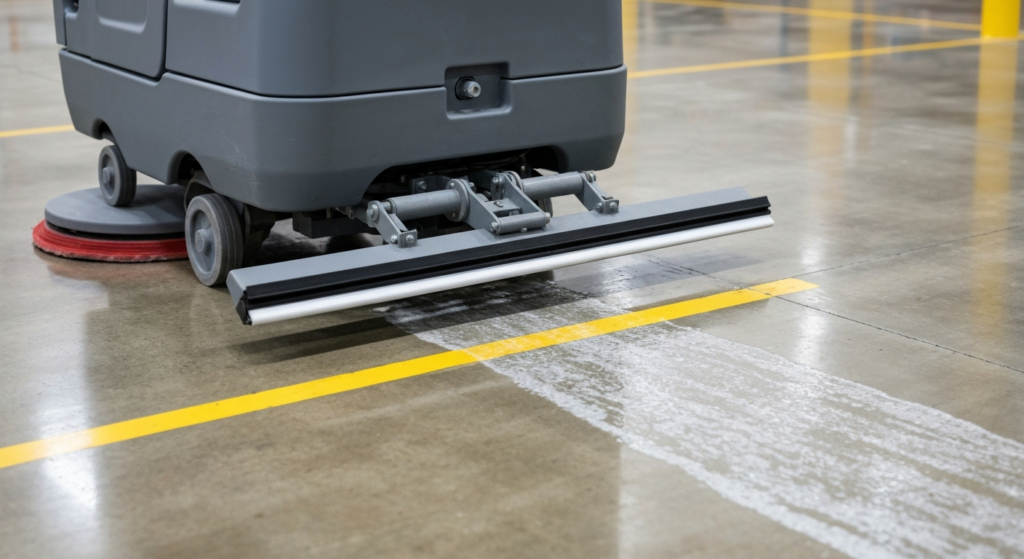
A floor scrubber not picking up water is the single most common service call I get. The good news: in the large majority of cases it is not the vacuum motor, and it is not expensive. It is an air leak in the vacuum path, and you can usually find it in under ten minutes with no tools.
Work through these seven causes in order. They are sequenced by how often each turns out to be the culprit, not by how hard they are to check.
First, Understand What You Are Looking For
The recovery system is a sealed vacuum circuit. The vacuum motor pulls air through the squeegee, up the vacuum hose, into the recovery tank, and out through the filter. Water gets dragged along with that airflow.
Break the seal anywhere in that chain, and the vacuum takes the path of least resistance, pulling air through the leak instead of through the squeegee. The motor still runs. It still sounds fine. But it is no longer pulling water off the floor.
So the question is almost never “is the motor dead.” It is “where is the air getting in.”
1. The Recovery Tank Lid Is Not Sealing
This is the number one cause, and it is the one people skip because it seems too obvious.
Check three things:
- Is the lid fully seated? On many machines the lid will sit down and look closed while one corner is proud of the gasket by 2 to 3 millimetres. That is enough to kill suction.
- Is the gasket intact? Run a finger around the full perimeter. Look for cracks, flat spots, or sections that have gone hard. A gasket that has taken a permanent compression set will not seal even when the lid is latched.
- Is there debris on the sealing surface? A single strand of mop fibre or a piece of grit across the gasket line will hold the lid open just enough to destroy the vacuum.
Quick test: With the vacuum motor running, press down firmly on the lid with the heel of your hand. If suction suddenly improves, you have found your problem.
2. The Squeegee Blades Are Worn, Nicked, or Installed Backwards
The squeegee is what actually seals against the floor. If it cannot hold that seal, nothing downstream matters.
Worn edge. A squeegee blade wipes on one edge at a time. Once that edge rounds over, it stops making a clean line of contact. Pull the blade and look at it edge-on, you want a sharp corner, not a radius. Most rubber blades have four usable edges: you can flip and rotate them three times before replacement is genuinely necessary.
Nicks and tears. A single nick from a screw head or a pallet nail creates a permanent gap. Even a 2mm notch will leave a continuous stripe of water behind on every pass.
Wrong orientation. Front and rear blades are frequently not interchangeable, the rear blade is often slotted or notched to allow airflow while the front is solid. Install them backwards and the machine will refuse to pick up properly no matter what else you fix. Check the parts diagram if you are not certain.
3. The Squeegee Is Out of Adjustment
Even a perfect blade will not seal if it is not meeting the floor correctly.
- Too high: obvious, it never makes proper contact.
- Too low: less obvious, and more common. Press the blade too hard into the floor and it folds under itself instead of wiping. It curls, rides on its back face, and leaves water behind.
- Not level: if one side sits lower than the other, one end wipes and the other does not. The classic symptom is water left in a stripe along one side of the pass.
Run the machine forward a few feet, stop, and look at the blade from behind. It should be deflecting evenly across its full width, a consistent, gentle curl, the same at both ends.
4. The Recovery Tank Is Full or the Float Is Stuck
Almost every machine has a float shutoff that closes the vacuum port when the tank fills. This protects the vacuum motor from ingesting water. It also means the machine stops picking up.
Two failure modes here:
- The tank actually is full and you did not notice. Drain it.
- The float is stuck closed. Foam is the usual culprit, if you are running too much detergent, or the wrong detergent, it will foam up in the recovery tank and lift the float long before the tank is genuinely full. The tank looks half empty; the float is up; suction is dead.
If you are getting persistent foam, you are almost certainly over-dosing chemical. That is worth fixing on its own, it is costing you money in detergent and killing your pickup at the same time.
The correct dilution is on the product’s safety data sheet, which under OSHA’s hazard communication standard your employer must keep accessible to you during your shift. Read it rather than guessing. A defoamer in the recovery tank will suppress the symptom, but it does not fix the cause, and you are still paying for chemical you are not using.
5. Something Is Blocking the Vacuum Hose or Squeegee Throat
Debris gets sucked in and lodges at the first restriction, usually the squeegee throat where it necks down into the hose, or a bend in the hose itself.
Pull the hose at both ends and look through it with a shop light at the far end. On the squeegee, check where the hose connects, this is a common collection point for hair, string, plastic wrap, and shrink film.
While you have the hose off, check the hose itself for splits. Vacuum hose gets dragged, crushed under the machine, and flexed thousands of times over its life. A crack on the underside will not be visible until you rotate it.
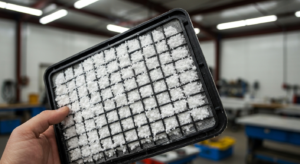
6. The Recovery Tank Filter or Float Screen Is Clogged
Between the recovery tank and the vacuum motor there is a filter or screen. Its job is to stop water and debris reaching the motor.
When it clogs with lint, hair, and detergent residue, airflow drops. Suction goes with it, and the drop is gradual, so you may not notice until pickup is genuinely poor.
This is the most commonly neglected item on the entire machine. It should be pulled and rinsed at the end of every shift. If yours has not been cleaned in weeks, pull it now, there is a good chance you have just found your answer.
7. The Vacuum Motor Itself
Last on the list, because it is last in the statistics.
Signs the motor is genuinely failing:
- The sound has changed. A healthy vacuum motor has a high, steady whine. A dying one screams, grinds, or drops in pitch. The specific sound narrows it down further, and that is covered in floor scrubber making loud noise.
- The carbon brushes are worn out. On brushed motors these are consumable parts, and they do wear out. If the motor cuts in and out, or runs weakly, brushes are a likely cause, and replacing them costs a fraction of a new motor.
- It has ingested water. If the float failed and the motor took water in, it may be finished. This is exactly why the float exists.
Before you condemn the motor: disconnect the vacuum hose from the squeegee and put your hand over the open hose end with the motor running. If you feel strong suction there, the motor is fine, and your problem is downstream in the squeegee or the seals. That single test will save you the cost of a motor you did not need.
A Faster Way to Narrow It Down
Work backwards from the motor, not forwards from the floor:
- Motor running, hand over the open vacuum hose. Strong suction? The motor and tank seal are fine, your problem is the squeegee.
- Weak suction at the open hose? The problem is the tank lid, the tank filter, the float, or the motor. Check them in that order.
Two minutes, and you have halved the search.
A Related Problem: Streaking
Everything above assumes the machine is leaving broad areas of standing water behind. If instead it is picking up most of the water but leaving thin lines, a hazy film, or dirty smears, that is a different fault with a different cause, see floor scrubber leaving streaks for that diagnosis.
How to Stop It Happening Again
Most of what I have described above is a maintenance failure that started weeks earlier:
- Rinse the recovery tank and filter at the end of every shift. Not weekly. Every shift.
- Wipe the squeegee blades daily and check for nicks while you are there.
- Rotate and flip blades before they are destroyed, not after. You get four edges from a blade if you actually use them.
- Leave the recovery tank lid open overnight. A sealed wet tank grows biofilm, stinks, and destroys the gasket. Open it and let it dry.
- Dose detergent correctly. Over-dosing foams the recovery tank, trips the float, and wastes chemical.
A scrubber that gets five minutes of attention at the end of each shift will not develop most of these problems in the first place.
When to Call a Technician
Call for service if:
- You have strong suction at the open hose end but the squeegee still will not pick up after a full blade replacement and adjustment, something structural is wrong with the squeegee assembly or its mounting.
- The vacuum motor has taken on water.
- The motor sounds mechanically wrong, grinding, screaming, or bearing noise.
- Anything requires opening the electrical enclosure and you are not qualified to work on it. Battery-powered scrubbers carry enough current to seriously injure you.
Everything else on this list is genuinely a ten-minute job with no special tools, and it is worth working through it yourself before you book a service call.