Pressure Washer Losing Pressure: Causes and Fixes, in the Order to Check Them

Some links in this guide are affiliate links. If you buy through them we may earn a commission, at no extra cost to you. This never affects what we recommend or how we rank equipment. Read our disclosure.
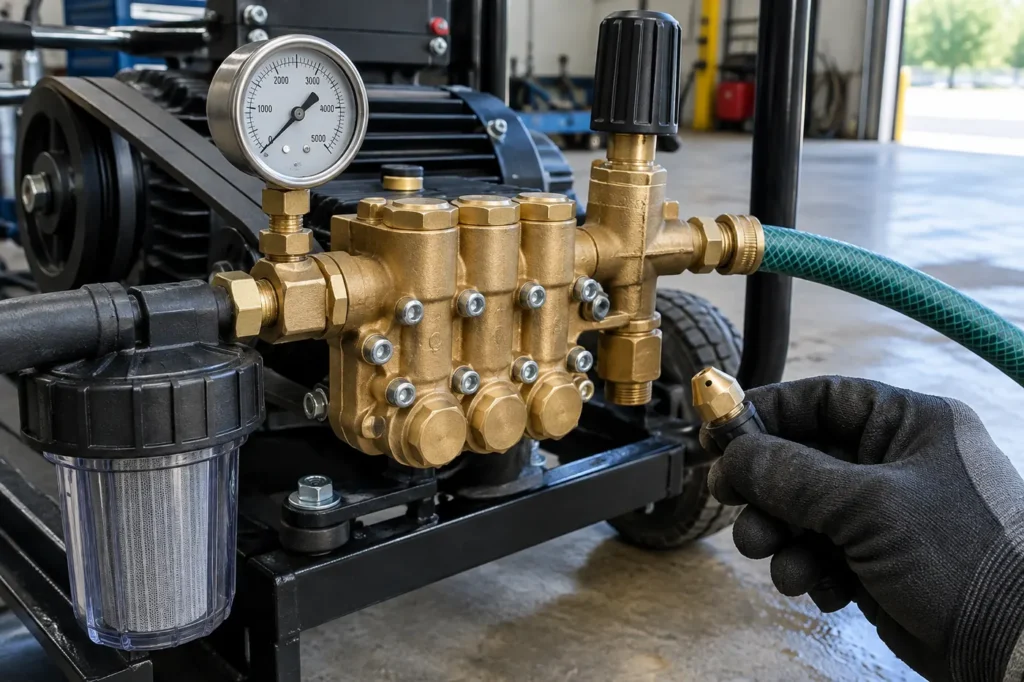
When a pressure washer is losing pressure, the cause is usually something cheap and outside the pump: a worn or wrong nozzle, a water supply that cannot keep up, a clogged inlet filter, or an air leak on the inlet side. Check those first. The unloader valve, the pump valves and the pump seals come next, in that order. Most low-pressure problems never need a new pump.
Check the cheap causes first: the nozzle (worn, clogged or a low-pressure soap tip), the water supply (it must deliver more GPM than the pump), the inlet filter and any air leak on the inlet hose. Then check engine speed or belt slip, the unloader valve, the pump’s check valves, and finally the pump seals. A new nozzle and a clean inlet filter fix a large share of cases.
Why do I keep losing pressure on my pressure washer?
A pump does not make pressure on its own. It makes flow, and the nozzle turns that flow into pressure by squeezing it through a small hole. Cat Pumps puts it plainly in its troubleshooting guide: “A pump generates flow, not pressure.” So anything that cuts the flow reaching the nozzle, or makes the hole bigger, shows up as lost pressure.
That gives you three places to look:
- Before the pump: not enough water coming in, a blocked filter, or air getting in.
- The pump and unloader: water slipping back to the low-pressure side instead of going to the gun.
- After the pump: a worn or wrong nozzle, or a leak in the hose, gun or wand.
Causes of low pressure, from most to least likely
| Cause | What you notice | Quick check | Typical fix |
|---|---|---|---|
| Wrong nozzle on the wand | Weak, wide spray from the start | Look at the tip color; black is usually the low-pressure soap tip | Fit the right high-pressure tip |
| Worn nozzle | Pressure has dropped slowly over weeks | Swap in a new tip of the same size and compare | Replace the nozzle (cheap) |
| Clogged nozzle | Spray pattern uneven or spitting, pressure may spike | Look through the orifice | Clean with a nozzle wire tool |
| Water supply too small | Strong for a few seconds, then drops | Bucket test (below) | Bigger supply hose, better source, or a buffer tank |
| Clogged inlet filter | Gradual loss, worse with dirty water | Remove and look at the screen | Clean or replace the filter |
| Air leak on the inlet | Pulsing, rough running | Check fittings, washers and the supply hose | Tighten, re-tape or replace |
| Engine not at full speed or slipping belt | Pressure low under load | Throttle position, belt tension | Throttle to fast, tighten or replace belt |
| Unloader valve stuck or worn | Low pressure even with a good nozzle and supply | Water bypassing while spraying | Clean, rebuild or replace the unloader |
| Debris in pump check valves | Pulsing that will not go away | Remove and inspect the valves | Clean or replace valves |
| Worn pump seals | Water dripping under the pump, steady loss | Look under the manifold | Replace seals (packings) |
Two cheap parts that solve most cases
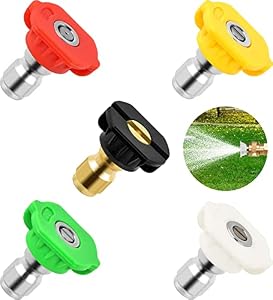
Pressure washer nozzle tip set (0, 15, 25, 40, soap)
1/4 inch quick connect set sized for 4 GPM machines. Match the orifice size to your pump before you buy.
Check price on Amazon
Pressure washer gauge kit, 0 to 5,000 PSI
Glycerin-filled gauge with 3/8 inch quick connects, for reading pressure at the pump.
Check price on AmazonAs an Amazon Associate we earn from qualifying purchases. Prices and availability change, so check the current price on Amazon.
How to fix a pressure washer with low pressure
Work through these in order. Each step either finds the problem or rules out a whole section of the machine.
1. Check the nozzle first
Make sure the tip on the wand is a high-pressure tip, not the black soap tip, which is made to drop pressure so detergent can be drawn in. If the right tip is fitted, look through the orifice for debris and clear it with the wire tool from your maintenance kit, with the engine off.
Nozzles also wear. As the hole gets bigger, pressure drops a little every week until the machine feels “tired”. The fastest test on any machine is to fit a brand-new tip of the same size. If pressure comes back, you are done. Commercial crews replace tips on a schedule for this reason.
2. Test the water supply
The pump can only push out what comes in. If the supply cannot keep up, the machine sprays hard for a few seconds on the water already in the hose, then drops. Briggs & Stratton lists inadequate supply pressure or flow as a cause and gives 20 PSI and 4 GPM as the minimum supply for its standard models. Commercial machines that pump 4 to 8 GPM need more.
A simple bucket test tells you what you have: time how long the tap takes to fill a 5-gallon bucket. Divide 5 by the minutes. A tap that fills it in one minute gives about 5 GPM. If that number is not comfortably above your pump’s rated GPM, fix the supply before you touch the pump. Use a wider, shorter supply hose, open the valve fully, or run from a buffer tank.
Also check the supply temperature. Briggs says supply water over 100°F causes low pressure on its units. On a hot water machine the burner heats the water after the pump, so the pump itself should still be fed cool water unless its spec sheet says otherwise.
3. Clean the inlet filter and stop air leaks
The inlet screen or filter catches sand and scale before it reaches the pump. When it clogs, the pump starves. Remove it, rinse it, and replace it if it is torn. Cat Pumps also warns against an undersized filter, so the filter should match the pump’s inlet port size.
Air getting in on the inlet side makes the pump pulse and lose pressure. Check every fitting between the tap and the pump, replace flattened hose washers, and re-tape threaded fittings. A cracked supply hose can pull in air without leaking water.
4. Check engine speed and belts
On a gas machine, the throttle must be on fast. Pump flow follows engine speed, so a governor problem or a half-open throttle means low pressure. On belt-drive machines, a loose or glazed belt slips under load and slows the pump. Tighten or replace the belts.
5. Find out whether the problem is the pump or the gun side
Briggs & Stratton gives a simple split test. With the high-pressure hose disconnected at the pump and the water on, run the machine briefly and watch the pump outlet. If flow is strong there, the pump is fine and the restriction or leak is in the high-pressure hose, gun, wand or nozzle. If flow is still weak, the problem is in the supply or inside the pump.
While you are on the gun side, check the high-pressure hose O-rings and the gun itself for leaks. A leaking gun or a split hose loses flow before it ever reaches the nozzle.
6. Check the unloader valve
The unloader sends water back to the pump inlet when you release the trigger. If its piston sticks or its seals wear, it keeps bypassing water while you spray, so less reaches the nozzle. Cat Pumps lists a worn or stuck unloader piston as a low-pressure cause and recommends taking it apart, cleaning and repairing it, or replacing the piston. If the unloader was replaced or never set correctly, follow our guide on how to adjust a pressure washer unloader valve.
Do not just screw the unloader tighter to “get pressure back”. If the nozzle or supply is the real problem, a tighter unloader only raises the pressure spike when you let go of the trigger, which is hard on the pump, hose and gun.
7. Clean the pump check valves
Each pump chamber has an inlet and an outlet check valve. A grain of sand or scale under one of them lets water slip back, which shows up as pulsing and lost pressure. Cat Pumps’ fix is to remove, inspect, and clean or replace the valves, and to keep proper filtration so it does not happen again. On most triplex pumps the valves come out from caps on the manifold without taking the pump apart.
8. Replace the pump seals
Worn seals (packings) let water leak past the plungers. You usually see water dripping from under the pump while it runs, and pressure drops steadily over time. On a commercial triplex pump, seal kits are a normal service part. On many homeowner axial pumps, a seal job can cost close to a new pump, so price both.
Pressure washer loses pressure after a few seconds
This pattern is almost always a supply problem. The machine runs on the water already sitting in the hose, uses it up, and then can only pump what the tap delivers. Check, in order:
- the bucket test result against the pump’s rated GPM
- a kinked, long or narrow supply hose
- a partly clogged inlet filter
- an air leak at the inlet fitting
If the supply is fine and the pressure still fades, look at the unloader. A sticking unloader can hold pressure at first and then start bypassing.
Hot water units: extra causes
On a hot water pressure washer the water passes through a heating coil after the pump. In hard water areas, scale builds up inside the coil and restricts flow, so the machine loses pressure at the gun and may show higher pressure at the pump gauge. Descaling the coil is a dealer job on most units. If you are choosing a machine, our guide to the best hot water pressure washers explains why local burner and coil service matters.
How to tell if a pressure washer pump is bad
Suspect the pump only after a new nozzle, a good supply and a clean filter have not fixed the problem. Then look for these signs:
- water dripping from under the pump while it runs (worn seals)
- milky or watery pump oil (water getting past the seals into the crankcase)
- pulsing that does not stop after the check valves are cleaned
- knocking or grinding from the pump
- weak flow at the pump outlet in the split test above
Also check the pump oil level. Briggs lists low pump oil as a cause of low pressure on its machines.
How long does a pressure washer pump last?
It depends on the pump design more than the brand. Many homeowner machines use axial-cam pumps that are built for occasional use and are often replaced rather than rebuilt. Commercial triplex pumps, like the ones on the machines in our hot water guide, are designed to be serviced with seal and valve kits and kept running for years of daily work. The pump’s warranty is a good hint: Hotsy, for example, lists 7 years on the triplex pump of its 1200 Series.
Frequently asked questions
Why does my pressure washer have no pressure at all?
Check that the engine is at full throttle, the water is turned fully on, and a high-pressure tip is fitted. Then purge air: with the engine off, squeeze the trigger until a steady stream of water comes out, then start the engine. No pressure with a good supply usually points to a stuck unloader or a blocked inlet.
What are the signs that a pressure washer unloader valve is faulty?
Low pressure even with a new nozzle and a good supply, pressure that fades while you spray, or a machine that will not build pressure at all. Water bypassing loudly while the trigger is held is another sign. Clean or rebuild the unloader rather than tightening it.
How can I increase the pressure on my pressure washer?
Fit a new nozzle of the correct size for your machine, make sure the supply delivers more water than the pump’s rated GPM, and run at full throttle. Do not fit a smaller nozzle than the maker recommends or crank the unloader past its setting, because both push the pump beyond its rated pressure.
Can a dirty inlet filter cause low pressure?
Yes. A clogged inlet screen starves the pump, which lowers flow and therefore pressure. It can also let the pump run partly dry, which wears the seals. Clean it whenever pressure drops and every time you use dirty or tank water.
Is it worth repairing a pressure washer pump?
On a commercial triplex pump, usually yes. Seal and valve kits cost far less than a new pump. On a homeowner axial pump, compare the repair parts with the price of a replacement pump before you start.
Bottom line: start with the nozzle and the water supply, because they cause most pressure loss and cost almost nothing to fix. Move to the unloader, the check valves and the seals only when those check out.
[…] than a cheaper one you have to ship back. When an older machine starts to feel weak, our guide to a pressure washer losing pressure covers the checks to do before you call […]
[…] setting to compensate for a worn nozzle; check the nozzle and replace it if worn. Our guide to a pressure washer losing pressure walks through those checks […]
[…] a commercial machine starts to lose power, our guide to a pressure washer losing pressure covers the checks to do first, and the unloader adjustment guide explains how to set pressure […]