Pressure Washer GPM vs PSI: Which Matters More?

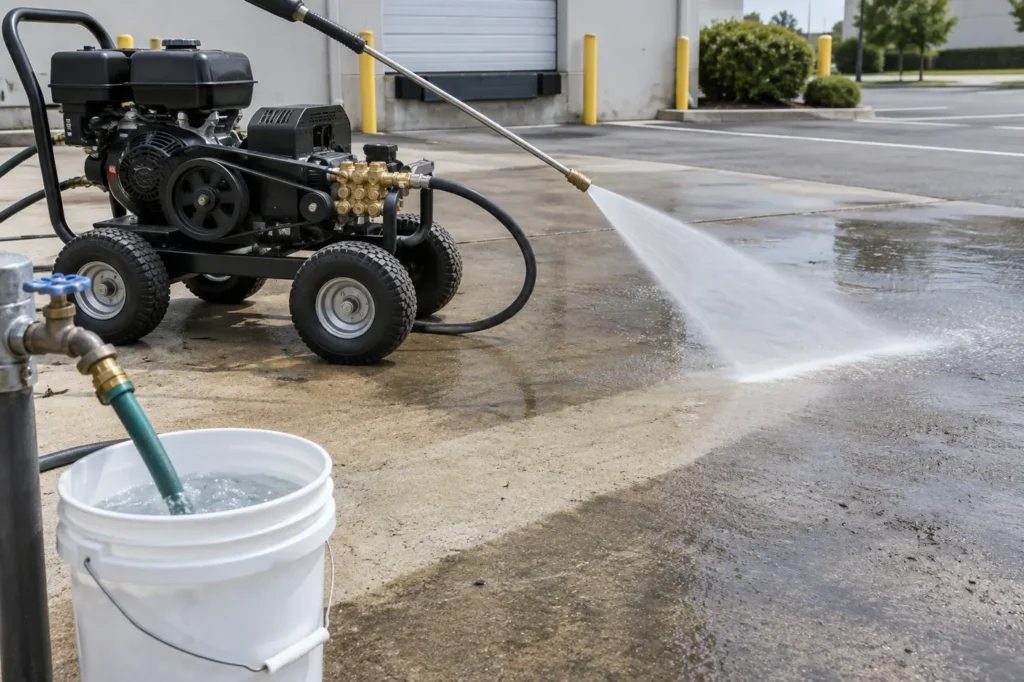
Pressure washer GPM vs PSI: PSI is the force of the water, which knocks dirt loose. GPM, gallons per minute, is the amount of water, which rinses the dirt away and decides how fast you cover a surface. Neither number alone tells you how well a machine cleans. Makers like Simpson multiply them into “cleaning units” (PSI x GPM) to compare machines, and for commercial work most pros lean toward higher GPM once they have enough PSI.
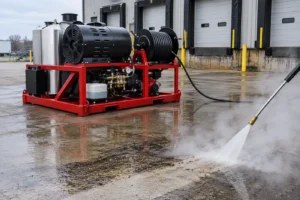
PSI breaks the bond between dirt and surface; GPM carries the dirt off and sets your speed. Cleaning units (CU) = PSI x GPM: a 3,000 PSI, 2.0 GPM machine and a 2,000 PSI, 3.0 GPM machine both rate 6,000 CU, but Simpson says the higher-GPM machine finishes faster. For contractors using detergent, Simpson notes most prefer more GPM over more PSI. A typical commercial gas machine runs about 3,000 to 4,000 PSI at 4 GPM or more.
What PSI and GPM actually measure
| PSI (pounds per square inch) | GPM (gallons per minute) | |
|---|---|---|
| What it is | Water pressure at the nozzle | Water volume through the machine |
| What it does | Knocks loose stuck-on dirt, paint, rust and scale | Rinses dirt away and keeps clean water hitting the surface |
| More of it means | More force on a small area; more risk of damage | Faster cleaning of large areas; more water used |
| Most useful for | Stubborn deposits, paint prep, concrete scale | Fleet washing, flat surfaces, mud, rinsing detergent |
Alkota’s rule of thumb sums it up: more PSI gives more knock-down, more GPM gives faster cleaning of larger areas. Simpson uses an analogy: two balls hitting a wall at the same speed, the speed being PSI, but the bigger ball, the GPM, hits harder.
Cleaning units: PSI x GPM
Simpson, Cam Spray and Powerline all use cleaning units to compare machines: multiply the PSI by the GPM.
| Machine type | PSI | GPM | Cleaning units |
|---|---|---|---|
| Homeowner machine (Powerline’s example) | 3,000 | 2.5 | 7,500 |
| Entry commercial machine (Powerline) | 3,500 | 4.0 | 14,000 |
| Typical belt-drive contractor machine | 4,000 | 4.0 | 16,000 |
| Production trailer unit (Powerline’s 23 HP example) | 4,000 | 6.5 | 26,000 |
Cleaning units are useful but not perfect. Two machines with the same CU clean differently. Simpson’s example: 3,000 PSI at 2.0 GPM and 2,000 PSI at 3.0 GPM are both 6,000 CU, but the 3.0 GPM machine rinses dirt away faster. Cam Spray adds the other side: for paint stripping and other jobs that need force, the higher-PSI machine is the better choice.
Which matters more for your work?
| Job | Lean toward | Why |
|---|---|---|
| Fleet and truck washing | GPM | Large surfaces, detergent does the loosening, flow rinses fast |
| Concrete flatwork, parking areas | GPM (with a surface cleaner) | Area coverage; a surface cleaner needs flow to spin and rinse |
| Building exteriors, soft washing | GPM, low pressure | Detergent cleans; high pressure damages siding and windows |
| Paint prep, rust, hardened deposits | PSI | Force breaks the bond |
| Equipment with grease | PSI and hot water | Heat breaks down grease; see hot vs cold below |
| Homeowner patios and cars | Neither extreme; about 2,000 to 3,000 PSI at 2 to 2.5 GPM | Light dirt, small areas |
Simpson’s “pro insight” is that contractors usually prefer higher GPM over higher PSI, because they use cleaning solutions to loosen grime and their job becomes mostly rinsing. Powerline makes the same point: chasing 5,000 PSI or more without matching flow gives more force per drop but not enough drops.
For grease and oil, heat matters more than either number. Our guide to hot vs cold water pressure washers explains when hot water is worth it.
GPM decides your water supply
A pressure washer cannot put out more water than it takes in. Before you buy a high-GPM machine, check that your water supply can feed it:
- Time how long the tap you will use takes to fill a 5 gallon bucket, with the tap fully open.
- Divide 5 by the minutes it took. If it fills in one minute, the supply is about 5 GPM.
- The supply should comfortably exceed the machine’s GPM rating. If it does not, the pump starves, loses pressure and wears faster.
Starved inlets are a common cause of the problems in our guide to a pressure washer losing pressure. Mobile contractors with high-GPM machines often carry a water tank for this reason.
Nozzles connect PSI and GPM
A pressure washer’s rated PSI depends on the nozzle. Each nozzle has an orifice size matched to the machine’s GPM. A nozzle that is too large for the flow drops the pressure; one that is too small pushes pressure up and makes the unloader bypass water. Nozzle orifices also wear and grow over time, which slowly lowers PSI. When you change machines, match the nozzles to the new GPM. Our guide on how to adjust a pressure washer unloader valve covers how pressure is set.
Reading the ratings on the box
- Look for certified ratings. Many machines carry ratings certified to the Pressure Washer Manufacturers’ Association (PWMA) standard, which tests them under set conditions. Those numbers are easier to compare than a bare “max PSI” claim.
- Check both numbers on the same line. A high PSI figure paired with a low GPM is common on homeowner machines, and the cleaning units tell you more than the PSI alone.
- Pressure drops along the hose. Long, narrow hoses lose pressure before the water reaches the nozzle, so very long hose runs need a larger diameter.
- Electric machines are limited by the outlet. A standard household circuit can only power so much motor, which is why most electric machines have modest GPM.
How much PSI and GPM do you need?
- Homeowner use: about 2,000 to 3,000 PSI at 2 to 2.5 GPM handles cars, patios and siding.
- Light commercial and maintenance crews: about 3,000 to 3,500 PSI at 3 to 4 GPM.
- Contractors doing daily work: a belt-drive machine around 4,000 PSI at 4 GPM is the common standard. Our best commercial pressure washer guide compares these.
- Production fleet and flatwork: 4,000 PSI at 5 to 8 GPM, often skid or trailer mounted, sometimes hot water. See our best hot water pressure washers.
Mi-T-M’s view is that PSI and GPM are equally important and that you need the right combination for the job. Use cleaning units to compare machines, then lean toward GPM for large areas and toward PSI for stubborn, bonded dirt.
Frequently asked questions
Should I look at GPM or PSI when buying a pressure washer?
Both. PSI loosens dirt and GPM rinses it away and sets your speed. Multiply them for cleaning units to compare machines. For large areas and detergent cleaning, lean toward higher GPM; for bonded deposits and paint prep, lean toward higher PSI.
How many GPM does a 4,000 PSI pressure washer use?
Most 4,000 PSI commercial machines run about 4 GPM, and production units can reach 5 to 8 GPM. Smaller homeowner machines advertising high PSI often have much lower flow, so check the GPM rating.
Is 2.5 GPM good for a pressure washer?
For homeowner jobs such as patios, cars and siding, yes. For daily commercial work it is slow; contractors usually want 4 GPM or more.
Is 1.2 GPM good for a pressure washer?
It is fine for light jobs such as cars, outdoor furniture and small patios, typical of small electric machines. Large areas take a long time at that flow.
What are cleaning units on a pressure washer?
Cleaning units are PSI multiplied by GPM, a single number makers use to compare machines. A 4,000 PSI, 4 GPM machine is 16,000 cleaning units. Two machines with the same number can still clean differently, so look at both values.
Bottom line: PSI knocks dirt loose and GPM carries it away. Compare machines with cleaning units, make sure your water supply can feed the GPM, and for commercial work favor more flow once you have about 3,000 to 4,000 PSI.