How to Clean Grout With a Floor Machine, Step by Step


Some links in this guide are affiliate links. If you buy through them we may earn a commission, at no extra cost to you. This never affects what we recommend or how we rank equipment. Read our disclosure.
How to clean grout with a floor machine: sweep, apply a cleaner suited to the soil, let it dwell, then scrub with a brush or a tile and grout pad on a rotary, oscillating or auto scrubber machine, and pick up the dirty slurry with a wet vacuum or the scrubber’s squeegee before it dries back into the grout. Rinse and recover again. Grout is porous and sits lower than the tile, so a brush or a pad made to reach into the joints does the work that a flat pad skates over.
Use a nylon or grit brush on a rotary machine or auto scrubber, or a tile and grout pad on an oscillating machine. Use an alkaline cleaner for grease and everyday soil and save acid cleaners for mineral scale, pre-wetting the grout first. Scrub slowly in overlapping passes, recover the slurry right away with a wet vac or squeegee, rinse with clean water and recover again. Seal cement grout once it is clean and dry.
Why grout is hard to clean
Square Scrub, which makes oscillating floor machines, puts it plainly: grout is a porous mix of sand and cement, and the grout lines are low spots where detergent, water and soil collect during cleaning, building up a film that is hard to remove. Kärcher adds that the rough surface of joints holds dirt more stubbornly than smooth tile and absorbs moisture, which makes grout a place for bacteria and mold to grow. That is why mopping alone often leaves grout dirty: the dirty water runs into the joints and stays there.
Which floor machine and which brush or pad
| Machine | Grout tool | Best for | Recovery |
|---|---|---|---|
| Rotary floor machine (about 175 rpm) | Stiff nylon or grit tile brush | Restorative grout cleaning, small to mid areas | Wet vac or squeegee to drain |
| Oscillating or orbital machine | Tile and grout pad | Grout and textured tile, low splash | Wet vac or mop |
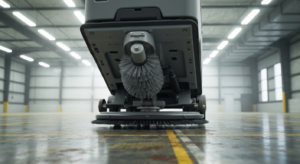
| Walk-behind auto scrubber | Nylon brush instead of a pad | Routine and deep cleaning of large tiled areas | Built-in squeegee and vacuum |
| Counter-rotating brush machine | Cylindrical brushes | Textured and grouted floors | Wet vac |
Tennant describes its nylon scrub brush as made for tough environments and uneven floors, with bristles designed to agitate grime from tile grout and textured surfaces. A flat pad tends to ride over grout lines that sit below the tile. Square Scrub’s blue tile and grout pad is sold for grouted tile floors and other uneven surfaces such as non-slip concrete. On an auto scrubber, swap the pad driver for a brush deck or disc brush to clean grout. Our floor buffer pad color chart covers pads for smooth floors.
Choose the cleaner for the soil
Kärcher sorts grout cleaners by pH:
- Alkaline cleaners remove organic soil such as grease and food residue. Kärcher notes most multi-purpose cleaners are slightly alkaline, and alkaline cleaners suit kitchens, cafeterias and other floors with grease and food soil.
- Acidic cleaners remove mineral deposits such as limescale and urine scale, common in restrooms. Kärcher warns that cement grout is mineral too, so acids attack it over time. Its advice is to pre-wet the grout with water before using an acid, so the acid works on the surface instead of soaking in.
Square Scrub’s routine method uses plain water or a neutral cleaner. Whatever you use, mix it at the label rate and check that it is safe for your tile; some natural stone is damaged by acids.
How to clean grout with a floor machine, step by step
- Prepare the area. Put out wet floor signs, move what you can, and sweep or dust mop to remove loose soil.
- Pre-wet the floor, especially before an acid cleaner, as Kärcher advises.
- Apply the cleaner to a section you can scrub and recover before it dries, and let it dwell for the time on the label.
- Fit the grout tool: a stiff brush on a rotary machine or auto scrubber, or a tile and grout pad on an oscillating machine.
- Scrub slowly in overlapping passes, then cross-scrub at right angles so the bristles reach both directions of grout line. Work edges and corners with a hand grout brush.
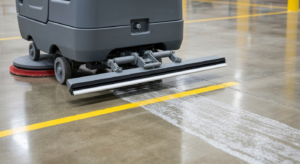
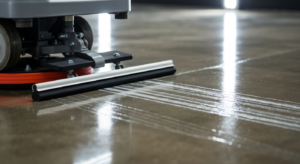
- Recover the slurry right away with a wet vacuum, the auto scrubber’s squeegee, or a squeegee to a floor drain. Square Scrub’s process ends by recovering the slurry with a mop or wet vac; do not let it dry back into the joints.
- Rinse with clean water and recover again, so no cleaner is left in the grout.
- Check the result when the floor is dry. Repeat heavily soiled areas.
- Seal the grout once it is clean and fully dry, if it is cement grout, following the sealer’s label for dry time and coverage.
For machine grout cleaning

Kritkin stiff nylon scrub brush for 17 inch rotary floor machines
Stiff nylon bristles for grout lines and textured floors. Check your machine's clip or plate before ordering.
Check price on Amazon
Miracle Sealants 511 Impregnator penetrating sealer, quart
Penetrating, no-sheen sealer for tile, stone and grout; the listing says it is safe for food areas. Apply once the grout is clean and dry.
Check price on AmazonAs an Amazon Associate we earn from qualifying purchases. Prices and availability change, so check the current price on Amazon.
Using an auto scrubber on grout
An auto scrubber can clean grout well if it has a brush, not a pad, and if you slow down. On heavily soiled floors, a common method is to scrub one pass with the squeegee raised and the vacuum off so the solution can dwell, then make a second pass with the squeegee down to scrub and recover. Check your machine’s manual for its double-scrubbing instructions. If the scrubber leaves water in the grout lines, see floor scrubber not picking up water; if the brush stops turning, see floor scrubber brush not spinning. Our guide on how to use a floor scrubber covers setup.
Keeping grout clean afterward
- Remove dirty solution instead of mopping it around; grout lines collect whatever water is left.
- Change mop water often if you do mop.
- In restrooms, Kärcher suggests alternating alkaline and acidic cleaners to keep both organic and mineral soil under control.
- Reseal cement grout on the schedule the sealer recommends.
For grease-heavy kitchen floors, see how to clean a commercial kitchen floor. For a machine that scrubs and recovers in one pass, see our best walk-behind floor scrubber picks.
Common questions
What do professionals use to clean grout on floors?
Floor machines with brushes or grout pads, such as rotary machines with stiff nylon or grit brushes, oscillating machines with tile and grout pads, or auto scrubbers with brushes, plus a wet vac to recover the slurry.
Is there a machine to clean floor grout?
Yes. Rotary floor machines, oscillating machines, counter-rotating brush machines and auto scrubbers can all clean grout when fitted with a brush or a tile and grout pad.
Should I use a brush or a pad to clean grout?
A brush or a pad made for grout. Tennant says its nylon brush is designed to agitate grime from tile grout and uneven floors. A flat pad tends to ride over grout lines that sit below the tile.
What cleaner is best for grout?
Alkaline cleaners for grease and organic soil, and acidic cleaners only for mineral scale. Kärcher says to pre-wet the grout before using an acid, because acids attack cement grout over time.
Can you use a floor buffer to clean grout?
Yes, a low-speed rotary floor machine with a stiff tile brush works. Recover the dirty solution with a wet vac. High-speed burnishers are for polishing, not grout.
Should grout be sealed after cleaning?
Cement grout is porous, so sealing it after a deep clean helps it resist stains. Let it dry fully first and follow the sealer’s label.
Bottom line: use a brush or a tile and grout pad, not a flat pad; match the cleaner to the soil, pre-wet before any acid, scrub slowly, recover the slurry before it dries, rinse, and seal the grout once it is clean.