Backpack vs Upright Vacuum for Commercial Cleaning

Some links in this guide are affiliate links. If you buy through them we may earn a commission, at no extra cost to you. This never affects what we recommend or how we rank equipment. Read our disclosure.
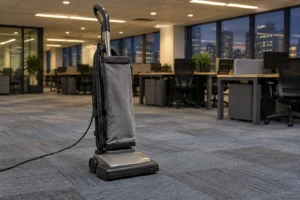
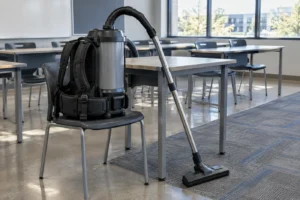
Backpack vs upright vacuum for commercial cleaning comes down to the route. A backpack vacuum rides on the cleaner’s back and works with a hose and wand, so it moves easily around desks, cubicles, chairs and stairs. An upright pushes like a lawn mower and usually has a powered brush roll that agitates carpet, which suits long open stretches of carpet. The published productivity numbers disagree, and some come from makers of one type, so look at your own floor plan before you trust any single figure.
Choose a backpack for routes full of obstacles: offices with cubicles, classrooms, stairs, theaters, and mixed carpet and hard floor. Choose an upright for open carpet where a powered brush roll helps loosen soil, such as hotel corridors and open-plan carpet. On mixed routes it can make sense to carry both: a backpack for detail and obstructed areas, an upright for wide carpet.
Backpack vs upright vacuum at a glance
| Factor | Backpack vacuum | Upright vacuum |
|---|---|---|
| How it works | Worn on a harness, cleaned with hose and floor tool | Pushed, with the floor head built in |
| Carpet agitation | Many use straight-suction floor tools | Powered brush roll is common |
| Obstacles and stairs | Strong: the body moves with you | Weaker: has to be lifted or worked around |
| Hard floors and edges | Strong, with the right tool | Varies by model |
| Above-floor dusting | Built in, with the wand | On-board hose and tools on many models |
| Weight | Carried on the back and hips | Pushed; weight at the handle matters |
| Training | Harness fit and technique | Little |
Monster Janitorial, an equipment supplier, sums up the split: backpacks for mobility and access around obstacles, uprights where powered brush agitation on carpet matters. It notes many backpack vacuums use straight-suction floor tools that work well on routine surface soil, low-pile commercial carpet and hard floors, while an upright’s brush roll can help loosen embedded dry soil.
Which is faster? It depends on whose study you read
There are two well-known sets of numbers, and they point in different directions.
- The case for backpacks. ISSA, the cleaning industry association, has published figures of 3,240 square feet per hour for an upright and 7,407 square feet per hour for a backpack. ProTeam, a major backpack vacuum maker, says that based on ISSA cleaning times a cordless backpack saves 1 to 1.5 hours per 4-hour shift, and that after five passes its backpack pulls 43% more soil from carpet than a commercial upright.
- The case that they are close. A study by the American Institute for Cleaning Sciences, reported by CleanLink, timed six workers vacuuming low-profile carpet in a Class A office. It found both types cleaned two to five times more square footage per hour than the older ISSA figures, and much less difference between them. Uprights cleaned more than 12,000 square feet per hour in obstructed space and up to 25,000 in open space; a corded backpack covered 17,775 square feet per hour in open space and a battery backpack more than 23,000. The announcement quoted the general manager of Sanitaire, an upright maker.
In the AICS timings, obstructed space took longer than open hallways with either machine, and the researchers credited easier handling and comfort for faster work. Time your own crew on one floor with each machine before you buy for a whole building.
One of each

ProTeam Super Coach Pro 10 backpack vacuum, 10 quart, corded
Articulating harness and ProTeam's ProLevel filtration system, per the listing. Telescoping wand tool kit for floors and above-floor dusting.
Check price on Amazon
Sanitaire Force SC5845D commercial upright vacuum
15 inch cleaning path, washable HEPA exhaust filter and a 3.5 quart dirt cup, per the listing. CRI certified.
Check price on AmazonAs an Amazon Associate we earn from qualifying purchases. Prices and availability change, so check the current price on Amazon.
When a backpack vacuum wins
- Obstructed spaces: offices with cubicles and desk chairs, classrooms, libraries and break rooms.
- Stairs and theaters, where an upright has to be lifted step by step.
- Mixed floors, with carpet, hard floor and edges in one route.
- Above-floor dust: vents, ledges and furniture with the same wand, no swapping machines.
- Cordless routes, where pulling and replugging a cord slows the crew; ProTeam’s time-saving figure is for its cordless backpack.
When an upright vacuum wins
- Long runs of open carpet: hotel corridors, open-plan offices and retail carpet.
- Carpet that needs agitation: the powered brush roll helps loosen dry soil from the pile, as Monster Janitorial notes.
- Staff who would rather not wear a harness, or short shifts where training on a backpack is not worth it.
- Wide paths: Sanitaire says its 15 inch Force covers over 25% more area per pass than a 12 inch vacuum.
Comfort and fit matter more than the label
A backpack is only fast if it fits. Adjust the harness so the weight sits on the hips rather than the shoulders, and choose a model with a harness that suits the crew; ProTeam’s listing describes an articulating harness meant to move with the shoulders, back and hips. For uprights, look at weight at the handle, height adjustment for the carpet and how easy the brush roll and belt are to service.
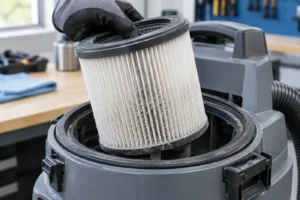
Filtration matters for both. If you need fine dust captured, look for a sealed HEPA system; see what is a HEPA vacuum. If an existing machine has gone weak, check commercial vacuum losing suction before replacing it.
For model picks, see our best commercial backpack vacuum and best commercial upright vacuum guides. Carpet tile in offices also needs periodic deep cleaning; see how to clean commercial carpet tile.
Common questions
Is a backpack vacuum better than an upright?
For obstructed spaces, stairs and mixed floors, usually yes. For long runs of open carpet that need brush agitation, an upright is often the better tool. Mixed routes can justify both.
Are backpack vacuums faster than uprights?
ISSA’s figures say yes: 7,407 square feet per hour against 3,240 for an upright. A later AICS study found both much faster than those figures and the gap much smaller. Time your own route.
Do backpack vacuums clean carpet as well as uprights?
ProTeam says its backpack pulls 43% more soil after five passes than a commercial upright. Uprights with powered brush rolls add agitation, which helps on embedded soil. Floor tool design matters for both.
Are backpack vacuums hard on your back?
They should not be if fitted properly. Set the harness so the weight rides on the hips, and choose a model whose harness suits the operator.
Which vacuum is best for office cleaning?
Offices with cubicles, desks and chairs favor a backpack. Large open-plan carpet favors an upright. A backpack for detail and an upright for open carpet can work well together.
Can a backpack vacuum clean hard floors?
Yes, with a hard floor tool. That makes backpacks useful on routes that mix carpet, tile and vinyl.
Bottom line: pick a backpack for obstacles, stairs and mixed floors, an upright for open carpet that needs a brush roll, and time both on your own route, because the published productivity figures disagree.