Auto Scrubber vs Mop: Speed, Cost and When Each Wins

Some links in this guide are affiliate links. If you buy through them we may earn a commission, at no extra cost to you. This never affects what we recommend or how we rank equipment. Read our disclosure.
Auto scrubber vs mop comes down to floor area. ISSA’s 612 cleaning times put a wet mop and rinse with a 16 ounce mop at about 1,700 square feet an hour, while a 20 inch self-propelled walk-behind auto scrubber does about 9,300 square feet an hour in practical use, more than five times faster. An auto scrubber also scrubs, rinses and vacuums up the dirty water in one pass, so the floor is left cleaner and drier. A mop still wins on small rooms, tight spaces and edges, and costs almost nothing to buy.
For more than a few thousand square feet of hard floor a day, an auto scrubber is faster and leaves the floor cleaner and drier, and the labor savings usually pay for an entry-level machine within a year or two. For restrooms, small offices, tight spaces and edges, a microfiber flat mop is the better tool. Most facilities use both: the scrubber for open floor, the mop for what the machine cannot reach.
Auto scrubber vs mop: speed compared
ISSA, the cleaning industry association, publishes standard production rates for cleaning tasks. These are its 612 cleaning times for mopping and auto scrubbing, in square feet per hour:
| Method | Square feet per hour | Minutes per 1,000 sq ft |
|---|---|---|
| Wet mop and rinse, 16 oz mop, single bucket | 1,724 | 34.8 |
| Wet mop and rinse, 16 oz mop, double bucket | 1,887 | 31.8 |
| Damp mop, 16 oz mop, single bucket | 4,167 | 14.4 |
| Damp mop, 24 oz mop, double bucket | 5,556 | 10.8 |
| Auto scrubber, 17 in walk-behind, not self-propelled (practical) | 5,917 | 10.1 |
| Auto scrubber, 20 in walk-behind, self-propelled (practical) | 9,274 | 6.5 |
| Auto scrubber, 24 in walk-behind, self-propelled (practical) | 11,132 | 5.4 |
| Auto scrubber, 32 in rider (practical) | 20,408 | 2.9 |
ISSA lists both theoretical and practical rates for scrubbers; the practical figures above allow for emptying, refilling and turning. Note that damp mopping is a lighter task than scrubbing. The fair comparison for a deep clean is wet mop and rinse against the auto scrubber, and there the 20 inch machine is more than five times faster. Tennant says its studies have found auto scrubbing can be 8 to 10 times faster than manual mopping.
Is scrubbing the floor better than mopping?
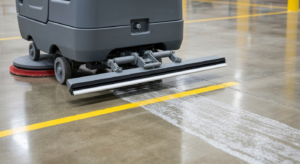
For cleaning results, yes. An auto scrubber puts down fresh solution, scrubs with a brush or pad, and its squeegee and vacuum pick up the dirty water in the same pass. A mop puts the dirty water back into the bucket and then back on the floor until you change it. Tennant says its data shows a modern auto scrubber delivers 90% cleaner surfaces than conventional mopping.
How you mop matters too. A study of mopping methods published in the Journal of the American Association for Laboratory Animal Science found that reusing cotton string mop heads with a quaternary ammonium disinfectant increased bacterial contamination on the floor, while the other mop and disinfectant combinations it tested reduced it. The authors also note that reused string mop and bucket systems have been implicated in spreading contamination in hospitals. If you mop, use clean mop heads and fresh solution.
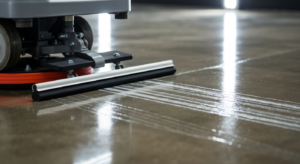
A drier floor is also a safer floor. Because the machine picks up its water as it goes, the floor can reopen sooner than after mopping, which leaves a wet film that has to air dry. Wet floor signs are still needed while either method is in use.
Auto scrubber vs mop: cost compared
A mop costs less up front. Our floor scrubber price guide found compact 17 inch walk-behinds listed at about $3,000 corded to $6,500 battery, and 20 inch battery walk-behinds at about $6,300 to $14,500 in November 2026. A commercial flat mop kit costs under $100 to $150.
Labor is where the money goes. Here is an example using ISSA’s times for 10,000 square feet cleaned every working day, 260 days a year, at an assumed $20 an hour labor cost:
| Method | Hours per day | Hours per year | Labor per year at $20/hour |
|---|---|---|---|
| Wet mop and rinse, 16 oz, single bucket | 5.8 | 1,508 | $30,160 |
| Damp mop, 16 oz, single bucket | 2.4 | 624 | $12,480 |
| Auto scrubber, 17 in, not self-propelled | 1.7 | 439 | $8,788 |
| Auto scrubber, 20 in, self-propelled | 1.1 | 280 | $5,607 |
Against wet mopping, a 20 inch scrubber saves about 1,230 labor hours a year in this example. Even against daily damp mopping, it saves about 340 hours, roughly $6,900. Tennant’s own estimate for a typical switch is about 300 hours and nearly $4,500 in labor a year. Add the machine’s running costs, such as batteries, pads, squeegee blades and detergent, before you work out the payback for your floor.
Our rule of thumb: if you clean a few thousand square feet of open hard floor every day, an auto scrubber pays for itself. Below that, or if the space is mostly small rooms, a good flat mop system is the better buy.
When a mop is still the right tool
- Small or broken-up areas. Restrooms, small offices and break rooms do not give a scrubber room to work.
- Edges, corners and under fixtures. A scrubber cannot reach every edge or get under drinking fountains and sinks, so crews keep a mop for detail work.
- Spills between scrubber runs. A mop is quicker to grab for a single spill.
- Stairs. ISSA has separate times for damp mopping stairs; there is no machine shortcut.
- Very tight budgets. If the floor area is small, the machine never earns its price back.
If you do mop, a microfiber flat mop is the upgrade. ISSA lists an 18 inch microfiber flat mop with a double-sided bucket among the fastest damp mopping methods it times.
Which auto scrubber replaces a mop?
- Up to about 10,000 square feet a day: a compact 17 inch walk-behind. The corded Viper AS430C is one of the lowest-priced entry points, and the battery Viper AS4325B removes the cord.
- 10,000 to 30,000 square feet: a 20 to 24 inch self-propelled battery walk-behind. See our best walk-behind floor scrubber guide.
- Above that: a ride-on, which ISSA times at 18,500 to 23,000 square feet an hour in practical use.
- Mostly dust and debris, not wet soil: a sweeper may be the better first machine; compare them in our floor sweeper vs floor scrubber guide.
A scrubber only beats a mop if it is run and cleaned properly. Our guides on how to use a floor scrubber and how to clean a floor scrubber cover both.
What we would buy to replace or upgrade the mop

Viper AS430C corded walk-behind scrubber, 17 inch, 13 gal
Low entry price for smaller floors. Needs an outlet and a cord plan.
Check price on Amazon
Viper AS4325B battery walk-behind scrubber, 17 inch, 6.6 gal
Cordless compact scrubber for shops, schools and offices.
Check price on Amazon
Rubbermaid Commercial microfiber adaptable flat mop kit, 18 inch
Washable microfiber pads for the areas a scrubber cannot reach.
Check price on AmazonAs an Amazon Associate we earn from qualifying purchases. Prices and availability change, so check the current price on Amazon.
Common questions
Is scrubbing the floor better than mopping?
Yes for larger hard floors. An auto scrubber scrubs and vacuums up the dirty water in one pass, while a mop can spread dirty water. Tennant says its data shows 90% cleaner surfaces than conventional mopping.
How much faster is an auto scrubber than a mop?
ISSA’s times put a 20 inch self-propelled walk-behind at about 9,300 square feet an hour, against about 1,700 for wet mopping and rinsing with a 16 ounce mop, more than five times faster.
Are floor scrubbers worth it?
If you clean a few thousand square feet of open hard floor daily, usually yes. In our 10,000 square foot example, a 20 inch scrubber saves about 340 labor hours a year over damp mopping and far more over wet mopping.
What does an auto scrubber do?
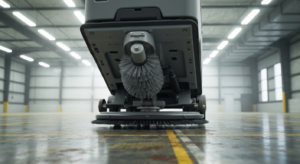
It sprays cleaning solution, scrubs the floor with a rotating brush or pad, and squeegees and vacuums the dirty water into a recovery tank, all in one pass.
Can an auto scrubber replace a mop completely?
Not quite. Scrubbers cannot reach every edge, corner and space under fixtures, and small rooms are faster with a mop. Most crews keep a flat mop for detail work.
How many square feet can you mop in an hour?
ISSA lists about 1,300 to 1,900 square feet an hour for wet mopping and rinsing, and about 3,600 to 7,100 for damp mopping with string mops, depending on mop size and bucket type.
Bottom line: use an auto scrubber for open hard floor above a few thousand square feet a day, because it is several times faster and leaves the floor cleaner and drier, and keep a microfiber flat mop for small rooms, edges and spills.