Pressure Washer Hose Repair: Fix It or Replace It?

Some links in this guide are affiliate links. If you buy through them we may earn a commission, at no extra cost to you. This never affects what we recommend or how we rank equipment. Read our disclosure.
Pressure washer hose repair depends on where the leak is. A leak at the end, where the hose meets the gun or machine, is usually a worn O-ring in the quick coupler, and that is a two-minute fix. A leak, bulge or exposed wire in the hose itself is different: Generac’s manuals say do not repair a high-pressure hose, replace it, and tape, glue and patches fail under pressure. The one repair the trade uses is to cut out the damaged section and join the hose with reusable fittings rated for that exact hose, or have a hose shop re-end it.
Leak at a fitting: shut down, relieve pressure, and replace the O-ring in the quick coupler; if the O-ring is fine, replace the coupler or plug. Leak, cut, bulge or exposed braid in the hose: replace the hose with one rated at or above your machine’s pressure, or cut out the bad section and fit reusable fittings made for that hose type and size, joined with a rated swivel or coupler. Never tape, glue or patch a high-pressure hose.
Can a pressure washer hose be repaired?
Sometimes, but not with a patch. Generac’s owner’s manuals tell users to inspect for “cuts, leaks, abrasions, bulging, and damage or movement of couplings,” to replace the hose immediately if any are present, and state: “DO NOT repair high-pressure hose. Replace with hose that meets or exceeds maximum pressure rating of unit.”
Washing Equipment of Texas, a commercial pressure washer dealer, explains why patches fail: high-pressure water can break the seal of a patch and hurt someone, and most epoxy or vinyl patches are not made for the pressure or the temperature. It says the safe options are replacing the hose or having a qualified hose shop repair it.
So the decision is simple:
| Problem | Repair or replace? | How |
|---|---|---|
| Leak at a quick coupler | Repair | Replace the O-ring, then the coupler or plug if needed |
| Leak at a crimped end fitting | Repair by re-ending | Cut off the end and fit a new reusable or crimped end rated for the hose |
| Pinhole, cut or split in the hose | Splice or replace | Cut out the section and join with rated reusable fittings, or replace |
| Exposed wire braid | Replace, or cut out that section | Treat it as a burst point |
| Bulge or blister | Replace, or cut out that section | The reinforcement has failed there |
| Hose old, stiff or cracked along its length | Replace | A splice will not fix a worn-out hose |
Pressure washer hose repair safety first
A pinhole in a high-pressure hose can inject water into skin. Generac’s manuals warn that fluid injection “could result in death or serious injury.” Before you touch a leaking hose:
- Turn off the machine and the water supply, then squeeze the gun trigger to release trapped pressure, as Generac describes.
- Never run your hand along a pressurized hose to find a leak. Look for the spray with the machine running and your hands clear, then shut down before handling it.
- Wear eye protection; Generac requires goggles whenever the machine is used.
- On a hot water machine, let the hose and water cool before you open any fitting.
Washing Equipment of Texas adds that “any exposed wire braiding on a pressure hose is a potential burst location,” and a blowout can injure anyone nearby with high-velocity and possibly hot water.
How to fix a leak at the hose fitting
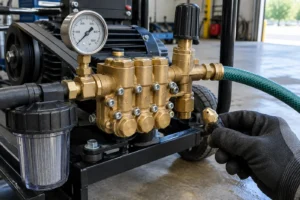
Washing Equipment of Texas notes that the leak often is not from the hose itself but from where it connects. A drip or spray at a quick connect usually means a damaged or missing O-ring.
- Shut down and relieve pressure as above, then disconnect the coupler.
- Look inside the quick coupler. With the machine off, you can see whether the O-ring is cracked, flattened or gone.
- Pick out the old O-ring with a small pick or a thin screwdriver, taking care not to scratch the groove.
- Fit the right size. A 3/8 inch quick coupler and a 1/4 inch quick coupler take different O-rings. Simpson notes that O-ring colors in its kit may not match your machine’s, so confirm the size rather than the color.
- Use a high-temperature O-ring on hot water machines. Washing Equipment of Texas specifies a high-temp O-ring, and Simpson says its standard 80151 kit is for cold water machines only.
- Reconnect and test. If the new O-ring does not stop the leak, the dealer’s advice is to replace the quick coupler or the plug.
A leak where the hose enters a crimped metal ferrule is not an O-ring problem. That end has to be cut off and replaced with a new end fitting, by you with a reusable fitting, or by a hose shop that can crimp one.
How to splice a pressure washer hose with reusable fittings
If the hose is in good condition apart from one damaged spot, you can cut that section out and join the two pieces. Kleen-Rite’s 3/8 inch hose repair kit for single wire braid hose shows the parts you need: two reusable hose fittings, a 3/8 inch female-by-female swivel to join them, and thread sealant tape.
The fittings must match the hose. Reusable fittings are made for a specific hose construction and inside diameter; Parker’s 20 Series fittings, for example, are listed for use with specific Parker hoses only. Check the hose’s printed layline for its size, braid and working pressure, and buy fittings rated for that hose and at least your machine’s pressure.
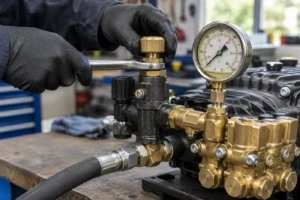
Parker’s assembly steps for its 20 Series reusable fittings show how the job is done:
- Cut the hose square. Use a fine-tooth hacksaw or cutoff tool to cut out the damaged section, making clean, square cuts. Cut well past any bulge or exposed braid.
- Clean the cut end. Blow out or flush the hose so no grit is left inside.
- Thread the hose into the socket. Clamp the socket in a vise and screw the hose into it counterclockwise until it bottoms, then back it out a quarter turn, per Parker’s instruction.
- Lubricate. Oil the inside of the hose and the nipple threads; Parker says not to oil the hose cover.
- Screw in the nipple with a wrench on its hex until the hex shoulders against the socket.
- Inspect the inside for a cut or bulged tube and make sure the hose is not twisted, as Parker advises.
- Join the two ends with the rated swivel and thread sealant, then pressure test with your hands clear before using it.
Our view: a splice is a sensible repair on a good, long commercial hose with one damaged spot. On a short or worn hose, or one that has failed in several places, replace it. Each splice also adds a rigid joint that gets dragged across the job.
Choosing a replacement pressure washer hose
- Pressure rating at or above the machine. Generac’s rule is a hose that “meets or exceeds” the unit’s maximum pressure. Professional hoses carry a 4:1 burst ratio, so a 4,000 PSI hose has a 16,000 PSI burst rating, as JRacenstein explains.
- Construction for the pressure. JRacenstein lists single wire braid as standard for 3,000 to 4,500 PSI and double wire braid for over 5,000 PSI.
- Temperature rating for hot water. JRacenstein says standard cold water hoses top out around 140°F, and a cold water hose on a burner can bubble, swell and blow out.
- Inside diameter and length. Long, narrow hoses lose pressure. Whisper Wash’s example in Cleaner Times: 8 GPM at 3,400 PSI loses about 300 PSI for every 100 feet of 3/8 inch hose. Use 3/8 inch or larger on commercial machines and keep the run as short as the job allows.
- Non-marking cover if you work on pool decks, light siding or pavers; JRacenstein says black rubber can leave marks there.
If you are running a surface cleaner on a long hose, the pressure loss matters even more; our guide to the best pressure washer surface cleaner covers sizing for GPM and hose length.
How to keep a pressure washer hose from failing
Washing Equipment of Texas lists the usual causes of hose breaks: excessive kinking, driving over the hose, and dragging it over rough ground. Its advice:
- Store the hose without kinks and with no pressure in the system.
- Keep vehicles from running over it on the job site.
- Use booms, hose reels and wand holders to keep the hose off the ground.
- Inspect it before each use, as Generac recommends, for cuts, abrasion, bulges and moving couplings.
- Drain it before freezing weather; our guide to winterizing a pressure washer covers the rest of the machine.
If the machine has lost pressure and the hose looks fine, the cause is more likely the nozzle, pump or unloader; see our guide to a pressure washer losing pressure.
Parts we would buy for this job

Viton O-ring kit for 1/4 and 3/8 inch quick couplers, high temperature, 20 pieces
For drips at quick connects. Listed to 400 degrees F, so it suits hot water machines. Check your coupler size.
Check price on Amazon
Reusable hose repair end, 3/8 inch MIP x 3/8 inch ID, for single wire braid pressure hose
Sold singly. A splice needs two plus a rated 3/8 inch female swivel. Confirm your hose is 3/8 inch single wire braid.
Check price on Amazon
Raptor Blast 4000 PSI pressure washer hose, 3/8 inch x 50 ft, single wire braid, with quick connects
Listed for hot and cold water commercial machines. Check the rating covers your machine's maximum pressure.
Check price on AmazonAs an Amazon Associate we earn from qualifying purchases. Prices and availability change, so check the current price on Amazon.
Common questions
Can a pressure washer hose be repaired?
A leaking fitting can usually be fixed with a new O-ring or coupler. Damage in the hose itself should not be patched; Generac says to replace the hose. On a commercial hose, the damaged section can be cut out and joined with reusable fittings rated for that hose.
Can you splice a power washer hose?
Yes, with two reusable fittings made for your hose’s size and braid and a rated swivel or coupler between them, as in Kleen-Rite’s 3/8 inch repair kit. Never splice with barbed fittings, clamps or tape.
How do you fix a pinhole leak in a pressure washer hose?
Not with tape or glue; Washing Equipment of Texas says patches are not made to hold that pressure. Cut out the section and splice it with rated reusable fittings, or replace the hose.
Why is my pressure washer hose leaking at the connection?
Usually a damaged or missing O-ring in the quick coupler. Replace it with the correct size, using a high-temperature O-ring on hot water machines. If it still leaks, replace the coupler or plug.
Can I use electrical tape or duct tape on a pressure washer hose?
No. Tape cannot hold back high-pressure water, and a pinhole leak can inject water into skin. Generac warns that fluid injection can cause serious injury.
What pressure rating should a replacement hose have?
At or above your machine’s maximum pressure, as Generac specifies. Commercial hoses usually carry a 4:1 burst ratio, so a 4,000 PSI hose bursts at about 16,000 PSI.
Bottom line: fix fitting leaks with the right O-ring or coupler, never patch the hose itself, and either splice out damage with reusable fittings rated for your hose or replace it with one rated for your machine.