Pressure Washer Pump Oil: Type, Change Interval and Milky Oil

Some links in this guide are affiliate links. If you buy through them we may earn a commission, at no extra cost to you. This never affects what we recommend or how we rank equipment. Read our disclosure.
Pressure washer pump oil depends on the pump, not the engine. Most commercial triplex pumps take a 30-weight non-detergent oil or the pump maker’s own oil, Cat Pumps uses an ISO 68 oil, and the small axial cam pumps on most residential machines are sealed and take no oil at all. Change it after the first 50 hours, then on the maker’s schedule, and stop the machine if the oil ever turns milky.
Use the oil your pump maker names. General Pump specifies its 30-weight non-detergent oil, Generac uses SAE 30 non-detergent in standard triplex pumps (SAE 15W-40 non-detergent on belt-drive units), and Cat Pumps uses ISO 68. Change after the first 50 hours, then every 50 to 500 hours depending on the maker. Milky oil means water is in the crankcase: stop, drain, find the leak and refill.
Engine oil and pump oil are different
A gas pressure washer has two separate oil systems. The engine takes regular small-engine oil, and Generac, for example, says to change engine oil every 20 hours or once a season. The pump’s crankcase is a separate reservoir with its own fill cap, dipstick or sight glass, and its own oil. Check which reservoir you are filling before you pour.
Before you buy anything, find out which pump you have. Generac says the axial cam pumps on residential pressure washers are factory sealed and do not need oil maintenance, while triplex pumps, found on its professional machines, do. If your pump has no drain plug, dipstick or sight glass, it is almost certainly a sealed axial pump. If you are choosing a machine for daily work, our best commercial pressure washer guide covers the options.
What oil goes in a pressure washer pump
| Pump maker | Oil it specifies | Change interval |
|---|---|---|
| General Pump | Series 100 oil, 30-weight non-detergent | Every 3 months or 500 hours |
| Cat Pumps | Cat Pumps ISO 68 oil (most models) | First 50 hours, then every 500 hours or 3 months |
| Annovi Reverberi (AR) triplex | AR factory crankcase oil (AR64516) | First 50 hours, then every 200 hours |
| Generac standard triplex | SAE 30 non-detergent | Every 50 hours |
| Generac belt-drive units | SAE 15W-40 non-detergent | Every 50 hours |
| Generac XC4000 and XC4200 | ISO 68 hydraulic oil | Every 50 hours |
| Residential axial cam pumps | None, factory sealed | No oil changes |
The pattern is clear: non-detergent oil, around 30 weight, or the specific oil the maker sells. Do not substitute regular detergent motor oil unless the manual allows it. Annovi Reverberi goes further and says all warranties are void if non-AR factory oil is used, so on a pump still under warranty, buy the maker’s oil.
How often to change pressure washer pump oil
Most makers want an early first change after the break-in period. Cat Pumps and AR both say to change after the first 50 hours. After that the interval depends on the maker: Cat Pumps says every 500 hours or 3 months, General Pump every 3 months or 500 hours, AR every 200 hours, and Generac every 50 hours on its triplex pumps.
Our advice: if you run a machine daily, follow the shorter of the hour or calendar limit, and check the oil level and color every week. Oil is cheap next to a new pump; our pump replacement guide covers the prices.
How to change pressure washer pump oil
This is Generac’s procedure for its triplex pumps; other makers are similar.
- Level the machine. Shut it off and set it on level ground so the drain and the level reading are accurate.
- Drain. Remove the drain plug and drain all the oil into a container. Look at it: grey or milky oil means a problem, covered below.
- Refit the plug. Tighten it, but do not over-tighten it, as Generac warns.
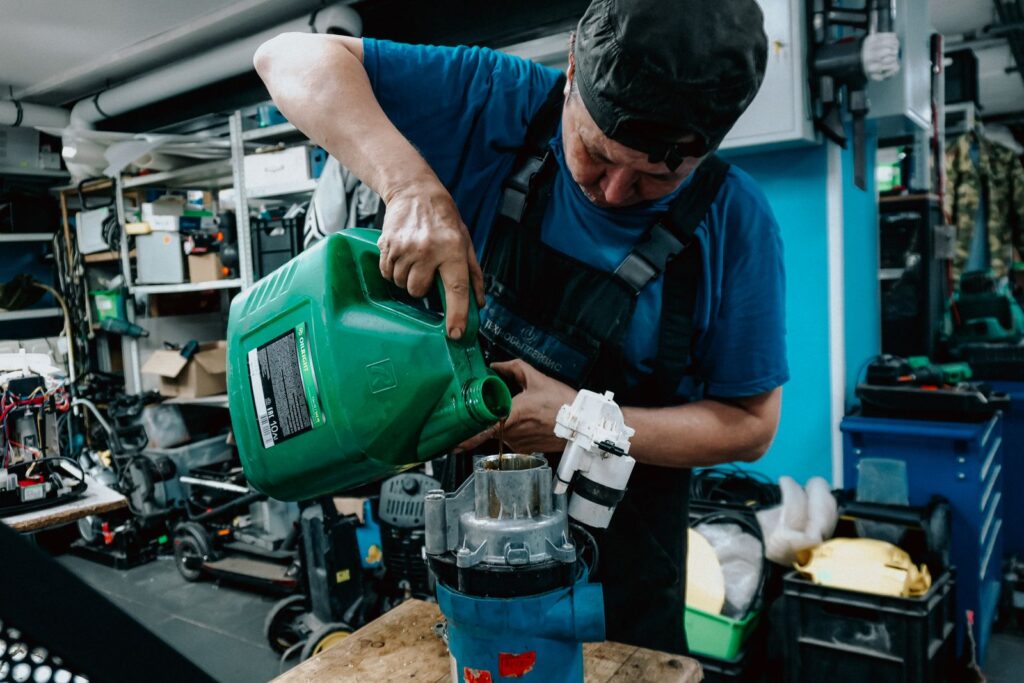
- Fill. Remove the dipstick or fill cap and add the correct oil slowly.
- Check the level. On a dipstick, keep it between the L and H marks; do not overfill. On a Cat Pumps sight glass, fill to the red dot.
- Refit the dipstick hand-tight, and dispose of the old oil at a recycling point.
Why pressure washer pump oil turns milky
Milky, foamy or white oil means water has got into the crankcase. Cat Pumps lists three ways it happens:
- Worn seals. When the seals and packings wear, water travels back along the plunger rod, attacks the crankcase oil seal and mixes with the oil.
- Humidity and condensation. Running in very humid conditions, or spraying water directly at the pump, can contaminate the oil, and humid air can condense inside the crankcase.
- Rising oil level. If pumped water leaks past worn manifold seals into the drive end, the oil level rises and can leak from the vented oil cap.
Cat Pumps’ instruction is direct: “If there are any signs of milky, foamy, or white oil, stop using the pump.” Drain it, clean the drive end, refill with fresh oil, and replace the seals as needed. Its instruction is to change contaminated oil immediately. If the oil turns milky again soon after a change, worn seals are the likely cause. A pump that has lost pressure as well often needs a seal kit; our guide to a pressure washer losing pressure walks through it.
Storing a pump for winter
Water left in the pump can freeze and crack the manifold, and that is a separate job from the oil. Change the oil before storage if it is near its interval, so the pump does not sit on used oil, then follow our pressure washer winterizing guide for the water side.
Pump oil we would buy

Cat Pumps pressure washer pump oil, 21 oz, 2 pack
Cat's own non-detergent pump oil. Check your Cat pump's manual for the grade it needs.
Check price on Amazon
Stens pump oil, replaces General Pump 100214, 30 weight non-detergent, six 16 oz
An OEM-supplier replacement, not General Pump's own bottle.
Check price on Amazon
AR Blue Clean PW64516 30W non-detergent pump oil, 16 oz
Listed for AR610, AR620, AR630 and other AR Blue Clean models. Check your manual.
Check price on AmazonAs an Amazon Associate we earn from qualifying purchases. Prices and availability change, so check the current price on Amazon.
Common questions
What kind of oil can I use in my pressure washer pump?
Use the oil your pump maker specifies. Most commercial triplex pumps take a 30-weight non-detergent oil or the maker’s own oil; Cat Pumps uses ISO 68. Residential axial cam pumps are sealed and take none.
Can I use SAE 5W-30 in a pressure washer pump?
Not unless your pump manual allows it. 5W-30 is an engine oil and is normally a detergent oil; pump makers such as General Pump and Generac specify non-detergent oil for the pump crankcase.
Can you use 15W-40 in a pressure washer pump?
Only where the maker allows it. Generac specifies SAE 15W-40 non-detergent oil for its belt-driven units, but SAE 30 non-detergent for its standard triplex pumps.
Why is my pressure washer pump oil milky?
Water has got into the crankcase, usually through worn seals or from humidity and condensation. Cat Pumps says to stop using the pump, drain and clean it, refill, and replace the seals as needed.
How often should you change pressure washer pump oil?
After the first 50 hours, then on the maker’s schedule: every 500 hours or 3 months for Cat Pumps, every 200 hours for AR, every 50 hours on Generac triplex pumps.
Do all pressure washer pumps need oil?
No. Generac says the axial cam pumps on residential pressure washers are factory sealed and need no oil maintenance. Triplex pumps on commercial machines do.
Bottom line: check which pump you have, use the maker’s non-detergent oil, change it after 50 hours and then on schedule, and treat milky oil as a stop sign for worn seals.


[…] Pressure Washer Pump Oil […]