Carpet Extractor vs Carpet Cleaner: What Is the Difference and Which Do You Need?

Some links in this guide are affiliate links. If you buy through them we may earn a commission, at no extra cost to you. This never affects what we recommend or how we rank equipment. Read our disclosure.
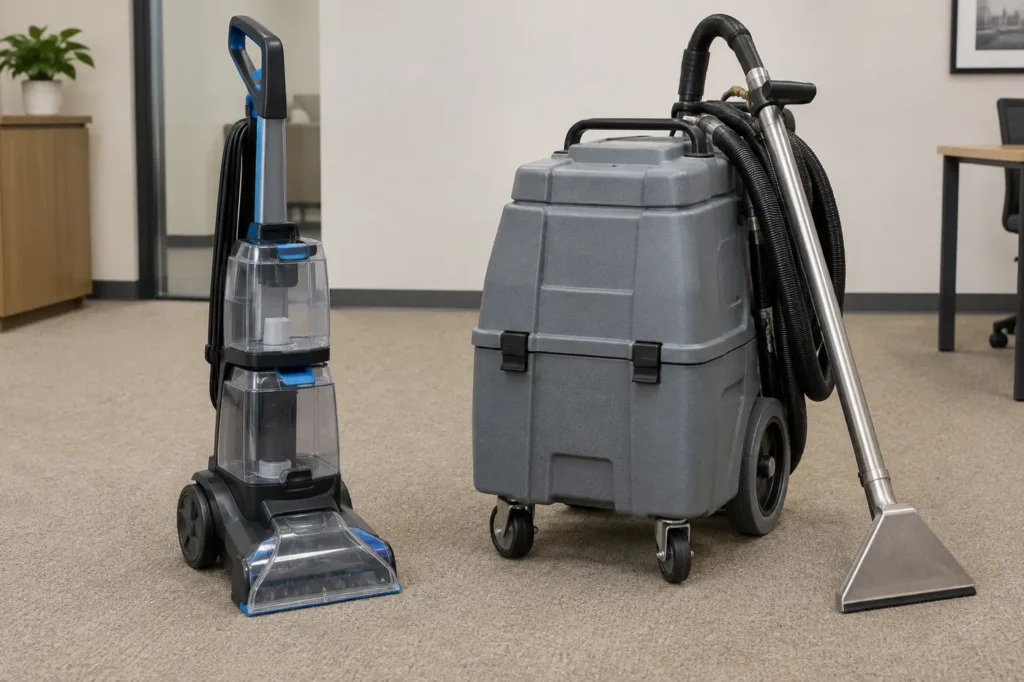
Carpet extractor vs carpet cleaner comes down to power, capacity and duty cycle. Both spray cleaning solution into the carpet and vacuum it back out, so technically both are extractors. The difference is scale. A household “carpet cleaner” is an upright with a tank of around 1 to 2 gallons, built for a few rooms a few times a year. A commercial carpet extractor has a real pump, stronger vacuum motors, tanks of roughly 4 to 12 gallons and often a heater, and it is built to run for hours, day after day. If you clean carpet for a business, you want the extractor.
Both machines spray solution and vacuum it back up. A carpet cleaner is a household upright with small tanks (the Bissell Big Green Professional holds 1.75 gallons) for occasional home use. A carpet extractor is a commercial machine with a pump (often 100 PSI or more), stronger vacuum motors, larger tanks (about 4 to 12 gallons) and often a heater. Extractors clean deeper, leave carpet drier and last under daily use.
Side by side
| Household carpet cleaner | Commercial carpet extractor | |
|---|---|---|
| Typical example | Bissell Big Green Professional | Sandia Sniper 80-2100 |
| Tank size | About 1 to 2 gallons (1.75 gal on the Big Green) | About 4 to 12 gallons (12 gal on the Sniper) |
| Spray | Gravity feed or a small pump | Pump, often 100 PSI; 220 to 500 PSI for upholstery and tile |
| Vacuum | One motor | Often two multi-stage vacuum motors |
| Heat | Usually none, uses hot tap water | Optional in-line heaters of 1,000 to 2,000 W |
| Tools | Brush head, small hose tool | Wand, stair tool, upholstery tool, hard floor tools |
| Built for | A few rooms a few times a year | Hours of daily commercial use |
| Price (Nov 2026) | About $430 | About $1,400 to $5,100 |
What is the difference between a carpet extractor and a carpet shampooer?
A shampooer, also called a rotary or bonnet machine, scrubs foamy shampoo into the carpet with a brush and lets it dry, then the residue is vacuumed later. An extractor sprays solution and immediately pulls the dirty water back out. Extraction removes more soil and leaves less residue, which is why carpet makers and most professionals prefer it. Residue left by shampooing attracts dirt, so carpet can look dirty again quickly.
Is an extractor just a vacuum?
No. A vacuum only lifts dry soil. An extractor adds a pump and a solution tank, so it can push cleaning solution or rinse water into the carpet fibers and then pull it back out with the soil dissolved in it. A wet/dry shop vac can pick up water but cannot spray, so it cannot rinse the carpet.
Why extractors clean deeper and dry faster
- More vacuum. Two vacuum motors pull far more water back out than one. Less water left in the carpet means faster drying and less chance of mildew or wicking spots.
- Real pump pressure. A pump sprays solution evenly into the fibers. Household machines often rely on gravity or a small pump.
- Heat. Heated solution breaks down greasy soil faster, especially in traffic lanes and food areas.
- Tools. A wand and hand tools reach edges, stairs and upholstery that an upright cannot.
- Duty cycle. Commercial motors, pumps and hoses are built to run for hours. A household machine used every day usually fails early, and its warranty may not cover commercial use.
Which one do you need?
| Situation | Best choice |
|---|---|
| A home, cleaned once or twice a year | Household carpet cleaner, or rent a machine |
| A small office or church cleaned a few times a year | A commercial upright like the Bissell BigGreen Commercial BG10 |
| Hotel rooms, spots and upholstery | A compact heated spotter like the Mytee Lite 8070 |
| Janitorial crews and small carpet cleaning businesses | A 12 gallon, 100 PSI box extractor like the Sandia Sniper |
| Large open carpet areas | A self-contained walk-behind like the Tennant E5 |
Our guide to the best commercial carpet extractors compares these machines in detail, with specs and November 2026 prices.
Both kinds on Amazon

BISSELL Big Green Professional carpet cleaner
1.75 gal tank and a 12 amp motor. Cleans going forward and back. For homes and occasional use.
Check price on Amazon
Bissell BigGreen Commercial BG10
Two-motor upright for small businesses that clean a few times a year.
Check price on Amazon
Mytee Lite 8070 heated carpet extractor
4 gal tanks and a 1,000 W in-line heater for spots, small rooms and upholstery.
Check price on Amazon
Sandia 80-2100 Sniper, 12 gal, 100 PSI
Dual 2-stage vacuum motors on a single cord, for daily commercial carpet work.
Check price on AmazonAs an Amazon Associate we earn from qualifying purchases. Prices and availability change, so check the current price on Amazon.
What is the most effective carpet cleaning method?
For a deep clean, most carpet makers and professionals recommend hot water extraction: pre-spray the soil, let it dwell, agitate it, then extract with clean rinse water. Truck-mounted systems are the most powerful version, and portable extractors bring the same method indoors where a truck cannot reach. Between deep cleans, regular vacuuming and prompt spot cleaning do the most to keep carpet looking new.
Frequently asked questions
Is a carpet extractor better than a carpet cleaner?
For commercial use, yes. Extractors have stronger pumps and vacuum motors, larger tanks and often heat, so they clean deeper, leave carpet drier and hold up to daily use. For a home cleaned once or twice a year, a household carpet cleaner is usually enough.
Do carpet extractors work?
Yes. Hot water extraction is the method most carpet makers recommend for deep cleaning. Results depend on pre-spraying, agitation and extracting enough water back out.
Can I use a household carpet cleaner for my business?
For a small space cleaned occasionally, it can work. For regular commercial cleaning, a household machine wears out quickly, takes longer and leaves carpet wetter. Its warranty may also exclude commercial use.
How long does carpet take to dry after extraction?
Usually a few hours with a good commercial extractor and decent airflow. Household machines often leave carpet wetter, so drying takes longer. Extra dry passes and air movers help.
Is steam cleaning the same as carpet extraction?
In carpet cleaning, “steam cleaning” usually means hot water extraction. True steam machines that make dry vapor are a different tool, used more for sanitizing hard surfaces than for deep cleaning carpet.
Bottom line: a household carpet cleaner is fine for a home a few times a year. For any business that cleans carpet regularly, a commercial extractor with a real pump, two vacuum motors and bigger tanks cleans deeper, dries faster and lasts.
[…] sure whether you need an extractor at all? Our comparison of a carpet extractor vs a carpet cleaner explains the […]