Carpet Extractor Leaking? Find the Leak and Fix It

Some links in this guide are affiliate links. If you buy through them we may earn a commission, at no extra cost to you. This never affects what we recommend or how we rank equipment. Read our disclosure.
Carpet extractor leaking? Where the water comes out tells you the cause. A drip at the hose connection is usually a worn O-ring in the quick disconnect. Solution dribbling from the wand when the trigger is released is a wand valve that no longer seals. A puddle under the machine means a loose clamp, a cracked fitting or a pump seal inside the shell. Water blowing out of the vacuum exhaust is foam in the recovery tank, and it needs attention right away because it can reach the vacuum motor.
Find the exact spot first: dry the machine, run it, and watch. Replace the O-ring if a quick disconnect leaks only while a hose is connected, and replace the female fitting if it drips with nothing in it. Rebuild or replace a wand valve that drips after you let go of the trigger. For water under the machine, unplug it, open the shell and check hose clamps, plastic connectors and the pump. If water or foam comes out of the vacuum exhaust, stop, empty the recovery tank and add defoamer.
Where is the water coming from?
Dry the machine and the floor around it, then run it on a hard floor or over a towel and watch where the first drops appear. Water runs along hoses and down the frame, so the spot where it drips off is often not the spot where it escapes.
| Where it leaks | Likely cause | First fix |
|---|---|---|
| Hose quick disconnect | Worn O-ring or worn female fitting | Replace the O-ring or the fitting |
| Wand jets after trigger is released | Wand valve not sealing | Rebuild or replace the valve |
| Under the machine while running | Loose clamp, cracked connector or pump seal | Open the shell and trace the drip |
| Vacuum exhaust | Foam or water past the float | Stop, empty the tank, add defoamer |
| Tank cap, drain cap or lid | Worn cap seal or gasket, cracked tank | Replace the seal, gasket or tank |
1. The quick disconnect is dripping
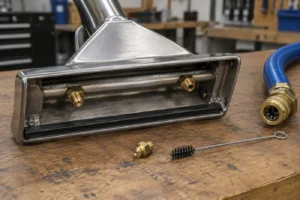
The brass quick disconnects that join the solution hose to the machine and the wand seal with small O-rings. One cleaner on The Cleaning Standard forum notes that the hottest water passes through them, which wears the O-rings out over time. Cleaners in the same thread give a simple rule for a female quick disconnect that leaks:
- It drips with no hose connected: the valve inside the fitting is worn. Replace the fitting; a new O-ring will not fix it.
- It leaks only with the male fitting pushed in: replace the O-ring or O-rings in the female fitting.
The same thread has two habits that make O-rings last longer: release the pressure before you connect or disconnect a hose, which keeps the O-ring from blowing out, and lubricate the fittings. Use a lubricant that is safe for the O-ring material in your fittings.
While you are at the hose, check it end to end for cuts and soft spots. Mytee’s extractor manual has a useful test for a hidden solution leak: if the pump keeps running when it should stop, disconnect the solution hose from the machine. If the pump then stops, the leak is outside the machine, in the hose or the tool. If it keeps running, the leak is inside the machine.
2. The wand drips after you let go of the trigger
The trigger valve on the wand opens and closes the solution flow. When its seal wears, solution keeps seeping to the jets. Sandia, which makes wand valves, lists the signs of a bad valve: solution dripping when the trigger is released, a sticky or stiff trigger, and spray that will not fully shut off. A dripping wand leaves wet spots and over-wets the carpet, which slows drying.
Most brass wand valves can be rebuilt with a kit of seals and O-rings for that valve model. Sandia’s advice when a valve has been leaking is to inspect or replace the related O-rings at the same time. If the valve body is cracked or still leaks after a rebuild, replace the valve.
Parts worth keeping in the van

Carpet cleaning wand angle valve repair kit
For Kingston and Dam style angle valves. Check your valve brand and model before ordering.
Check price on Amazon
Vinsot 1/4 inch quick disconnect couplers for carpet cleaning, 2 sets
Male and female brass fittings for when a female coupler drips with nothing connected. Match the thread size on your hose.
Check price on AmazonAs an Amazon Associate we earn from qualifying purchases. Prices and availability change, so check the current price on Amazon.
3. Water is leaking from under the machine
A puddle under a portable extractor while it runs usually comes from the solution side: the pump, its hoses and the connectors between the solution tank, pump, heater and outlet. Cleaners answering a “brand new machine leaking from bottom” question on Reddit point first to a loose hose clamp or a broken plastic connector at the pump, and to cuts in the internal hoses. On Truckmount Forums, a cleaner with a Mytee portable leaking underneath got the same advice: check the hoses, clamps and pump.
Mytee’s troubleshooting table lists the pump-side causes and fixes:
- Cracks or leaks on the inlet side of the pump: make sure the hoses are secured tightly; if the inlet side of the pump is cracked or damaged, replace the pump.
- Seals degraded by chemical: install a seal repair kit.
- Debris blocking the inlet filter or pump head: clean the filter or pump head.
Unplug the machine before you open the shell. Water and live wiring sit close together inside an extractor, so if you need to run it open to see the leak, keep your hands clear, or hand it to a service center. A machine still under warranty should go to the dealer before you open it.
If the pump runs but less solution reaches the carpet, the same leak may be causing a spray problem; see carpet extractor not spraying.
4. Water or foam is coming out of the vacuum exhaust
This is the leak to stop at once. Mytee lists foam in the recovery tank as the cause when the vacuum blows water out of the exhaust, and the fix is a defoaming solution in the recovery tank. Tennant’s manual for its 1510 and 1530 extractors warns that foam does not activate the float shut-off, so foam or water can get into the vacuum motor and damage it, and that damage is not covered by its warranty.
Turn the machine off, empty and rinse the recovery tank, clean the float screen and add defoamer before you continue. If the exhaust sprays water with no foam in the tank, the float may be stuck; have it checked before the motor fails. Our guide to a carpet extractor not picking up water covers the float and foam in more detail.
5. The tank cap, drain cap or lid is leaking
Caps, drain plugs and lids all seal with a rubber insert or gasket. Tennant lists the recovery tank cover gasket as a part to replace when it is worn, and both Tennant and Mytee list a loose drain cap or plug as a cause of air leaks. For home carpet cleaners, Bissell’s support answer for its ProHeat 2X is to unscrew and replace the cap and inserts on the clean water and formula tanks.
A tank that weeps from a seam or corner, not from a cap, is cracked and should be replaced; ask your dealer for the part number.
How to stop leaks coming back
- Release the pressure before connecting or disconnecting hoses.
- Lubricate quick disconnect O-rings with a compatible lubricant.
- Flush the solution system regularly. Mytee recommends its System Maintainer to clear chemical buildup, and Tennant’s manual calls for a monthly acetic acid flush, about every 80 hours of use, to dissolve alkaline buildup.
- Check the machine for water leaks and loose hardware. It is on the maintenance chart in both the Tennant and Mytee manuals.
- Use defoamer on carpet that foams.
New to running an extractor? Our guide on how to use a carpet extractor covers setup and technique. If the machine needs more repairs than it is worth, our best commercial carpet extractor guide compares current models, and carpet extractor vs carpet cleaner explains how home and commercial machines differ.
Common questions
Why is my carpet extractor leaking from the bottom?
Usually a loose hose clamp, a cracked plastic connector or a worn seal on the solution pump inside the machine. Unplug it, open the shell and trace the water back to where it starts.
Why is my quick disconnect leaking?
If it drips with nothing connected, the female fitting is worn and needs replacing. If it leaks only when the hose is connected, replace the O-rings in the female fitting.
Why does my carpet wand keep dripping?
The trigger valve is not sealing. Sandia lists dripping after the trigger is released, a sticky trigger and spray that will not shut off as signs of a bad valve. Rebuild it with a kit or replace it.
Why is water coming out of my extractor's exhaust?
Mytee says this is usually foam in the recovery tank. Stop the machine, empty the tank and add defoamer, because Tennant warns foam can get past the float and into the vacuum motor.
Can a leaking pump be repaired?
Often. Mytee’s manual lists a seal repair kit for seals damaged by chemicals. If the inlet side of the pump is cracked or damaged, Mytee says to replace the pump.
How do I stop my extractor from leaking?
Release pressure before disconnecting hoses, lubricate quick disconnect O-rings, flush the solution system regularly, and check for leaks and loose hardware as both Tennant and Mytee recommend.
Bottom line: find where the water first appears, then fix that part: O-rings or the fitting at a quick disconnect, a rebuild kit for a dripping wand, clamps, connectors or pump seals for water underneath, and defoamer for water from the exhaust.