Commercial Cleaning Equipment List for a Cleaning Business (Starter Kit to Machines)

Some links in this guide are affiliate links. If you buy through them we may earn a commission, at no extra cost to you. This never affects what we recommend or how we rank equipment. Read our disclosure.
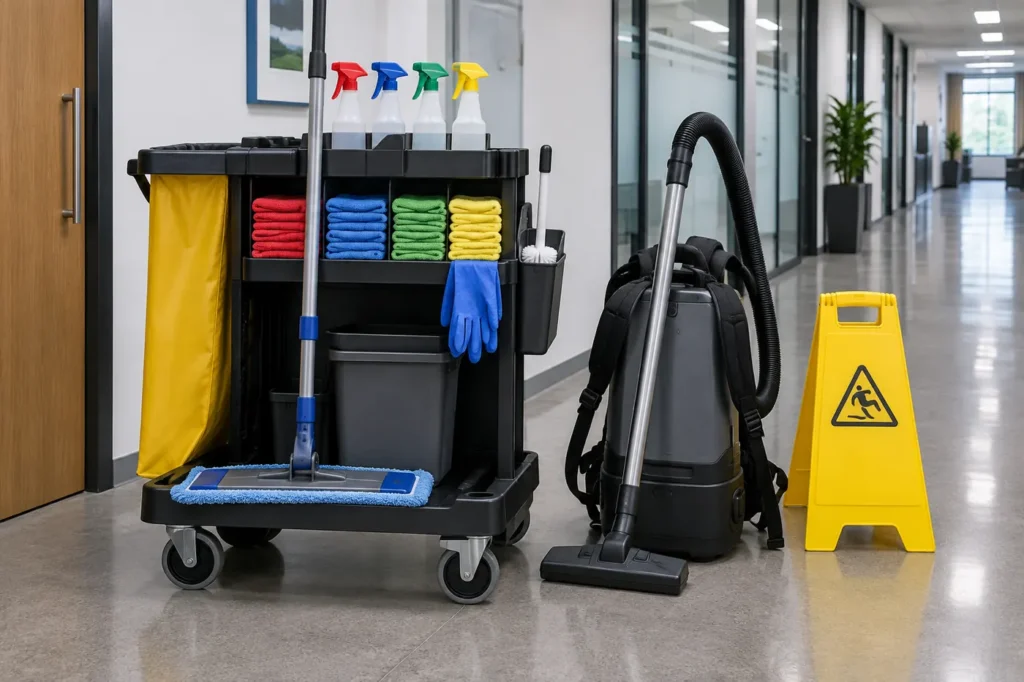
A commercial cleaning equipment list for a new cleaning business is shorter than most checklists make it look. To start cleaning offices you need a commercial vacuum, a microfiber flat mop system, color-coded microfiber cloths, a janitorial cart, wet floor signs, a few labeled chemicals, and gloves and eye protection. That kit costs roughly $900 to $1,200 per crew. Machines like a carpet extractor, floor machine, burnisher or auto scrubber come later, when you win contracts that need them, and you can rent them until then.
Starter kit per crew: a backpack or upright commercial vacuum (about $320 to $500), a microfiber flat mop kit (about $80), a 24-pack of color-coded microfiber cloths (about $25), a janitorial cart (about $130 to $175), wet floor signs, labeled spray bottles, restroom brushes, an extension duster, glass squeegee, nitrile gloves and safety glasses, plus a neutral floor cleaner, an EPA-registered disinfectant, glass cleaner and a degreaser. Add a small wet/dry vacuum next, then a carpet extractor, floor machine or scrubber only when a contract needs one.
Phase 1: the starter kit for office cleaning
Most new commercial cleaning businesses start with small offices, medical suites, churches and retail units cleaned in the evening. This list covers that work for one crew of one or two people.
| Item | What to buy | Approx. price (Nov 2026) |
|---|---|---|
| Vacuum | Commercial backpack (Bissell BG1001) or upright (Sanitaire SC5815E) | About $320 to $500 |
| Hard-floor mopping | Microfiber flat mop kit, such as Rubbermaid’s Adaptable Flat Mop Kit | About $80 |
| Cloths | Color-coded microfiber, 24 pack | About $25 |
| Cart | Janitorial cart with bag and tool hooks | About $130 to $175 |
| Safety signs | Two or more wet floor signs | Low cost |
| Restroom tools | Toilet brushes or bowl mops, scrub pads, caddy | Low cost |
| Dusting | Extension duster for vents, ledges and high spots | Low cost |
| Glass | Squeegee and scrubber for doors and glass partitions | Low cost |
| Spray bottles | Labeled bottles, one per chemical | Low cost |
| PPE | Nitrile gloves and safety glasses, plus anything the chemical labels require | Low cost |
The total comes to roughly $900 to $1,200 per crew, depending on the vacuum, cart and how many signs and spare pads you buy. The prices for the vacuums come from our guides to the best commercial backpack vacuums and best commercial upright vacuums. The others are Amazon listings from November 2026.
Backpack or upright vacuum?
For offices with many small rooms, stairs and furniture, a backpack is usually faster and reaches under desks. For open carpet areas, an upright covers ground quicker and some crews carry both. Pick a model with sealed HEPA filtration if you clean medical offices or clients who ask about air quality. Our guide on what a HEPA vacuum is explains what that label should mean.
Why microfiber flat mops instead of string mops
Flat mops use less water and chemical, are lighter, and let you change to a clean pad for each room so you do not spread dirt from a restroom to a lobby. Rubbermaid says its microfiber flat mop pads are tested to withstand up to 200 machine wash cycles. String mops and a wringer bucket still make sense for heavy, greasy floors like commercial kitchens.
Color-code your cloths and mop pads
Color coding prevents cross-contamination, so a cloth used on a toilet never touches a desk. One widely used scheme is red for toilets and urinals, yellow for other restroom surfaces, blue for general surfaces and glass, and green for food areas. Some kits use grey instead of yellow. The exact colors matter less than everyone on the crew using the same scheme every time.
Chemicals: keep the list short
Four or five products handle most commercial cleaning:
- Neutral floor cleaner for daily mopping of finished hard floors.
- EPA-registered disinfectant for restrooms and high-touch surfaces. The label lists the contact time, which is how long the surface must stay wet for the disinfectant to work. Follow it.
- Glass cleaner for doors, mirrors and partitions.
- Degreaser for break rooms and kitchens.
- Restroom bowl cleaner for toilets and urinals.
Buying concentrates with a dilution system or measuring cups costs far less per gallon than ready-to-use bottles, but only if you measure every time.
Under OSHA’s Hazard Communication Standard (29 CFR 1910.1200), employers must keep a safety data sheet for each hazardous chemical, label containers, and train employees on the hazards. In practice, that means a labeled bottle for every chemical you decant, a binder or app with the safety data sheets, and a short training session for every new cleaner. Never mix chemicals, especially bleach with ammonia or with acid cleaners.
Phase 2: equipment to add as contracts grow
Add these when a client’s floors need them, not before. Each one opens up higher-paying work.
| Equipment | When you need it | Approx. price (Nov 2026) |
|---|---|---|
| Small wet/dry vacuum | Spills, flooded restrooms, picking up stripper slurry | About $180 and up |
| Carpet extractor | Carpet deep cleaning and stains in offices, hotels and churches | About $1,400 heated portable to $2,700 box extractor |
| Floor machine (175 RPM buffer) | Stripping and refinishing VCT, spray-buffing, scrubbing | About $1,350 to $1,450 for a Clarke CFP Pro |
| Burnisher | High-gloss finish in stores, schools and clinics | About $1,400 to $1,700 corded |
| Compact auto scrubber | Larger hard floors cleaned several times a week | About $3,000 corded to $6,500 battery |
| Pressure washer | Sidewalks, dumpster pads and dock areas | About $1,100 cold water and up |
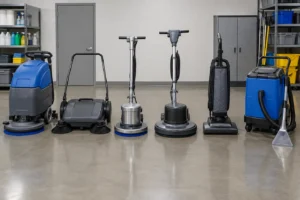
For details and picks, see our guides to industrial and wet/dry vacuums, commercial carpet extractors, walk-behind floor scrubbers and commercial pressure washers. Our overview of commercial floor cleaning machines explains what each machine type does.
Floor machine or auto scrubber first?
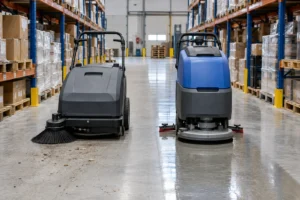
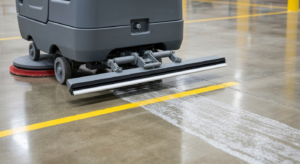
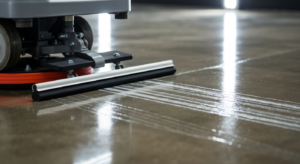
For a small cleaning business, a floor machine usually comes first. It handles strip and wax jobs, which are often sold as one-off or quarterly projects, and it costs far less than a scrubber. An auto scrubber pays off when you clean the same large hard floor several times a week, because it washes and dries the floor in one pass. Our guide on how to use a floor scrubber shows what that work looks like.
Phase 3: rent before you buy big machines
Ride-on scrubbers, sweepers and large carpet machines cost thousands to tens of thousands of dollars. Our floor scrubber price guide lists mid-size ride-on scrubbers at about $28,000 to $38,700. Until a contract pays for one every month, rent by the day or week from an equipment rental branch or a janitorial supply dealer. If you rent the same machine more than a few times a year, buying, or buying refurbished, usually costs less.
Starter kit items on Amazon

Rubbermaid Commercial 3-shelf janitorial cart
Front platform holds a mop bucket or a 32 gallon trash container, zippered vinyl bag, 11 tool hooks.
Check price on Amazon
Rubbermaid Commercial Adaptable Flat Mop Kit
Microfiber pads rated for up to 200 machine washes. Works with WaveBrake buckets using the wringer insert.
Check price on Amazon
ProVanta color-coded microfiber cloths, 24 pack
16 x 16 inch, 300 GSM, in red, blue, green and grey for a four-color system.
Check price on Amazon
Bissell BigGreen Commercial BG1001 backpack vacuum
10 qt bag, 50 ft cord, wand and hose for high cleaning.
Check price on Amazon
ProTeam ProGuard 4, 4 gal wet/dry vacuum
Small and easy to carry for spills, restrooms and day porters.
Check price on AmazonAs an Amazon Associate we earn from qualifying purchases. Prices and availability change, so check the current price on Amazon.
Equipment by type of cleaning contract
| Contract | Core equipment beyond the starter kit |
|---|---|
| Offices | Second vacuum (backpack plus upright), carpet spotter or small extractor |
| Medical and dental offices | HEPA vacuum, strict color coding, disinfectant with suitable claims and contact time |
| Restaurants | String mop and wringer bucket, degreaser, deck brush, small wet/dry vacuum |
| Retail stores | Auto scrubber or floor machine, burnisher for finished floors |
| Schools and churches | Floor machine for summer strip and refinish, carpet extractor, burnisher |
| Warehouses and light industrial | Sweeper and scrubber, industrial vacuum, degreaser and spill absorbent |
| Post-construction | HEPA vacuum, wet/dry vacuum, scrapers, plenty of microfiber |
For industrial floors, see how to clean a warehouse floor and floor sweeper vs floor scrubber.
Keep equipment working
- Empty and clean vacuums daily. Change bags before they are full and replace filters on the maker’s schedule. A full bag cuts suction long before the vacuum stops.
- Wash microfiber correctly. Wash it separately from cotton, skip fabric softener, and follow the maker’s temperature limits, so the fibers keep picking up dirt.
- Rinse machines after each job. Extractors and scrubbers left with dirty water in the tanks smell, clog and fail sooner. Our floor scrubber maintenance checklist shows a good daily routine.
- Keep spare parts on hand. A spare vacuum belt, extractor spray tip and squeegee blade can save a job. See carpet extractor not spraying for the parts that fail most often.
Frequently asked questions
What equipment do I need to start a commercial cleaning business?
A commercial vacuum, a microfiber flat mop system, color-coded microfiber cloths, a janitorial cart, wet floor signs, labeled spray bottles, restroom brushes, an extension duster, a glass squeegee, gloves and safety glasses, and a short list of chemicals. That is roughly $900 to $1,200 per crew.
What chemicals does a commercial cleaner need?
A neutral floor cleaner, an EPA-registered disinfectant, glass cleaner, a degreaser and a restroom bowl cleaner cover most office and retail work. Keep a safety data sheet for each and label every bottle.
Should a new cleaning business buy a floor scrubber?
Usually not at first. Rent one for occasional jobs, and buy when you clean the same large hard floor several times a week. A floor machine for strip and wax work is a cheaper first floor-care purchase.
What is the color code for cleaning cloths?
A common scheme is red for toilets and urinals, yellow for other restroom surfaces, blue for general surfaces and glass, and green for food areas. Schemes vary, so pick one and train everyone to use it.
Backpack or upright vacuum for office cleaning?
Backpacks are faster in offices with many small rooms, stairs and furniture. Uprights are faster on large open carpet. Many crews carry one of each.
Once you have the equipment, price your first contracts with our commercial cleaning bid calculator, which works from square feet, wages, overhead and margin.
Bottom line: start with a vacuum, a microfiber flat mop, color-coded cloths, a cart, signs, PPE and five labeled chemicals. Add a wet/dry vacuum, then an extractor, floor machine or scrubber as your contracts call for them, and rent the big machines until the work pays for them.