Commercial Floor Cleaning Machines: 8 Types and Which One You Need

Some links in this guide are affiliate links. If you buy through them we may earn a commission, at no extra cost to you. This never affects what we recommend or how we rank equipment. Read our disclosure.
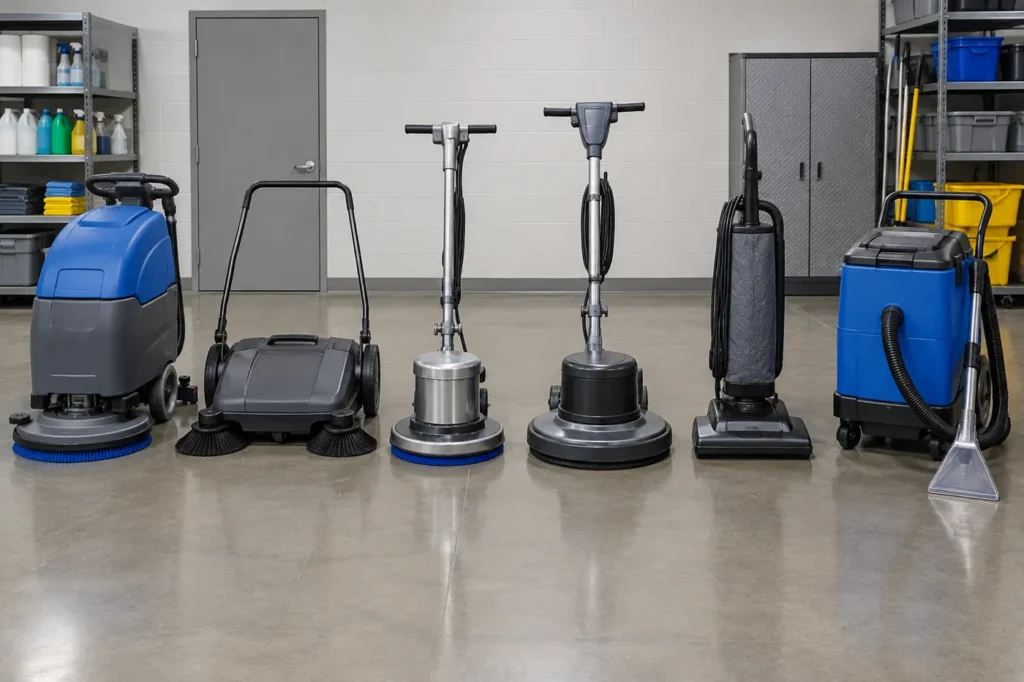
Commercial floor cleaning machines come in eight main types: floor scrubbers, floor sweepers, sweeper-scrubbers, low-speed floor machines (buffers), burnishers, commercial vacuums, carpet extractors and pressure washers. Which one you need depends on three things: whether the floor is hard or carpet, whether the soil is loose debris or stuck-on grime, and how much floor you clean. Most facilities end up with two or three of them, for example a vacuum and an extractor for carpet plus a scrubber for hard floors.
For hard floors that need washing, buy a floor scrubber. For loose debris on warehouse, dock and parking floors, buy a sweeper. To strip, scrub or spray-buff hard floors, use a low-speed floor machine (about 175 RPM). To shine a finished floor, use a burnisher (Nilfisk puts burnishers at 1,000 to 3,000 RPM). For carpet, use a commercial vacuum every day and a carpet extractor for deep cleaning. For outdoor concrete, docks and equipment, use a pressure washer.
The main types at a glance
| Machine | What it does | Floors | Typical price (Nov 2026) |
|---|---|---|---|
| Floor scrubber | Washes and dries hard floors in one pass | Hard floors, indoors | About $3,000 to $14,500 walk-behind; $28,000+ mid-size ride-on |
| Floor sweeper | Picks up dry debris into a hopper | Hard floors, indoors and outdoors | About $1,000 manual; about $8,900 battery walk-behind |
| Sweeper-scrubber | Sweeps and scrubs in the same pass | Large hard floors | Dealer quote |
| Floor machine (buffer) | Scrubs, strips and spray-buffs at low speed | Hard floors, some carpet bonnet cleaning | About $1,350 to $1,450 for Clarke CFP Pro 17 and 20 inch models |
| Burnisher | Polishes floor finish to a high gloss | Finished hard floors | About $1,400 to $1,700 for 20 inch corded models; more for battery and propane |
| Commercial vacuum | Removes dry soil from carpet | Carpet and some hard floors | About $170 to $900+ for uprights; about $450+ for backpacks |
| Carpet extractor | Sprays solution into carpet and extracts it | Carpet and upholstery | About $1,400 heated portables to $5,100 self-contained walk-behinds |
| Pressure washer | Blasts grime off outdoor surfaces | Concrete, docks, equipment | About $1,100 cold water to $5,000+ hot water |
Prices are from US listings in November 2026 and from our individual buying guides, linked in each section below. Dealer-only machines are quoted by configuration.
Floor scrubbers
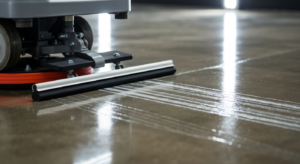
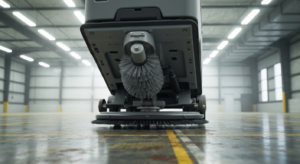
A scrubber puts cleaning solution on a hard floor, scrubs it with a pad or brush, and pulls the dirty water into a recovery tank with a squeegee and vacuum motor. The floor is washed and almost dry in one pass, which is why scrubbers replace mops in stores, schools, hospitals and warehouses.
- Walk-behind scrubbers are 17 to 20 inch machines for aisles, restrooms and mid-size floors. The Tennant T300 (11 gallon solution, 14 gallon recovery) and Minuteman E20 are common picks, and the 17 inch Viper AS4325B suits small shops. See best walk-behind floor scrubbers.
- Ride-on scrubbers cover large open floors. Tennant lists up to 56,320 square feet per hour for the T7. See best ride-on floor scrubbers.
- Micro riders like the Minuteman Max Ride 20 give the operator a seat on a machine about the size of a walk-behind.
Our floor scrubber price guide covers what each size costs, and how to use a floor scrubber covers operation.
Floor sweepers
A sweeper uses a roller brush and side brushes to throw dry debris into a hopper, with a filter to trap dust. It does not wash the floor, but it picks up sand, packaging, gravel and litter that would clog a scrubber, and it works outdoors.
- Manual push sweepers like the Karcher KM 70/20 C need no batteries and suit areas up to about 20,000 square feet.
- Battery walk-behinds like the Nilfisk SW900 and Tennant S10 suit daily sweeping of larger floors.
- Ride-on sweepers like the Tennant S16 suit warehouses and distribution centers.
See best commercial floor sweepers, and if you are deciding between the two machines, floor sweeper vs floor scrubber.
Sweeper-scrubbers
A sweeper-scrubber sweeps debris into a hopper and scrubs behind it in one pass. Tennant’s M17 has a 40 inch scrub path and a 75 gallon solution tank, and its M20 cleans a path of 40 inches, or up to 56 inches with a sweeping side brush. These are large industrial riders for plants and distribution centers that have both heavy debris and grime and want one operator doing one pass.
Floor machines (buffers)
A low-speed floor machine, often called a buffer or swing machine, spins a single pad or brush at about 175 RPM. The Clarke CFP Pro 20HD, for example, has a 20 inch deck, a 175 RPM pad speed, a 1.5 hp motor and weighs about 101 lb. Nilfisk puts buffers in the range of 150 to 330 RPM.
These machines do the heavy work of floor care: scrubbing, stripping old finish, spray-buffing, and bonnet cleaning carpet. They are cheaper than an automatic scrubber but do not pick up water, so wet scrubbing or stripping needs a wet/dry vacuum or mop to recover the slurry. They take practice to control, because the machine swings to the side when you raise or lower the handle. The Clarke CFP Pro 17HD and 20HD were listed at about $1,350 to $1,450 in November 2026.
Burnishers
A burnisher spins a pad at high speed to polish floor finish to a gloss. Nilfisk puts commercial burnishers at 1,000 to 3,000 RPM, and floor care distributor Waxie describes 1,500 RPM as the most common speed, with 2,000 to 2,500 RPM ultra-high-speed machines mostly used on higher-solids finishes. Burnishers only work on clean, finished hard floors. They do not scrub or strip, so they are used after the floor has been cleaned. In November 2026, 20 inch corded burnishers such as the Viper VN1500 (1,500 RPM, 1.5 hp, 50 ft cord) and the Powr-Flite NM2000 (2,000 RPM) were listed at about $1,400 to $1,700. Corded models suit smaller areas, and battery or propane models suit large stores and schools.
Commercial vacuums
Vacuums handle carpet, and they handle the daily dry-soil removal that makes carpet last longer.
- Uprights are the standard for offices and hotels. Our pick for heavy daily use is the dual-motor Windsor Versamatic VS14. See best commercial upright vacuums.
- Backpacks are faster for stairs, under furniture and crowded spaces. See best commercial backpack vacuums.
- Wet/dry and industrial vacuums pick up water, slurry and heavy debris. See best industrial vacuums.
- HEPA vacuums are needed for lead, silica and other hazardous fine dust. See what is a HEPA vacuum.
Carpet extractors
An extractor sprays cleaning solution into carpet with a pump and vacuums it back out with strong vacuum motors, pulling out the soil a vacuum leaves behind. Commercial machines have pumps of about 100 PSI or more, tanks of about 4 to 12 gallons, and often a heater. Box extractors with a wand suit most commercial work, self-contained walk-behinds suit large carpet areas, and small heated units suit spots. See best commercial carpet extractors and carpet extractor vs carpet cleaner.
Pressure washers
Pressure washers clean outdoor concrete, loading docks, dumpster pads, fleet vehicles and equipment. They are not indoor floor machines, because they leave far more water than a floor can handle. Cold water machines suit dirt and mud. Hot water machines clean grease and oil much faster. See best commercial pressure washers, best hot water pressure washers and hot vs cold water pressure washers.
How to choose: match the machine to the floor and the soil
| Your floor and soil | Machine |
|---|---|
| Hard floor, tracked-in dirt, spills, grease | Floor scrubber |
| Hard floor, loose dry debris, outdoor areas | Floor sweeper |
| Large hard floor with both debris and grime | Sweeper-scrubber, or a sweeper then a scrubber |
| Hard floor that needs stripping and refinishing | Floor machine (buffer) plus a wet/dry vacuum |
| Finished hard floor that needs shine | Burnisher |
| Carpet, daily soil | Commercial vacuum |
| Carpet, deep cleaning and stains | Carpet extractor |
| Outdoor concrete, docks and equipment | Pressure washer |
After the type, size the machine to the area. Walk-behinds suit smaller and crowded spaces, and ride-ons suit large open floors where one person would otherwise spend most of a shift behind a machine. Measure your narrowest aisle and doorway before you compare models.
Typical machine sets by facility
| Facility | Usual machines |
|---|---|
| Office | Upright or backpack vacuums, a small carpet extractor, and a small scrubber or mop for restrooms and break rooms |
| Retail store | Walk-behind or micro rider scrubber, burnisher for finished floors, vacuum for entry mats |
| School | Walk-behind scrubbers, floor machine for summer strip and refinish, burnisher, vacuums, carpet extractor |
| Restaurant or commercial kitchen | Small walk-behind scrubber for grease, wet/dry vacuum, pressure washer for mats and dumpster pads |
| Warehouse or plant | Sweeper and scrubber, or a sweeper-scrubber, plus an industrial or HEPA vacuum |
| Hotel | Upright and backpack vacuums, carpet extractors, scrubber for lobby and back-of-house hard floors |
For a warehouse routine that uses these machines in order, see how to clean a warehouse floor. If you are equipping a cleaning business, our commercial cleaning equipment list shows what to buy first and what to rent.
Starter machines on Amazon

Viper AS4325B walk-behind scrubber, 17 inch
Battery scrubber with 85Ah AGM batteries and an onboard charger for small hard-floor areas.
Check price on Amazon
Karcher KM 70/20 C push sweeper, 28 inch
No batteries or fuel. For workshops, small warehouses and parking areas.
Check price on Amazon
Clarke CFP Pro 20HD floor machine, 20 inch
175 RPM, 1.5 hp, all-steel gearbox. For scrubbing, stripping and spray-buffing.
Check price on Amazon
Viper VN1500 Venom burnisher, 20 inch, 1,500 RPM
Corded high-speed burnisher with a 1.5 hp motor and 50 ft cord, for shining finished floors.
Check price on Amazon
Sandia 80-2100 Sniper, 12 gal, 100 PSI
Box extractor with dual 2-stage vacuum motors for general commercial carpet work.
Check price on AmazonAs an Amazon Associate we earn from qualifying purchases. Prices and availability change, so check the current price on Amazon.
Buying tips that apply to every machine
- Service matters as much as the machine. Most commercial machines are sold and repaired through dealers. Before you buy, find out who services that brand near you and how long parts take.
- Count the running costs. Pads, brushes, squeegee blades, filters, detergent and batteries add up every year.
- Corded or battery. Corded machines cost less and never run out mid-shift, but cords slow work and are a trip hazard in busy areas.
- Train every operator. Most machine problems come from skipped daily care, such as tanks left full, filters left dirty and batteries left half charged. Our floor scrubber maintenance checklist is a good model for any machine.
Frequently asked questions
What are the different types of floor cleaning machines?
The main commercial types are floor scrubbers, floor sweepers, sweeper-scrubbers, low-speed floor machines (buffers), burnishers, commercial vacuums, carpet extractors and pressure washers.
What is the best floor cleaning machine for commercial use?
For most hard-floor facilities, a battery walk-behind floor scrubber, such as a 20 inch Tennant T300 or Minuteman E20, because it washes and dries the floor in one pass. For carpeted offices, a commercial upright vacuum plus a carpet extractor.
What is the difference between a buffer and a burnisher?
A buffer, or low-speed floor machine, spins at about 175 RPM and is used for scrubbing, stripping and spray-buffing. A burnisher spins much faster, about 1,000 to 3,000 RPM, and is only used to shine a clean, finished floor.
What machine is used to clean commercial carpet?
A commercial vacuum for daily soil removal, and a carpet extractor for deep cleaning and stains. Some cleaners also use a floor machine with a bonnet pad for quick interim cleaning.
Is a floor scrubber better than a mop?
On large hard floors, yes. A scrubber puts down clean solution and picks up the dirty water in one pass, so it leaves the floor cleaner and drier, while a mop spreads dirty water around as the bucket gets dirty.
Bottom line: pick the machine by floor type and soil first, then by area. Scrubbers wash hard floors, sweepers pick up dry debris, floor machines strip and scrub, burnishers shine, vacuums and extractors handle carpet, and pressure washers handle outdoor concrete.
[…] Commercial Floor Cleaning Machines […]