How to Adjust a Pressure Washer Unloader Valve (Step by Step)

Some links in this guide are affiliate links. If you buy through them we may earn a commission, at no extra cost to you. This never affects what we recommend or how we rank equipment. Read our disclosure.
To adjust a pressure washer unloader valve, fit a pressure gauge at the pump outlet, start the machine with the unloader backed off (turned counterclockwise), then squeeze the trigger and turn the adjuster clockwise a quarter turn at a time until the gauge shows the pressure you want. Never go above the pump’s rated pressure, and never use the unloader to make up for a worn nozzle. Lock the nut when you are done.
Install a gauge at the pump, start with the unloader backed off counterclockwise, then squeeze the trigger and read the gauge. Release the trigger, turn the adjuster a quarter turn clockwise, and check again. Repeat until you reach the desired pressure, staying below the pump’s rated maximum. Then tighten the lock nut. Read pressure at the pump, not at the gun.
What does an unloader valve do?
A pressure washer pump keeps pumping water as long as the engine or motor runs. When you release the trigger, that water has nowhere to go. The unloader valve senses this and sends the flow back to the pump inlet or a bypass line instead of letting pressure climb until something bursts. When you squeeze the trigger again, it closes the bypass and sends the flow to the gun.
Most unloaders also set the working pressure. The adjuster on top changes the spring tension, and that decides the pressure at which the valve starts to bypass. That is the setting this guide covers.
The unloader is only one half of the protection. Cat Pumps’ unloader manual warns that every system needs both a primary pressure regulating device, such as an unloader, and a secondary safety relief device, such as a pop-off valve. Do not remove or plug the relief valve to get more pressure.
When should you adjust the unloader?
- after replacing the pump, the unloader or the nozzle set
- when a gauge shows the machine is above or below its rated pressure with a correct new nozzle
- when the machine was set by someone else and you do not know the setting
Do not adjust it to fix pressure that has dropped slowly over time. That is almost always a worn nozzle, a supply problem or worn seals. Cat Pumps says plainly: do not adjust the unloader pressure setting to compensate for a worn nozzle; check the nozzle and replace it if worn. Our guide to a pressure washer losing pressure walks through those checks first.
Tools you need
- a pressure gauge with a fitting that goes between the pump outlet and the hose, or a test port on the pump; a gauge range of about twice your working pressure reads more accurately and is not over-stressed
- the correct new nozzle for your machine’s rated pressure and flow
- wrenches for the adjuster and lock nut
- the pump’s rated maximum pressure, from the data plate or manual
- safety glasses and gloves
Tools for this job

Pressure washer gauge kit, 0 to 5,000 PSI
Glycerin-filled gauge with 3/8 inch quick connects. Pick a range of about twice your working pressure.
Check price on Amazon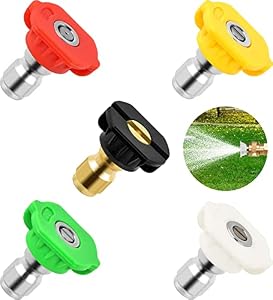
Pressure washer nozzle tip set (0, 15, 25, 40, soap)
1/4 inch quick connect set sized for 4 GPM machines. Match the orifice size to your pump.
Check price on AmazonAs an Amazon Associate we earn from qualifying purchases. Prices and availability change, so check the current price on Amazon.
How to adjust a pressure washer unloader valve, step by step
These steps follow the pressure adjustment procedure in Cat Pumps’ unloader manual. Check your own unloader’s manual too, because designs differ.
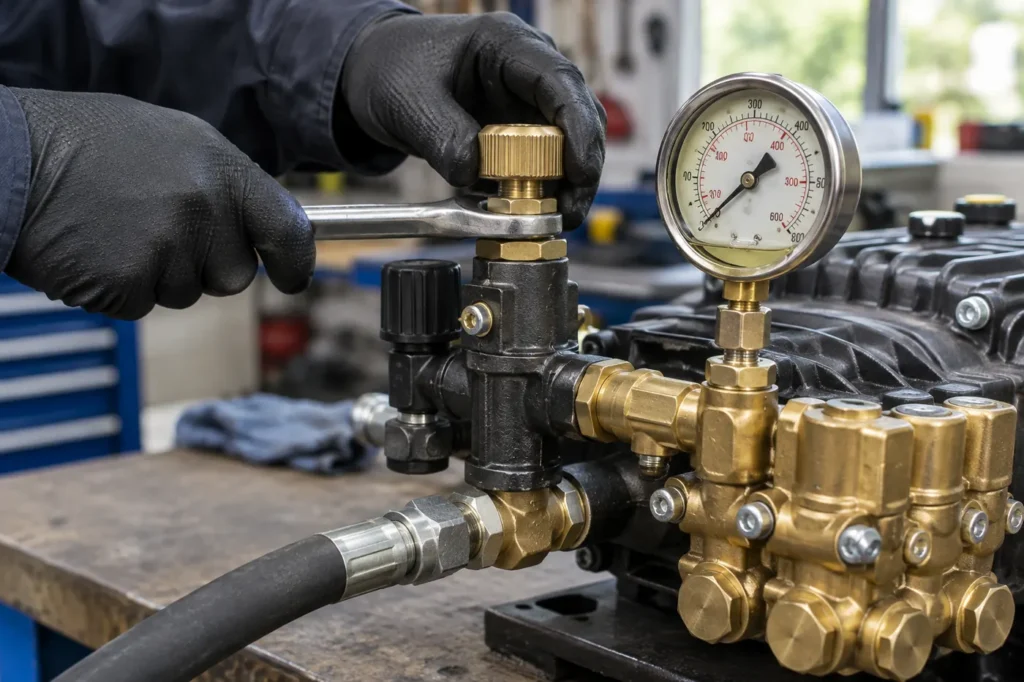
- Fit the gauge at the pump. Read pressure at the pump outlet, not at the gun or nozzle. Pressure at the gun is lower because of hose losses, and setting by the gun reading leads people to over-tighten.
- Fit the correct, unworn nozzle. The nozzle size decides what pressure the pump can reach. A worn or wrong nozzle gives a false reading.
- Loosen the lock nut and back the adjuster off. Turn the adjuster counterclockwise to the lowest pressure setting.
- Start the machine with the water on. Cat’s manual says setting and adjusting the unloader must be done with the system on. Run the engine at full throttle.
- Squeeze the trigger and read the gauge.
- Release the trigger and turn the adjuster a quarter turn clockwise. Small steps matter. A full turn at a time makes it easy to overshoot.
- Squeeze the trigger and read the gauge again. Repeat steps 6 and 7 until the gauge shows the pressure you want.
- Stop below the pump’s rated maximum. If you reach the rated pressure, stop turning, even if you wanted more.
- Tighten the lock nut against the adjuster so vibration cannot change the setting.
- Check the trigger release. Release and squeeze the trigger several times. The pressure should return to the same reading each time, and the hose should not jump hard when you let go.
Keep some water bypassing
Cat Pumps’ manual adds a caution many people miss: at least 5% of the unloader’s rated flow should be bypassing during operation. If you screw the adjuster in until none of the water bypasses, the cushioning effect is lost and the unloader can malfunction or wear early. Screwing the adjuster all the way in is also the cause Cat lists for extreme pressure spikes.
Setting the relief valve
If your machine has a separate relief or pop-off valve, Cat’s guidance is to set it to relieve at about 200 PSI above the system’s operating pressure. That way it stays closed during normal use but opens before pressure reaches a dangerous level.
What if it will not reach the right pressure?
Cat Pumps’ troubleshooting chart lists these causes when an unloader will not come up to pressure:
| Cause | What to check |
|---|---|
| Nozzle worn | Fit a new nozzle of the correct size |
| Not enough water reaching the pump | Supply flow, supply hose size, inlet filter |
| Debris in the unloader | Clean the inlet filter and the unloader |
| Worn piston stem O-rings | Rebuild the unloader with a seal kit |
| Unloader not sized for the system | Check its pressure and flow rating against the pump |
If none of these fix it, the pump itself may have worn seals or valves. Turning the adjuster further will not help and can damage the pump.
Signs of a bad or badly set unloader
| Symptom | Likely cause |
|---|---|
| Pressure spikes or the hose jumps when you release the trigger | Adjuster screwed in too far, restricted bypass, or flow above the unloader’s rating |
| Pump cycles (pulses on and off) with the trigger released | A leak downstream of the unloader, a worn gun O-ring, a worn check valve, or air in the system |
| Water leaking from the unloader body | Cut or worn O-rings on the fitting, seat or piston |
| Low pressure that adjusting does not fix | Worn nozzle, low water supply, debris or worn piston O-rings |
A pump that cycles while the trigger is off is often a leak, not an adjustment problem. Check the gun, the hose fittings and the wand for drips before you touch the unloader. Our guide to a pressure washer surging or pulsing walks through every cause.
Safety
- Shut off the engine or motor and squeeze the trigger to release trapped pressure before you remove the gauge, the nozzle or the unloader.
- Never point the gun at anyone while testing, and keep hands clear of the spray.
- Never go above the pump’s or the hose’s rated pressure, whichever is lower.
- Never disable the relief valve or the thermal relief valve.
Frequently asked questions
Which way do you turn an unloader to increase pressure?
Clockwise increases pressure on most unloaders, and counterclockwise lowers it. Cat Pumps’ procedure starts with the adjuster backed off counterclockwise and raises pressure a quarter turn clockwise at a time. Check your unloader’s manual to confirm.
Can I adjust the unloader without a pressure gauge?
You can, but you will be guessing. Without a gauge it is easy to set the pressure above the pump’s rating, which shortens pump and seal life and can cause pressure spikes. A gauge costs far less than a pump.
Why does my pressure washer pulse when the trigger is released?
That is usually the unloader cycling because water is leaking somewhere after it, such as a worn gun O-ring, a leaking fitting or a worn check valve. Fix the leak first. Cat Pumps also lists air in the system and low flow through the unloader as causes.
How do I know if my unloader valve is bad?
Signs include pressure that will not come up even with a new nozzle and good supply, water leaking from the unloader body, pressure spikes at trigger release, or pressure that fades while spraying. Worn O-rings inside the unloader are a common cause, and rebuild kits are available for most commercial unloaders.
Should I set the unloader to the pump's maximum pressure?
No. Set it at or below the pump’s rated pressure and never above it. Many operators run slightly under the maximum to reduce wear on the pump, hose and gun.
Bottom line: set the unloader with a gauge at the pump and a new nozzle fitted, raise pressure a quarter turn at a time, stop below the pump’s rating and lock the nut. If pressure will not come up, fix the nozzle, supply or seals instead of turning the adjuster further.
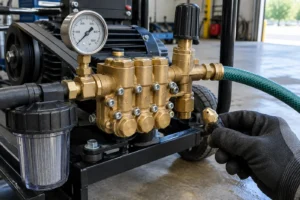
[…] The unloader sends water back to the pump inlet when you release the trigger. If its piston sticks or its seals wear, it keeps bypassing water while you spray, so less reaches the nozzle. Cat Pumps lists a worn or stuck unloader piston as a low-pressure cause and recommends taking it apart, cleaning and repairing it, or replacing the piston. If the unloader was replaced or never set correctly, follow our guide on how to adjust a pressure washer unloader valve. […]
[…] lose power, our guide to a pressure washer losing pressure covers the checks to do first, and the unloader adjustment guide explains how to set pressure correctly after a pump or nozzle […]
[…] not try to fix cycling by turning the unloader adjuster. Our guide on how to adjust a pressure washer unloader valve explains the right way to set it with a […]