Hot Water Pressure Washer Burner Not Firing: Causes and Fixes

Some links in this guide are affiliate links. If you buy through them we may earn a commission, at no extra cost to you. This never affects what we recommend or how we rank equipment. Read our disclosure.
When a hot water pressure washer burner is not firing, work through it in the order the burner needs things: water flow first, then fuel, then spark. Most burners will not light unless the pump is pushing water through the coil, so a wrong nozzle, a low water supply or a flow switch that never closes can look exactly like a dead burner. After that, the usual causes are no fuel, a clogged fuel filter or fuel nozzle, a weak fuel pump, worn or misadjusted electrodes, and a failed ignition transformer.
Check in this order: the burner switch and thermostat are on, the pump is spraying with the correct nozzle and enough water supply (so the flow or pressure switch closes), there is clean fuel in the burner tank, the fuel filter and fuel nozzle are not clogged, the fuel pump delivers pressure, the electrodes are gapped and not eroded, and the ignition transformer makes a spark. Alkota, a hot water pressure washer maker, lists these same causes.
How the burner decides to fire
A diesel or kerosene burner on a pressure washer needs three things: fuel, air and a spark. On top of that, a safety switch only lets the burner run while water is moving through the heating coil, so the coil never boils dry. Depending on the machine this is a flow switch or a pressure switch. When you squeeze the trigger, water flows, the switch closes, and the burner gets power. Release the trigger and the burner should stop.
That is why the first checks are about water, not fire.
Burner not firing: causes in the order to check them
| Check | What to look for | Fix |
|---|---|---|
| Burner switch and thermostat | Burner switch off, thermostat turned down | Turn the burner on and set the thermostat above the water temperature |
| Water flow and nozzle | No spray, wrong or worn nozzle, weak supply | Fit the correct high-pressure nozzle and confirm the supply |
| Flow or pressure switch | Switch does not close when spraying | Test it; clean or replace it |
| Fuel | Empty tank, closed fuel valve, old or contaminated fuel | Fill with clean, fresh diesel or kerosene as the maker specifies |
| Fuel filter | Clogged filter or water in the filter bowl | Drain water and replace the filter |
| Fuel nozzle | Clogged or worn burner nozzle | Replace the nozzle with the exact size and spray angle |
| Fuel pump | Pump not building pressure | Check output pressure against the spec; replace if low |
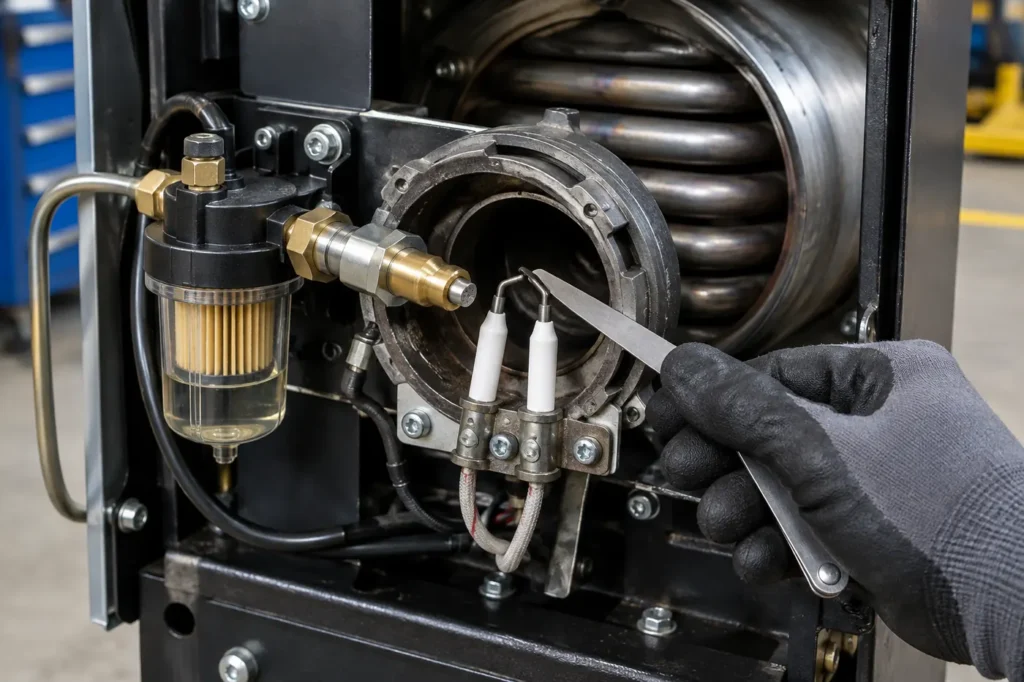
| Electrodes | Gap out of adjustment, tips eroded or sooted | Clean, re-gap to spec, replace eroded electrodes |
| Ignition transformer | No spark at the electrodes | Test the output; replace if failed |
1. Burner switch and thermostat
It sounds obvious, but it catches people every day. Many machines have a separate burner switch, and the thermostat must be set higher than the incoming water temperature or the burner has no reason to fire.
2. Water flow, nozzle and supply
If the machine is not spraying properly, the flow or pressure switch never closes. Fit the correct high-pressure nozzle, not the low-pressure soap tip, and make sure the water supply can deliver the pump’s rated flow. If you are fighting low pressure too, start with our guide to a pressure washer losing pressure.
3. The flow or pressure switch
With the machine spraying, the switch should close and send power to the burner. To test it, disconnect the switch wires from the burner circuit and put a multimeter on continuity across the switch. It should read open with no water flowing and closed while the pump is spraying. A stuck or failed switch is a common cause on older machines, and scale in the coil can also reduce flow enough that the switch drops out.
4. Fuel supply
Check the burner tank level and the fuel shutoff valve. Alkota warns that old fuel “can wreak havoc on all burner parts”, and recommends clean, fresh fuel, draining or topping off the tank for storage, and draining water from the fuel filter.
5. Fuel filter and fuel nozzle
A clogged fuel filter starves the pump, and a clogged or worn burner nozzle sprays a poor pattern or none at all. Burner nozzles are cheap wear parts. Replace with the exact flow rate, spray angle and pattern listed for your burner.
6. Fuel pump
If fuel reaches the pump but the burner still does not fire, the pump may not be building enough pressure. Burner fuel pumps have a set output pressure listed in the machine’s manual, and checking it needs a fuel pressure gauge on the test port. This is often a dealer job.
7. Electrodes and ignition transformer
The ignition transformer sends high voltage to two electrodes that make the spark in front of the fuel nozzle. If the gap is wrong, the tips are eroded, or they are covered in soot, the spark is weak or missing. If the electrodes are fine and there is still no spark, the transformer or the ignition control may have failed. Mi-T-M notes that on its HEG burners the ignition control box needs its 24V AC supply, or no other part of the burner circuit works.
Work on the ignition system only with the power disconnected. The transformer output is high voltage.
Burner fires, then shuts off
Alkota lists these causes when the burner lights but shuts off shortly after:
- the flow switch is tripping because water flow through the coil is low
- the high temperature limit switch is tripping from overheating
- the flame sensor or stack switch is not detecting the flame
- the thermostat is set too low and shuts the burner off immediately
- heavy scale in the coil is restricting flow, so the flow switch trips
Burner runs but the water is not hot enough
If the burner fires but the outlet temperature is low, Alkota points to a low thermostat setting, scale in the coil reducing heat transfer, a worn or partly clogged fuel nozzle, an air band out of adjustment, or the burner cycling off too often. Also check the flow: a machine putting out more water than its burner is rated for cannot reach full heat rise. Our guide to the best hot water pressure washers explains how burner output and flow set the temperature you get.
Black smoke or white smoke
- Black smoke: usually too much fuel or too little air, from a wrong fuel nozzle, a misadjusted air band, or soot blocking the coil. The burner needs cleaning and tuning.
- White smoke: often unburned fuel or water in the fuel, and sometimes simply a cold start. If it continues, check the fuel for water and the spark for weakness.
Tool for the electrical checks

Klein Tools MM325 digital multimeter
Checks continuity on the flow or pressure switch and voltage at the burner circuit. Use with the power off for continuity tests.
Check price on AmazonAs an Amazon Associate we earn from qualifying purchases. Prices and availability change, so check the current price on Amazon.
Preventing burner problems
- Use clean, fresh fuel of the type the maker specifies, and drain water from the fuel filter regularly.
- Replace the fuel filter and fuel nozzle on the maker’s schedule.
- Have the burner cleaned and tuned once a year on machines that run often.
- In hard water areas, use the maker’s scale protection or descaling routine, because scale cuts both flow and heat.
- Never let the coil freeze. Drain it or fill it with antifreeze before cold weather.
Frequently asked questions
Why won't my hot water pressure washer get hot?
Most often the burner is not firing because water is not flowing well enough to close the flow switch, the thermostat is set too low, or the fuel filter or fuel nozzle is clogged. If the burner fires but the water stays warm, look for scale in the coil or a worn fuel nozzle.
Will a hot water pressure washer burner fire without water flowing?
No. A flow or pressure switch only lets the burner run while water moves through the coil, which protects the coil from overheating. Squeeze the trigger with the correct nozzle fitted to test the burner.
How do I know if the ignition transformer is bad?
With the power off, check the electrodes first: correct gap, clean tips, no cracks. If they are fine and there is still no spark when the burner should fire, the transformer or ignition control is the likely cause. Testing the output involves high voltage, so it is often a dealer job.
What fuel does a pressure washer burner use?
Most portable burners run on diesel or kerosene from a separate tank. Use the fuel listed on the burner label, keep it clean and fresh, and never put gasoline in a diesel burner.
Why does my burner smoke?
Black smoke usually means too much fuel or not enough air, from a wrong nozzle, a misadjusted air band or soot in the coil. White smoke usually means unburned fuel or water in the fuel. Either way, the burner needs cleaning and tuning.
If water is flowing but the pressure is weak or pulsing, see pressure washer surging or pulsing. Still choosing a machine? Read hot vs cold water pressure washer.
Bottom line: a burner needs water flow, fuel and spark, in that order. Confirm the machine is spraying and the switch closes, then check fuel, filter and nozzle, then the electrodes and transformer. Fresh fuel and a yearly burner service prevent most of these problems.
[…] Hot Water Pressure Washer Burner Not Firing […]