How Long Do Floor Scrubber Batteries Last? Lithium vs Lead-Acid

Some links in this guide are affiliate links. If you buy through them we may earn a commission, at no extra cost to you. This never affects what we recommend or how we rank equipment. Read our disclosure.
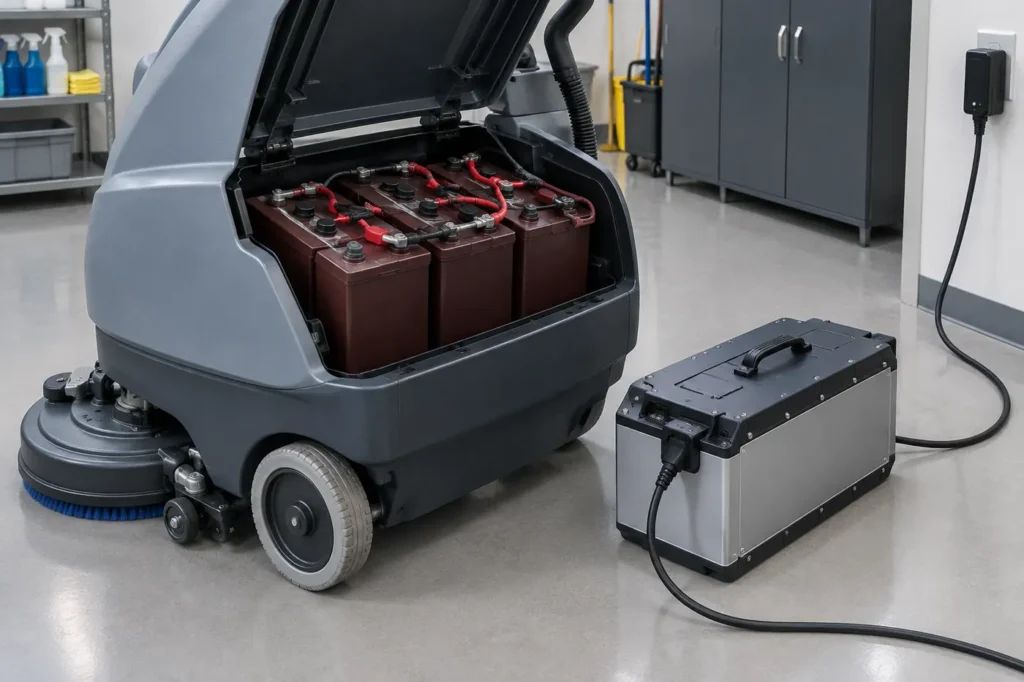
How long do floor scrubber batteries last? On a charge, most walk-behind and ride-on scrubbers run about 2 to 4.5 hours, depending on battery size and the machine. Over their life, flooded and AGM lead-acid batteries are typically rated for several hundred cycles, which works out to roughly 2 to 3 years of daily use when they are charged correctly, and less when they are not. Lithium batteries are rated for 2,000 or more cycles by makers like Tennant, which could mean about 8 years of one charge per working day.
Run time per charge: about 2 to 4.5 hours on the machines we cover. Service life: lead-acid batteries rated around 700 cycles give roughly 2 to 3 years at one cycle per working day, but battery maker EnerSys warns that frequent partial charging can cut a 700 cycle battery to about 300 cycles. Lithium: Tennant rates its lithium batteries at 2,000+ cycles (1,500 to 4,000 by model) with a 5-year warranty, and they handle partial charging without damage.
Run time per charge
| Machine | Battery | Run time listed |
|---|---|---|
| Viper AS4325B, 17 in walk-behind | 85Ah AGM | Up to about 4 hours |
| Nilfisk SC401 17B, 17 in walk-behind | Standard wet batteries | Up to about 3 hours |
| Tennant T300, 20 in walk-behind | 105 to 155Ah options | About 2.5 to nearly 4 hours by deck |
| Minuteman Max Ride 20, micro rider | Standard pack | About 3 to 3.5 hours |
| Tennant T7, mid-size rider | Battery options | Up to 4.5 hours |
| Tennant T16, large rider | Battery options | Up to 4 hours |
These are the makers’ and dealers’ figures from our walk-behind and ride-on scrubber guides. Real run time drops with heavy brush pressure, high vacuum settings, aggressive floors and older batteries.
How many years do floor scrubber batteries last?
Battery life is measured in charge cycles. One cycle is roughly one discharge and recharge. To turn cycles into years, divide by how many times you charge per year. At one charge per working day, about 250 cycles a year:
| Battery type | Cycle rating (maker figures) | Rough life at 250 cycles per year |
|---|---|---|
| Flooded lead-acid or AGM | Around 700 cycles in EnerSys’s example | About 2.5 to 3 years |
| Flooded or AGM with frequent partial charging | Can drop to about 300 cycles, per EnerSys | About 1 to 1.5 years |
| Lithium (Tennant) | 2,000+ cycles (1,500 to 4,000 by model) | About 6 to 16 years by cycles, limited by age and warranty |
| Lithium (U.S. Battery Essential Li) | Over 3,000 cycles | About 12 years by cycles |
These are rough planning numbers, not guarantees. Batteries also age with time, heat and how deeply they are discharged, so check the warranty, which is often the better guide. Tennant offers a 5-year warranty on its lithium batteries.
Lithium vs lead-acid scrubber batteries
| Flooded (wet) lead-acid | AGM (sealed lead-acid) | Lithium-ion | |
|---|---|---|---|
| Up-front cost | Lowest | Moderate | Highest |
| Watering | Weekly, after charging | None | None |
| Charge time | Up to 8 hours or more | Up to 8 hours or more | About 2 to 3 hours on many packs |
| Partial (opportunity) charging | Shortens life | Shortens life | Fine |
| Cycle life | Hundreds of cycles | Hundreds of cycles, often less than wet | 2,000+ cycles on Tennant packs |
| Spill and fume risk | Acid spills if overwatered; gas when charging | Sealed | Sealed |
EnerSys, which makes all of these battery types, notes that wet batteries need weekly watering, that over-watering spills acid onto equipment and floors, and that lithium-ion has by far the highest replacement cost. It also points out that wet and AGM batteries can come back from a long idle period, like a school’s summer break, dead.
What shortens battery life
- Partial charging lead-acid batteries. Plugging in for short top-ups is the fastest way to wear out wet and AGM batteries. Charge them fully after each use.
- Running them flat. Deep discharges cut cycle life. Recharge when the battery indicator says so instead of running until the machine stops.
- Low water in flooded batteries. Plates exposed to air are damaged permanently.
- Watering before charging. Electrolyte expands during charging and can overflow. Water after the charge, to the level in the manual.
- The wrong charger profile. A charger set for flooded batteries can damage AGM or lithium packs, and the reverse.
- Heat and storage. Hot storage rooms and long periods sitting discharged shorten life.
- Dirty tops and corroded terminals. These cause voltage loss and charging faults.
How to make scrubber batteries last longer
- Charge lead-acid batteries fully after every use, in a ventilated area.
- Water flooded batteries after charging, with distilled water, to the level in the manual.
- Check each cell’s specific gravity with a hydrometer every month on flooded batteries to find weak cells early.
- Keep battery tops clean and dry, and terminals tight and free of corrosion.
- Store machines fully charged, and top them up periodically during long idle periods.
- Use the charger profile the battery maker specifies.
Our floor scrubber maintenance checklist covers battery care along with the rest of the machine, and if a battery will not take a charge, see our guide to a floor scrubber battery not charging.
Battery care tools

Battery hydrometer tester, 2 pack
Reads each cell's specific gravity to find a weak cell. Not for AGM, gel or lithium.
Check price on Amazon
Klein Tools MM325 digital multimeter
Checks pack and charger voltage and cable connections.
Check price on Amazon
Battery watering gun with automatic shut-off
Fills flooded cells to the right level and stops, which prevents overfilling.
Check price on AmazonAs an Amazon Associate we earn from qualifying purchases. Prices and availability change, so check the current price on Amazon.
Is lithium worth it for a floor scrubber?
Lithium makes the most sense when the machine runs more than one shift a day, when you want to charge during breaks, or when nobody reliably waters batteries. Its higher price is offset by longer life, no watering and faster charging. For a machine used once a day and charged overnight by someone who looks after it, well-maintained lead-acid batteries are still the lowest up-front cost.
Frequently asked questions
How long does a floor scrubber battery last on one charge?
Most walk-behind and ride-on scrubbers run about 2 to 4.5 hours per charge, depending on battery size, brush pressure, vacuum setting and the floor.
How many years do floor scrubber batteries last?
Lead-acid batteries rated around 700 cycles last roughly 2.5 to 3 years at one charge per working day if they are charged fully. Lithium batteries rated at 2,000 or more cycles can last many years longer.
Can I top up charge my floor scrubber batteries during breaks?
With lithium, yes. With flooded or AGM lead-acid batteries, frequent partial charging shortens their life, so charge them fully after each use instead.
When should I water floor scrubber batteries?
After a full charge, not before. Use distilled water and fill only to the level in the manual. Overfilling can spill acid when the battery charges.
Are lithium floor scrubber batteries worth the extra cost?
For machines used more than once a day, or where nobody waters batteries reliably, usually yes. For single-shift machines charged overnight with good care, lead-acid is still the cheaper choice.
Bottom line: expect 2 to 4.5 hours per charge and roughly 2 to 3 years from well-kept lead-acid batteries. Charge them fully, water them after charging, and avoid partial top-ups. Lithium costs more but lasts far longer and handles charging during breaks.

[…] For how long each battery type should last, see how long floor scrubber batteries last. […]