Encapsulation vs Hot Water Extraction for Commercial Carpet

Some links in this guide are affiliate links. If you buy through them we may earn a commission, at no extra cost to you. This never affects what we recommend or how we rank equipment. Read our disclosure.
Encapsulation vs hot water extraction is not an either-or choice for commercial carpet. Encapsulation is a low-moisture interim clean: a chemical wraps the soil, dries into crystals and is vacuumed away. Hot water extraction is the restorative deep clean: solution is rinsed through the pile and pulled back out with a strong vacuum. Mohawk’s commercial carpet care guide calls for both, with encapsulation done often to keep carpet looking good and hot water extraction done less often to remove embedded soil.
Use encapsulation for frequent interim cleaning, because it uses little water and the carpet can be vacuumed once dry. Use hot water extraction for periodic deep cleaning, because Mohawk calls it the most effective method for restorative results and the only one that removes soil and residue from deep in the fibers. In a typical office, Mohawk’s schedule has general areas interim cleaned 9 times a year and deep cleaned 3 times a year.
What is encapsulation cleaning?
Encapsulation is a low-moisture method. Mohawk describes it as special chemistry that encapsulates the soil and dries it into a crystalline form, which is then removed by vacuuming. Mohawk’s process:
- Vacuum thoroughly to remove as much dry soil as possible.
- Apply the encapsulation pre-spray to the carpet.
- Agitate with a counter-rotating brush machine.
- Vacuum thoroughly once the carpet is dry.
Because so little water goes down, the carpet can go back into use much sooner than after extraction, which is why encapsulation suits offices, lobbies and hallways that cannot close for long. The soil does not leave the building on the day of cleaning; it leaves with the vacuuming that follows.
What is hot water extraction?
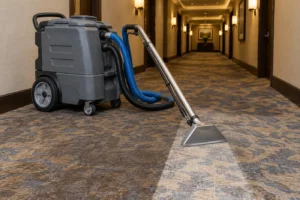
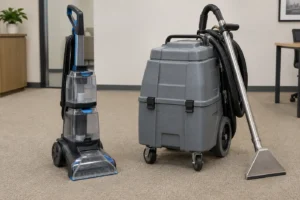
Hot water extraction, often called steam cleaning, injects water into the carpet under pressure and pulls it back out with strong suction. It can be done with a truck-mount, a portable or a self-contained extractor. Mohawk’s method has a detail many operators miss: the extraction happens so fast that detergent in the machine’s tank gets no dwell time. Mohawk’s process:
- Vacuum thoroughly.
- Pre-spray with the cleaning agent.
- Agitate with a counter-rotating brush or carpet rake to work the pre-spray through the pile.
- Rinse with plain water through the extractor. The only things Mohawk says to add to the machine’s tank are an acidic rinse agent or a defoamer.
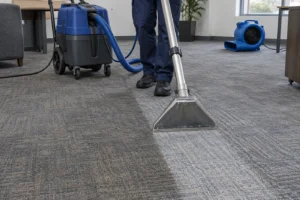
Mohawk says to make 3 to 4 dry passes for each wet pass, use air movers, and allow 3 to 4 hours of drying time before traffic. Done properly, it says the carpet should be dry within 4 to 6 hours. Our guide on how to use a carpet extractor covers the machine work step by step.
Encapsulation vs hot water extraction: side by side
| Factor | Encapsulation | Hot water extraction |
|---|---|---|
| Role in Mohawk’s program | Interim cleaning | Restorative deep cleaning |
| Water used | Low moisture | Rinse with plain water, then 3 to 4 dry passes |
| Drying | Vacuum once dry | Dry within 4 to 6 hours, per Mohawk |
| Main machine | Counter-rotating brush machine | Truck-mount, portable or self-contained extractor |
| Where the soil goes | Crystallized, then vacuumed out | Pulled into the recovery tank |
| Deep embedded soil | Not the method Mohawk names | Mohawk calls it the only method that removes it |
| Office general areas | 9 times a year | 3 times a year |
How often should you use each?
Mohawk gives a reference schedule by traffic level. Occupancy and traffic decide the real frequency, but the ratio is the useful part: interim cleaning about three times as often as deep cleaning.
| Area | Traffic | Interim (encapsulation) | Deep (hot water extraction) |
|---|---|---|---|
| Entries, ground floor halls, breakrooms | Heavy | 18 times a year | 6 times a year |
| Upper halls, offices, classrooms, corridors, conference rooms | Medium | 9 times a year | 3 times a year |
| Executive offices, boardrooms | Light | 3 times a year | Once a year |
Shaw Industries gives a similar rule in its commercial maintenance documents: hot water extraction after every third encapsulation. Whichever schedule you follow, check the warranty and maintenance guide for your specific carpet, since makers set the methods they accept.
For an encapsulation program

CarpetGeneral 5821 encapsulation cleaner, 1 gallon
Commercial interim cleaner that crystallizes soil for vacuuming. Mix at the label dilution.
Check price on Amazon
14 inch counter-rotating brush carpet machine
The machine type Mohawk names for encapsulation agitation and for pre-spray agitation before extraction.
Check price on AmazonAs an Amazon Associate we earn from qualifying purchases. Prices and availability change, so check the current price on Amazon.
Mistakes that hurt either method
- Using a spin bonnet. Mohawk says it does not recommend a spin bonnet, because it can damage carpet fibers. Use a counter-rotating brush machine for agitation instead.
- Skipping the vacuuming. Both methods start with thorough vacuuming, and encapsulation only works if you vacuum the crystallized soil away afterward.
- Leaving sticky residue. Mohawk says to test the cleaning agent to be sure it dries without stickiness, because residue causes rapid re-soiling.
- Harsh chemistry. Mohawk says to use cleaning agents with a pH below 10 and low VOCs, and points to the Carpet and Rug Institute’s Seal of Approval list of approved chemicals and equipment.
- Putting detergent in the extractor tank. Pre-spray and agitate, then rinse with plain water, as Mohawk describes. Detergent in the tank also causes foam, which can cause trouble in the recovery tank; see carpet extractor not picking up water.
Setting up a program from scratch? Our best commercial carpet extractor guide covers the deep-cleaning side, and our commercial cleaning equipment list covers the rest of the kit. To compare with hiring it out, try our carpet cleaning cost calculator.
Common questions
Is encapsulation better than hot water extraction?
Not on its own. Mohawk uses encapsulation for interim cleaning between deep cleans and calls hot water extraction the most effective method for restorative deep cleaning. A good commercial program uses both.
How long does encapsulation take to dry?
It uses low moisture, so it dries much faster than extraction. Mohawk’s process has you vacuum once the carpet is dry; check the drying time on your chemical’s label, which depends on the product and conditions.
How often should commercial carpet get hot water extraction?
Mohawk’s reference schedule is 6 times a year for heavy traffic areas, 3 times a year for medium traffic areas such as offices, and once a year for light traffic areas.
Can you use a rotary floor machine for encapsulation?
Mohawk recommends a counter-rotating brush machine and says it does not recommend a spin bonnet, because it can damage the fibers. Check your carpet maker’s guide before using a rotary machine.
Does encapsulation remove soil from carpet?
Yes, through vacuuming. The chemical dries the soil into crystals, and those are removed when you vacuum. Mohawk says only hot water extraction removes soil and residue from deep down in the fibers.
Should I put detergent in my extractor tank?
Mohawk says no. Pre-spray the cleaning agent, agitate, and rinse with plain water. The only additives it lists for the tank are an acidic rinse agent and a defoamer.
Bottom line: run encapsulation as your frequent interim clean and hot water extraction as your periodic deep clean, at roughly three interim cleans per deep clean, and follow your carpet maker’s maintenance guide.