Floor Buffer vs Burnisher: Speed, Jobs and Which One You Need

Some links in this guide are affiliate links. If you buy through them we may earn a commission, at no extra cost to you. This never affects what we recommend or how we rank equipment. Read our disclosure.
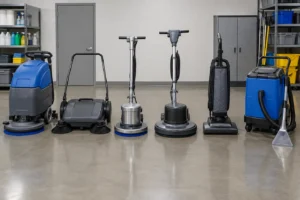
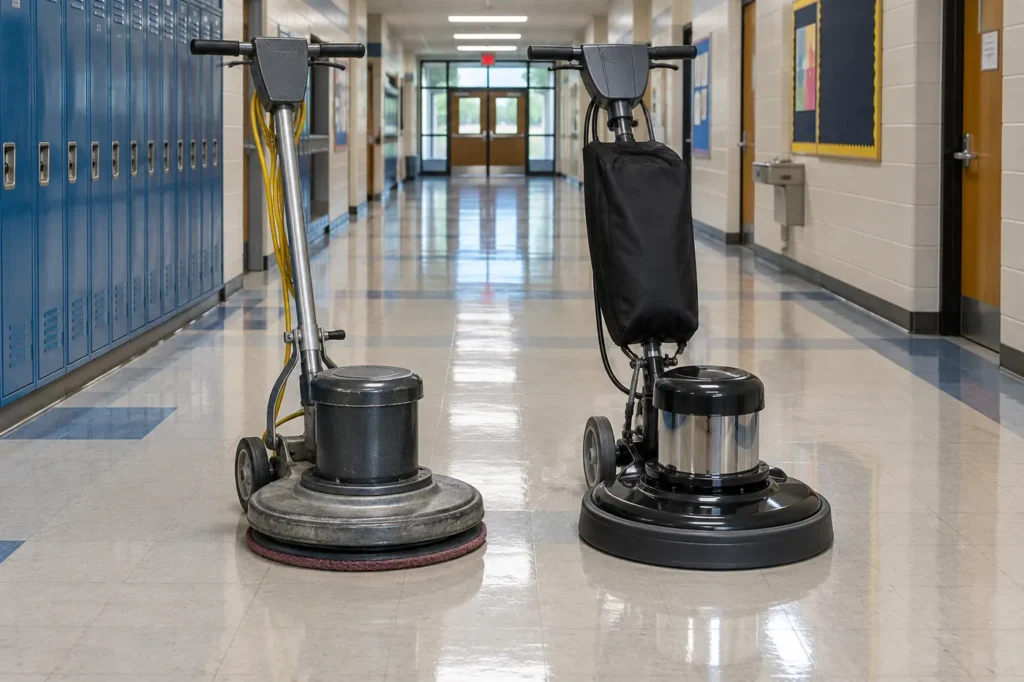
Floor buffer vs burnisher: the difference is speed and job. A buffer, also called a floor machine or swing machine, spins a pad at low speed, usually 175 RPM, and does the heavy work: scrubbing, stripping old finish and spray-buffing. A burnisher spins much faster, typically 1,500 to 2,000 RPM or more, and does one job: polishing a clean, finished floor to a high gloss. Most facilities that keep finished vinyl or VCT floors end up using both.
Nilfisk puts buffers at 150 to 330 RPM and commercial burnishers at 1,000 to 3,000 RPM. A buffer cleans, scrubs, strips and spray-buffs, and is guided side to side. A burnisher only polishes, and is pushed forward and back like a vacuum. Burnish only a clean floor: Nilfisk warns that burnishing a dirty floor traps dirt under the finish. If you need one machine first, buy the buffer; add a burnisher when you want a high-gloss look on a regular schedule.
Buffer vs burnisher at a glance
| Floor buffer (floor machine) | Burnisher | |
|---|---|---|
| Pad speed | Usually 175 RPM; dual-speed models 175 to 300 RPM | Usually 1,500 RPM; ultra-high-speed 2,000 to 2,500 RPM and up |
| Main jobs | Scrubbing, stripping, spray-buffing, carpet bonnet cleaning | High-gloss polishing of finished floors only |
| How you move it | Side to side in an arc | Forward and back in straight lines |
| Floor condition | Any: dirty, worn or ready for stripping | Clean, finished floors only |
| Common sizes | 13, 17 and 20 inch | 20 inch is most common for corded models |
| Power | Corded | Corded, battery or propane |
| Typical price (Nov 2026) | About $1,350 to $1,450 for a 17 or 20 inch Clarke CFP Pro | About $1,400 to $1,700 for 20 inch corded models |
Speeds are from Nilfisk and floor care distributor Waxie. Prices are US listings we checked for our commercial floor cleaning machines overview.
What a floor buffer does
A floor buffer is a heavy, low-speed machine that drives a single round pad or brush. Waxie says about 99.5% of low-speed machines run at 175 RPM, with no speed control. That slow, high-torque spin is what lets one machine do so many jobs:
- Scrubbing a soiled hard floor with a scrub pad and cleaning solution.
- Stripping old floor finish with a stripping pad and stripper, before new finish goes down.
- Spray-buffing, a maintenance step where a spray product and a buffing pad restore some shine between refinishing.
- Bonnet cleaning carpet, using an absorbent bonnet pad for quick interim carpet cleaning.
A buffer does not pick up water. After wet scrubbing or stripping, the slurry has to be picked up with a wet/dry vacuum or mop, or with an auto scrubber. Our guide to the best industrial and wet/dry vacuums covers the pickup side.
Dual-speed machines switch between 175 and about 300 RPM. Waxie says they give some polish, but not the same effect as a true burnisher, and they are generally only made in the 20 inch size.
What a burnisher does
A burnisher spins a soft burnishing pad very fast against a cleaned, finished floor. The friction and heat polish the finish to a gloss. Waxie describes 1,500 RPM as the most common speed and enough for most jobs, with ultra-high-speed machines at 2,000 to 2,500 RPM mostly used on higher-solids floor finishes.
A burnisher is a single-purpose machine. It does not scrub, strip or clean carpet. Its job is to keep finished floors in stores, schools, hospitals and offices looking glossy between full strip-and-refinish projects.
Waxie notes that 2,500 RPM machines often have dust control, a small passive vacuum with a paper bag, which matters in hospitals where even fine finish dust is a problem.
How you operate each one
The technique is different, and new operators often mix them up:
- Buffer: guided side to side in a sweeping arc. Raising the handle slightly makes the machine swing one way, lowering it swings it the other. It takes practice; a buffer that gets away from an operator can hit walls and furniture.
- Burnisher: pushed forward and back in straight lines, much like a vacuum, according to Nilfisk. Keep it moving, because a burnisher left spinning in one spot can burn the finish.
Do you need a buffer, a burnisher or both?
| Your situation | What to buy |
|---|---|
| Cleaning companies doing strip-and-wax jobs | Buffer first; it handles stripping and scrubbing |
| Small office or shop with mostly carpet | Buffer for bonnet cleaning and occasional hard floors |
| School, store or clinic with finished VCT or vinyl kept glossy | Both: buffer for scrubbing and stripping, burnisher for regular shine |
| Large retail floors burnished daily | Burnisher (battery or propane) plus an auto scrubber for daily cleaning |
| Unfinished concrete or tile without finish | Neither is the main tool; an auto scrubber cleans these floors |
If you are buying one machine, the buffer is more versatile and cheaper. Add a burnisher when the floors are finished and the facility wants a consistent high gloss.
The order matters: clean, then burnish
Nilfisk advises cleaning a floor first, or removing old polish, before burnishing, and warns against burnishing a dirty floor because dirt gets trapped under the finish and becomes very hard to remove. A typical routine on a finished floor:
- Dust mop or sweep to remove grit.
- Clean with a neutral cleaner, using an auto scrubber or a mop.
- Let the floor dry fully.
- Burnish with a clean burnishing pad.
- Dust mop again to pick up the fine powder burnishing leaves behind.
For the scrubbing step, see how to use a floor scrubber.
Corded, battery or propane burnishers
- Corded: the cheapest and lightest. Fine for small and mid-size areas, but the cord limits range and is a trip hazard in busy spaces.
- Battery: no cord and no fumes, so they suit stores and schools during open hours. They cost more and need charging.
- Propane: the most power and run time for very large floors. Propane engines produce carbon monoxide, so these machines need proper emissions control, ventilation and a maintenance schedule, and are usually run after hours in large open spaces. Follow the maker’s rules closely.
Choosing a machine
Size: Waxie calls the 20 inch floor machine the most common for productivity, with 13 inch machines easier to steer around restroom stalls.
Power on a buffer: Waxie’s guidance is about 1 HP for normal cleaning, 1.5 HP for cleaning and stripping, and 2 HP as the heavy-duty choice, including spin bonneting on carpet, where drag is higher. Underpowered machines can trip breakers under load.
Lifespan: Waxie says most low-speed machines and burnishers are meant to last 10 to 15 years, and warranties vary by brand, so ask.
Buffers and burnishers on Amazon

Clarke CFP Pro 20HD floor machine, 20 inch, 175 RPM
1.5 hp, all-steel gearbox. For scrubbing, stripping and spray-buffing.
Check price on Amazon
Viper VN1500 Venom burnisher, 20 inch, 1,500 RPM
Corded high-speed burnisher with a 1.5 hp motor and 50 ft cord.
Check price on Amazon
Powr-Flite NM2000 burnisher, 20 inch, 2,000 RPM
Corded burnisher with a flexible pad driver and non-marking bumpers.
Check price on AmazonAs an Amazon Associate we earn from qualifying purchases. Prices and availability change, so check the current price on Amazon.
Frequently asked questions
Is a floor burnisher the same as a floor buffer?
No. A buffer runs at low speed, usually 175 RPM, and scrubs, strips and spray-buffs. A burnisher runs at about 1,500 RPM or more and only polishes clean, finished floors to a high gloss.
Is burnishing the same as buffing?
They are related but different. Buffing with a low-speed machine and a spray product restores some shine. Burnishing at high speed produces a much higher gloss, and Waxie says even a dual-speed buffer at 300 RPM does not match a true burnisher.
How often should you burnish a floor?
It depends on traffic and how glossy the floor needs to look. Busy stores may burnish daily or several times a week, while offices may burnish weekly or less. Always clean the floor first.
Can a buffer polish a floor?
A little. Spray-buffing with a low-speed or dual-speed machine adds some shine, but it will not reach the gloss of a 1,500 RPM or faster burnisher.
Can you burnish a dirty floor?
You should not. Nilfisk warns that burnishing a dirty floor traps dirt under the polish, making it very difficult to remove. Clean and dry the floor first.
Bottom line: a buffer is the slow, versatile machine for scrubbing, stripping and spray-buffing; a burnisher is the fast, single-purpose machine for high gloss on clean, finished floors. Buy the buffer first, and add a burnisher when shine matters every week.