Pressure Washer vs Power Washer: Is There a Difference?

Some links in this guide are affiliate links. If you buy through them we may earn a commission, at no extra cost to you. This never affects what we recommend or how we rank equipment. Read our disclosure.
Pressure washer vs power washer: in most stores and listings they are the same machine. Both pump water at high pressure through a nozzle, and makers and retailers use the two names interchangeably; Wikipedia notes the terms are used interchangeably in many scenarios. Where people do draw a line, “power washer” means a machine that heats the water and “pressure washer” means one that uses cold water. So the useful question is not the name but whether the machine has a burner, and whether your jobs need hot water.
There is no standard difference: “pressure washer” and “power washer” are used for the same machines. Some cleaners use “power washer” for a hot water machine with a burner. Check the spec sheet for a heater or burner and a temperature rating. Buy hot water if you clean oil and grease from engines, equipment, garages, drive-throughs or fuel stations; cold water handles dirt, mud, decks, siding and paint stripping.
Is there any difference between a pressure washer and a power washer?
Not in the products themselves. Look at how makers name their own machines. Simpson’s listing for its PowerShot 3500 calls it a “Gas Power Washer For Professionals” and in the same listing calls it a “cold water machine.” Simpson also sells its pump protector under the name POWERWASHER.
The distinction some cleaning companies use is heat: power washing with heated water, pressure washing with unheated water. It is a convention, not a rule, so a product called a power washer may well be a cold water unit. Read the specs instead:
- Burner or heater: hot water machines have a burner, usually fired by diesel or kerosene, or an electric heating element.
- Temperature: hot water units list an outlet temperature or a temperature rise, such as a rise of 150°F over the incoming water.
- Price and weight: a burner, coil and fuel tank add a lot of both.
Cold water vs hot water: the real comparison
| Factor | Cold water pressure washer | Hot water pressure washer |
|---|---|---|
| Heats the water | No | Yes, with a burner or heater |
| Best for | Dirt, mud, sand, decks, siding, paint stripping | Oil, grease, engines, equipment, fleet vehicles |
| Typical places | Homes, decks, fences, siding, roofs | Parking garages, drive-throughs, gas stations |
| Fuel | Engine fuel or electricity only | Engine fuel or electricity, plus burner fuel |
| Upkeep | Engine and pump | Engine, pump and burner service |
| Up-front cost | Lower | Higher |
Wikipedia’s summary, citing Mi-T-M, puts hot water machines on flatwork with grease or oil residue, such as parking garages, drive-throughs and gas stations, and cold water machines on residential siding, gutters, roofs, decks and windows. Hotsy’s rule for choosing: if oil or grease is present in any form, you need hot water to remove it quickly, while cold water is fine for blasting away sand, caked-on mud or stripping paint. Hotsy also says that whatever cold water cleans, hot water cleans better and faster.
Hot water costs more to run as well. The burner needs fuel and regular service; Hotsy recommends professional burner maintenance twice a year. Our guide to hot vs cold water pressure washers goes deeper into running costs and job types.
One cold, one hot

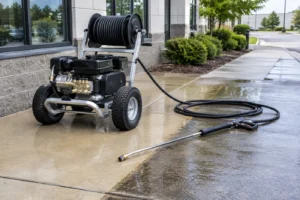
Simpson PowerShot PS3228 gas pressure washer, 2.5 GPM, Honda GX200
Sold as a gas power washer and described as a cold water machine. AAA triplex pump with thermal relief.
Check price on Amazon
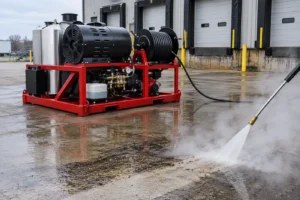
Powerhorse 4000 PSI 4 GPM gas hot water pressure washer with diesel heater
Diesel burner with up to a 150°F temperature rise, per the listing. For grease and oil on equipment and concrete.
Check price on AmazonAs an Amazon Associate we earn from qualifying purchases. Prices and availability change, so check the current price on Amazon.
What about soft washing?
Soft washing is the third term you will see. It uses low pressure with cleaning solutions that do most of the work, and cleaners use it on roofs, siding and other surfaces that high pressure can damage. A pressure washer with a wide spray tip and a soap nozzle, or a separate low-pressure pump, can do it. It is a technique, not a different kind of machine.
What matters more than the name
- PSI and GPM. Pressure (PSI) breaks dirt loose and flow (GPM) carries it away. Simpson’s manual defines cleaning units as GPM multiplied by PSI, a quick way to compare machines. Our guide to pressure washer GPM vs PSI explains which matters for which job.
- Nozzles. Wikipedia notes nozzles are color-coded, from a black 65 degree tip, the widest, to a red 0 degree tip, which can injure people and damage surfaces.
- Gas or electric. Gas units are portable and come in higher-output models; electric units suit indoor or enclosed work where exhaust is a problem. Simpson warns that gas engine exhaust contains carbon monoxide, so gas machines must run outdoors.
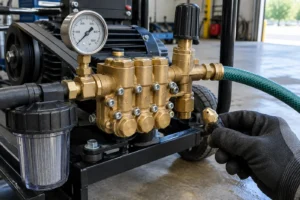
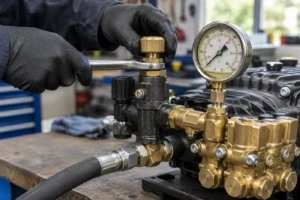
- Pump type. Commercial machines use triplex plunger pumps built for long hours; check for thermal relief protection, as the Simpson models list.
Which one do you need?
| Job | Choose |
|---|---|
| House siding, decks, fences, patios | Cold water pressure washer |
| Paint stripping, mud and sand | Cold water pressure washer |
| Driveways with oil stains | Hot water, or cold water with a degreaser |
| Engines, equipment, fleet vehicles | Hot water pressure washer |
| Parking garages, drive-throughs, gas stations | Hot water pressure washer |
| Roofs and delicate surfaces | Soft washing at low pressure |
For specific models, see our picks for the best commercial pressure washer and the best hot water pressure washer.
Common questions
Is a power washer the same as a pressure washer?
In most products, yes. The names are used interchangeably; Simpson even sells a cold water machine as a “gas power washer.” Some cleaners use “power washer” only for machines that heat the water.
Which is better, a power washer or a pressure washer?
Neither, since the names usually mean the same thing. Decide between hot water and cold water: hot water for oil and grease, cold water for dirt, mud, decks and siding.
Does a power washer use hot water?
Only if it has a burner or heater. Check the spec sheet for a temperature rating; many machines sold as power washers are cold water units.
Is power washing or pressure washing safer for a house?
The machine matters less than the pressure and nozzle. Use a wide tip and lower pressure on siding, and soft washing at low pressure for roofs and delicate surfaces. Never use a 0 degree red tip on siding.
When do you need a hot water pressure washer?
When there is oil or grease. Hotsy says that if oil or grease is present in any form, you need hot water to remove it quickly. Engines, equipment and fuel station forecourts are typical jobs.
What is soft washing?
Cleaning at low pressure with cleaning solutions doing most of the work. It is used on roofs, siding and surfaces that high pressure could damage.
Bottom line: a power washer and a pressure washer are usually the same thing; what matters is whether the machine heats the water, and you only need hot water when oil and grease are part of the job.