Pressure Washer Thermal Relief Valve: How It Works and Fixes

Some links in this guide are affiliate links. If you buy through them we may earn a commission, at no extra cost to you. This never affects what we recommend or how we rank equipment. Read our disclosure.
A pressure washer thermal relief valve is a small, temperature-triggered valve on the pump that dumps hot water when the pump overheats. When you let go of the trigger, the pump keeps running and the same water circulates inside it, heating up with every stroke. Once that water reaches the valve’s rating, commonly 140°F, the valve opens, lets a burst of hot water out so cool water can flow in, and closes again. Water from this valve after a long pause is normal. Water from it all the time, with the pump cool, is not.
The thermal relief valve protects the pump’s seals from heat when it runs in bypass with the trigger released. If it spits hot water after you idle for a while, it is working; pull the trigger more often or shut the engine off between tasks. If it drips constantly with cold water, replace it with a valve of the same thread size and temperature rating. Never plug it.
What does a thermal relief valve do?
Many pressure washers have an unloader that sends water around inside the pump when the trigger is released, which Simpson’s manual calls bypass mode. The engine or motor keeps turning, so the trapped water heats up. Simpson explains that when the temperature inside the pump rises too high, the thermal relief valve opens and releases a gush of water to lower the internal temperature, then closes.
AR North America, a major pump maker, says its TPP140 valves are mounted on the low-pressure side of the pump manifold and vent when the water exceeds the valve’s rated temperature, protecting the pump from heat abuse. The product listing for one of its replacement valves gives a reset feature: it closes again on its own once the water cools.
Where is the thermal relief valve?
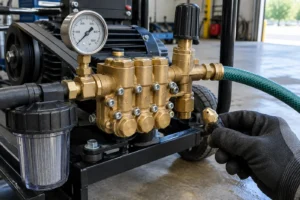
Look on the pump itself for a small brass valve, often about an inch or two long, threaded into the pump manifold. AR says its valves go into the low-pressure side of the manifold. On many consumer and light commercial pumps it sits near the water inlet or the outlet fitting, sometimes with a small plastic cap that directs the spray downward. Your pump’s parts diagram will show the exact spot.
What temperature does it open at?
The common rating is 140°F. AR North America’s TPP140 series and the General Pump 100558 valve are both rated at 140°F. Parts sellers list thermal relief valves rated from about 133°F to 190°F, so always replace a valve with one of the same rating your pump maker specifies. A valve rated too high will let the pump run hotter before it opens.
| Valve | Rating | Thread |
|---|---|---|
| AR North America TPP140-1/4 | 140°F, resets when cool | 1/4 inch male pipe thread |
| General Pump 100558 | 140°F | See General Pump’s spec for your pump |
| Other aftermarket valves | About 133°F to 190°F | 1/4 or 3/8 inch are common |
Water coming out of the thermal relief valve: normal or not?
Normal: a burst of hot water after you have stopped spraying for a while, which stops once you pull the trigger and cool water flows through. Simpson’s rule is not to let the unit run for more than two minutes without pulling the trigger, because bypass running overheats the pump and can damage it. If the valve opens often, you are idling too long.
Not normal:
- It drips or sprays all the time, even with cold water and the trigger pulled. The valve is likely worn or stuck open and should be replaced.
- It never opens, and the pump gets very hot in bypass. The valve may be stuck closed. Shut down, let the pump cool and replace the valve.
- It leaks around its threads rather than from the valve opening. That is a thread leak; remove it, clean the threads and reinstall with thread sealant tape.
If water is coming from somewhere else on the pump, such as under the pump head, see pressure washer pump leaking water.
How to test a thermal relief valve
- Start the pressure washer with the water supply on and spray for a minute so the pump is full of cool water.
- Watch the valve while spraying. It should stay dry. A steady drip now means it is leaking.
- Release the trigger for no more than two minutes, the limit Simpson gives. If the valve opens and dumps hot water, then closes, it is working. If it does not open in that time, that alone does not prove it is bad; the water may not have reached its rating yet.
- Pull the trigger right away after it opens, to bring cool water back through the pump.
Do not touch the discharged water or the valve; the water coming out is hot by design.
Replacement thermal relief valves

AR North America TPP140-1/4A thermal relief valve
Trips at 140°F and resets when it cools, per the listing. 1/4 inch male pipe thread. Match your pump's thread and rating.
Check price on Amazon
7101359 thermal relief valve for gas pressure washer pumps, 1/4 inch NPT
Replacement for many gas pressure washer pumps. Check the part number and thread against your pump before ordering.
Check price on AmazonAs an Amazon Associate we earn from qualifying purchases. Prices and availability change, so check the current price on Amazon.
How to replace a thermal relief valve
- Turn off the engine or motor and the water supply, and squeeze the trigger to release pressure.
- Let the pump cool.
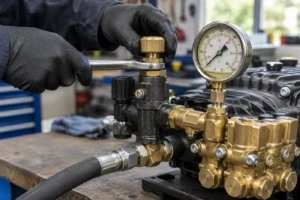
- Unscrew the old valve from the pump manifold with a wrench.
- Clean the threads in the manifold.
- Wrap the new valve’s threads with thread sealant tape, keeping the tape off the valve opening.
- Screw the new valve in snugly; do not overtighten into a brass manifold.
- Turn the water on, start the machine and check for leaks while spraying.
Match three things on the new valve: the thread size, the temperature rating and, where your pump maker gives one, the part number.
Do not plug the valve
It can be tempting to screw a plug into the port to stop a dripping valve. That removes the pump’s protection against overheating in bypass, which is exactly what the valve is there for. Replace a bad valve instead. Valves cost far less than the pump; see pressure washer pump replacement for what a new pump involves.
A valve that opens too often may also point to an unloader set wrong, since the unloader decides how the pump bypasses; see how to adjust a pressure washer unloader valve. For other signs of a pump running hot, see pressure washer smoking.
Common questions
What does a thermal relief valve do on a pressure washer pump?
It opens when the water inside the pump gets too hot in bypass mode and releases a burst of hot water so cool water can come in, then closes. That protects the pump’s seals from heat damage.
Why is water coming out of my pressure washer's thermal relief valve?
Usually because the pump idled too long with the trigger released and the water got hot. Simpson says not to run more than two minutes without pulling the trigger. If it leaks with cold water, the valve is bad.
How do I know if my thermal relief valve is bad?
It drips while you are spraying cool water, it never opens even when the pump gets very hot in bypass, or it is cracked or corroded. Replace it with one of the same thread and rating.
What temperature does a pressure washer thermal relief valve open at?
Commonly 140°F. AR North America’s TPP140 valves and the General Pump 100558 are both rated at 140°F, though aftermarket valves range from about 133°F to 190°F.
Where is the thermal relief valve on a pressure washer?
On the pump manifold. AR says its valves mount on the low-pressure side of the manifold; it is a small brass valve, often near the inlet or outlet fitting.
Can I run a pressure washer without a thermal relief valve?
Not safely. Without it, the pump has no protection from overheating in bypass and the seals can be damaged. Replace a faulty valve rather than plugging the port.
Bottom line: the thermal relief valve dumps hot water to save the pump when it idles in bypass; a burst after a long pause is normal, a constant drip with cold water means replace it, and plugging it is never the fix.