How to Clean Commercial Carpet Tile: Daily to Deep Clean

Some links in this guide are affiliate links. If you buy through them we may earn a commission, at no extra cost to you. This never affects what we recommend or how we rank equipment. Read our disclosure.
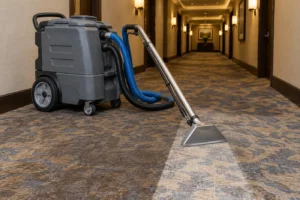
How to clean commercial carpet tile: vacuum the traffic areas every day, remove spots the day they happen, run a low-moisture interim clean on a schedule, and deep clean with hot water extraction every 3 to 12 months depending on traffic. Carpet tile also gives you an option broadloom does not: a tile that will not come clean can be lifted out and replaced. Interface, Mannington and Mohawk publish maintenance guides for their commercial carpet, and this guide follows them; the Interface figures come from its European carpet tile maintenance guide.
Vacuum entries, corridors and other heavy traffic areas daily. Blot spills right away and use a spotter, working from the edge toward the center. Interim clean with an encapsulation chemical and a counter-rotating brush machine, then vacuum when dry. Deep clean with hot water extraction: Interface suggests every 3 months for heavy traffic, 6 for medium and 12 for light, with no more than 120°F water on the carpet and plenty of dry passes. Replace tiles that are damaged or permanently stained.
Start at the door
Most soil walks in. Interface says 80% of the soil deposited in a carpet usually comes from outside the building, and recommends at least 3 to 5 meters of barrier matting at entrances. Mannington Commercial suggests an entry of 10 to 15 feet to trap 80% of soil. Clean barrier mats daily, as Interface advises, and replace them when they stop trapping dirt.
Mannington also gives a useful rule for planning the work: spend 80% of your time and resources on the 20% of carpet that gets the most traffic, meaning entries, walk-off areas and main traffic lanes.
Daily: vacuum and spot clean
Vacuum heavy traffic areas daily. Mannington recommends a dual-motor upright, canister or backpack vacuum with a power head and a quality HEPA filter, and changing bags when they are half full. Interface says the vacuuming frequency should follow what you see and the traffic, with entrances and corridors needing daily attention.
For spots, Interface and Mannington give the same basics:
- Act right away. A fresh spill is easier to remove than a set stain.
- Blot, do not rub. Interface says to work from the outer edge of the spot toward the center and never rub across a wet spill.
- Test the spotter first on an inconspicuous area, and apply it sparingly.
- Flush it out. Mannington says to clean an area three to four times larger than the stain and flush it from the backing so it does not wick back up. Interface says spotting solutions should always be flushed out with clean water after treatment.
- Do not over-wet. Interface lists over-wetting the carpet among the things to avoid when spot cleaning.
Interim cleaning: low moisture
Interim cleaning keeps the carpet looking good between deep cleans. Mannington’s schedule runs from quarterly for light traffic areas, to every two to three months for medium traffic, to monthly for heavy traffic. Its method:
- Spray a crystallizing (encapsulation) solution.
- Scrub it in with a twin cylindrical, counter-rotating brush machine.
- Vacuum thoroughly when the carpet is dry.
Interface says encapsulation uses about 90% less water than water extraction and dries in about 10 minutes. Low moisture also matters for raised access floors: Interface says low-moisture methods are generally preferred there, and to check with the access floor maker. Our guide to encapsulation vs hot water extraction compares the two methods in more detail.
Deep cleaning: hot water extraction
Interface recommends periodic deep cleaning by hot water extraction, and its maintenance plan sets the timing by traffic:
| Traffic level | Example areas | Deep clean |
|---|---|---|
| Heavy | Entrances, lobbies, main corridors | Every 3 months |
| Medium | General offices, meeting rooms | Every 6 months |
| Light | Executive offices, boardrooms | Every 12 months |
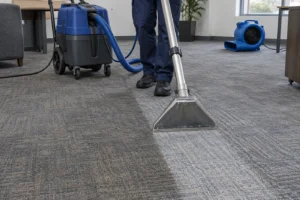
Interface’s extraction technique:
- Spot clean and vacuum thoroughly first.
- Make a wet pass of about 1 to 2 meters with the solution valve open, releasing the valve before the end of the pass so all the solution is picked up.
- Go over the same area two or three more times with the solution valve off.
- Overlap the next pass by about 5 cm.
- In very dirty areas, add two or three more wet passes, then several dry passes, without over-wetting.
- Place fans on wet areas to cut drying time, and finish with pile lifting once dry.
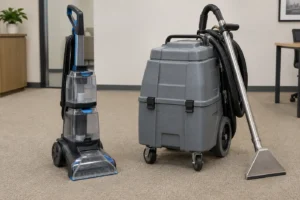
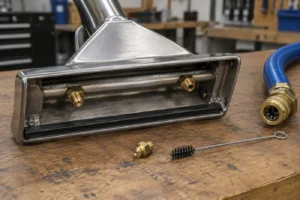
Two limits in Interface’s guide matter for tile: do not let water on the carpet exceed 50°C (120°F), and keep foot traffic off until the carpet is completely dry, because traffic on damp carpet can damage fibers and cause rapid re-soiling. If you run a heated extractor or a truck-mount, check the temperature at the wand. Mannington adds a pro tip: pre-spray so the chemical has time to work, use a pile lifter, and rinse with plain water to remove residue. Our guide on how to use a carpet extractor covers the machine side, and how long carpet takes to dry covers drying.
Chemicals that fit these guides

CarpetGeneral 53105 carpet fiber rinse, 1 gallon
Mildly acidic rinse for the extractor tank after pre-spraying. Check its pH and residue against your carpet maker's limits.
Check price on Amazon
Diversey tannin stain remover carpet spotter, 32 oz
Ready to use for coffee, tea and cola spills, the daily stains in offices and breakrooms. Test on a spare tile first.
Check price on AmazonAs an Amazon Associate we earn from qualifying purchases. Prices and availability change, so check the current price on Amazon.
Choosing cleaning chemicals
Interface warns that some commercial carpet cleaning solutions are harsh enough to damage both the pile and the backing. Its specification:
- pH of 9.5 or lower in dilution. Mannington says neutral pH, 10 or under.
- Solvents no more than 10% by volume, and no toxic, odorous or flammable solvents.
- No optical brighteners, which can change the carpet’s color.
- No oil-based defoamers in extraction products, because they leave oily residue.
Both makers describe the same residue test. Pour a little of the diluted solution into a clean glass dish and let it dry; Interface says at least 24 hours. Dry powder, flakes or crystals pass. An oily, greasy, sticky or waxy residue fails, because it will attract soil.
When to replace a tile instead
Carpet tile that is badly stained or damaged can be replaced from spare stock. Interface’s method: slip a knife edge under one corner and peel the tile up if it was glued, or lift the corner if it was installed with its TacTiles connectors. Brush the pile of the surrounding tiles upright and fit the new tile carefully so no fibers get trapped in the joints.
A new tile may look brighter than the worn ones around it. Interface says random, non-directional designs blend old and new tiles best; on other designs, move the new tiles to less visible areas. Keep spare tiles from the original installation for this.
Bonnet cleaning: the makers disagree
Mannington says bonnet cleaning was designed for hard surfaces, is not recommended for carpet and can cause abrasion. Mohawk says it does not recommend a spin bonnet because it can damage fibers. Interface allows occasional bonnet cleaning with a low-speed rotary machine of 175 rpm at most and a 100% cotton bonnet, while saying hot water extraction is generally preferred. Follow the guide from the maker of your tile.
For deep-cleaning equipment, see our best commercial carpet extractor guide, and for the full list of kit a cleaning crew needs, our commercial cleaning equipment list.
Common questions
What is the best way to clean commercial carpet tiles?
Daily vacuuming and spot cleaning, low-moisture interim cleaning, and periodic hot water extraction. Interface suggests deep cleaning every 3 months in heavy traffic, 6 in medium and 12 in light traffic areas.
Can you use hot water extraction on carpet tiles?
Yes. Interface recommends it for periodic deep cleaning, with water on the carpet no hotter than 120°F, two or three dry passes per wet pass, and no foot traffic until the carpet is completely dry.
How often should commercial carpet tile be cleaned?
Vacuum heavy traffic areas daily. Mannington suggests interim cleaning monthly in heavy traffic and quarterly in light traffic, and Interface suggests deep cleaning every 3 to 12 months by traffic level.
Can carpet tiles be replaced individually?
Yes. Interface says a damaged tile can be peeled up from one corner with a knife edge if glued, or simply lifted if installed with TacTiles, and replaced from spare stock.
What cleaner is safe for carpet tiles?
Interface specifies a pH of 9.5 or lower, solvents under 10%, no optical brighteners and no oil-based defoamers. Test any cleaner by drying it in a glass dish; it should leave dry powder or crystals, not a sticky film.
Can I bonnet clean carpet tiles?
The makers disagree. Mannington and Mohawk advise against bonnet cleaning carpet, while Interface allows it occasionally at 175 rpm or less with a cotton bonnet. Follow your tile maker’s guide.
Bottom line: trap soil at the door, vacuum and spot clean daily, run low-moisture interim cleans often and hot water extraction every 3 to 12 months, keep water under 120°F and chemicals at pH 9.5 or lower, and replace tiles that will not come clean.