Floor Sweeper vs Floor Scrubber: Which One Do You Need?

Some links in this guide are affiliate links. If you buy through them we may earn a commission, at no extra cost to you. This never affects what we recommend or how we rank equipment. Read our disclosure.
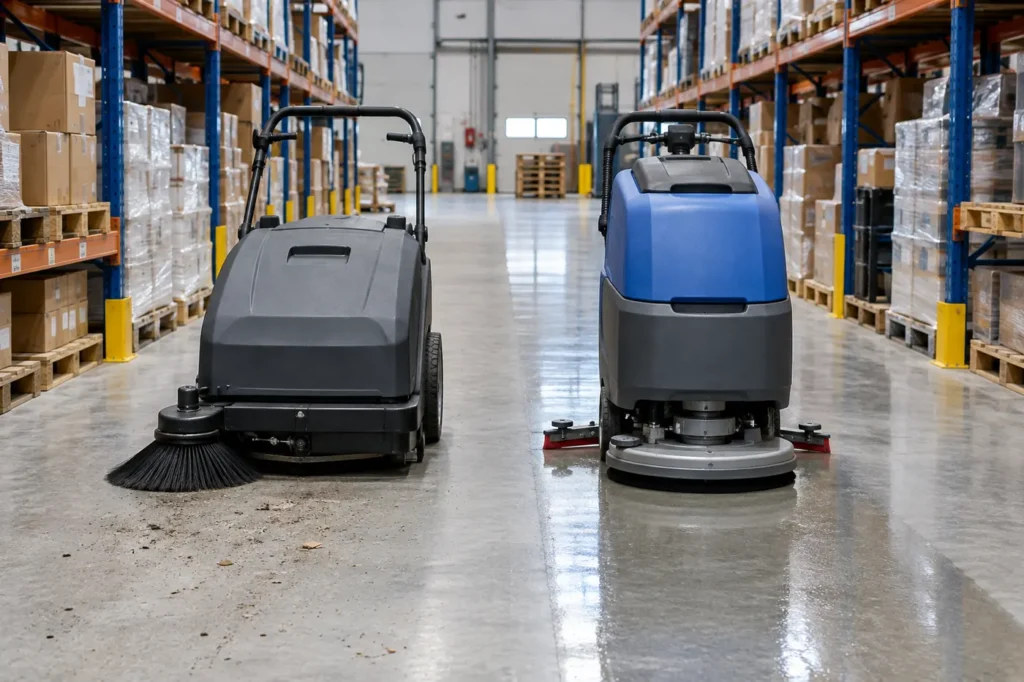
Floor sweeper vs floor scrubber: a sweeper picks up dry debris like dust, sand, packaging and gravel and drops it into a hopper. A scrubber puts water and detergent on a hard floor, scrubs it with a pad or brush, and vacuums the dirty water back up. If your mess is loose and dry, you need a sweeper. If it is stuck on, greasy or tracked-in grime, you need a scrubber. Many warehouses and plants need both, and they sweep first, because large debris damages a scrubber’s squeegee and blocks its recovery hose.
Buy a sweeper for loose, dry debris and for floors that are also outdoors, such as loading docks and parking areas. Buy a scrubber for floors that need washing: grease, spills, tire marks and the fine soil that foot traffic tracks in. Tennant’s buying advice draws the same line: light, bulky debris points to a sweeper, while fine dirt, floor marks and grease point to a scrubber. If you have both kinds of mess and large open floors, a combination sweeper-scrubber like the Tennant M17 or M20 does both in one pass.
Sweeper vs scrubber at a glance
| Floor sweeper | Floor scrubber | |
|---|---|---|
| What it removes | Dry debris: dust, sand, litter, packaging, shavings, gravel | Stuck-on soil, grease, spills, tire marks, fine tracked-in dirt |
| Water and chemical | None | Solution tank with water and detergent |
| How it works | Rotating brushes throw debris into a hopper; a filter traps dust | Pad or brush scrubs; squeegee and vacuum pull dirty water into a recovery tank |
| Floor left | Debris-free but not washed | Washed and nearly dry |
| Where it works | Indoors and outdoors, including parking areas | Indoors, on hard floors only |
| Main consumables | Brushes and dust filters | Pads or brushes, squeegee blades, detergent |
| Entry price (Nov 2026) | About $970 for a manual push sweeper | About $3,000 for a 17 inch corded walk-behind |
The prices come from our commercial floor sweeper guide and our floor scrubber price guide, both based on US listings in November 2026.
What a floor sweeper does
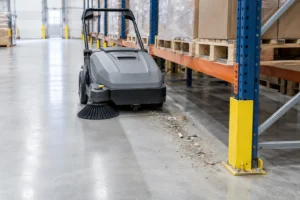
A sweeper has a main roller brush, and usually one or two side brushes, that flick debris forward into a hopper. On powered machines a vacuum fan pulls air through a dust filter, so fine dust is trapped instead of thrown back into the air the way a push broom does. A filter shaker knocks the dust off the filter so suction stays strong.
Sweepers are made for loose material. They collect sand, dirt, paper, shrink wrap scraps, wood chips and metal shavings, and they work outdoors as well as in. What they do not do is wash. A sweeper leaves oil stains, tire marks and dried spills exactly where they were.
They come in three sizes:
- Manual push sweepers, like the Karcher KM 70/20 C, for workshops, small warehouses and parking areas up to about 20,000 square feet.
- Battery walk-behinds, like the Nilfisk SW900 or Tennant S10, for daily sweeping of larger floors.
- Ride-on sweepers, like the Tennant S16, for warehouses and distribution centers.
What a floor scrubber does
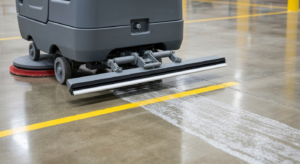
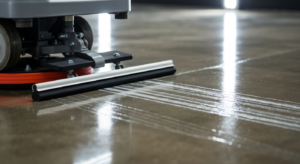
A scrubber has two tanks. Clean solution flows from one tank to the pad or brush, which scrubs the floor. Right behind it, a curved squeegee gathers the dirty water and a vacuum motor pulls it up into the second tank, the recovery tank. The floor is washed and almost dry in one pass, which is why scrubbers replace mops in stores, schools, hospitals, kitchens and warehouses.
Scrubbers remove the soil a sweeper cannot: grease, sticky residue, dried spills, scuffs and the fine film that builds up from foot and forklift traffic. They only work on hard floors, and almost always indoors. Our guide on how to use a floor scrubber covers the steps, and our overview of commercial floor cleaning machines compares every machine type.
Scrubbers also come in walk-behind and ride-on sizes. Most facilities start with a 17 or 20 inch walk-behind and move to a rider once one person spends most of a shift behind the machine.
Which one do you need?
Look at what is actually on your floor, and where the floor is.
| Your floor | What to buy | Why |
|---|---|---|
| Sand, grit, packaging and litter, little grease | Sweeper | Loose dry debris is what a sweeper’s hopper is built for |
| Loading docks, yards, parking areas | Sweeper | Sweepers work outdoors; scrubbers are indoor machines |
| Store, school, office or hospital hard floors | Scrubber | The soil is fine tracked-in dirt and spills, which needs washing |
| Kitchens, food plants, oily shop floors | Scrubber | Grease and residue have to be scrubbed and picked up wet |
| Warehouse with debris and tire marks | Both, sweep first | The sweeper clears debris that would jam the scrubber |
| Large plant with both, and limited labor | Sweeper-scrubber | One machine and one operator, one pass |
Floor size decides the next question, walk-behind or ride-on. Tennant’s own buying advice is that walk-behinds suit smaller and tighter areas, and that using a walk-behind on a large area shortens the machine’s life and wastes labor. Measure your narrowest aisle, doorway and any dead-end aisles where the machine has to turn around before you compare models.
Why most warehouses use both, and sweep first
A scrubber is not built to swallow large debris. Shrink wrap, banding, screws and gravel get caught under the squeegee and drag across the floor, leaving streaks and water trails. They can also tear the squeegee blade or lodge in the recovery hose, which is one of the most common reasons a floor scrubber stops picking up water.
So the usual routine on dirty floors is:
- Sweep the area to pick up the loose debris.
- Scrub to wash off the soil, grease and tire marks.
- Empty and rinse both machines at the end of the shift.
On floors that only see light, fine dirt, like a store or school corridor, many crews skip the sweeper and dust-mop the edges before scrubbing. Some scrubbers also help here. Cylindrical scrub decks have a small debris tray that picks up light debris as they scrub, and some riders offer side brushes or a pre-sweep option. These handle light litter, not the debris load of a busy dock.
Sweeper-scrubber combination machines
A sweeper-scrubber sweeps debris into a hopper and scrubs the floor behind it in the same pass. Tennant lists these as ride-on machines for indoor and outdoor use. Two examples from Tennant’s spec sheets:
| Model | Cleaning path | Tanks | Hopper |
|---|---|---|---|
| Tennant M17 (battery) | 40 in, 48 in with scrubbing side brush | 75 gal solution (115 gal with ES recycling), 91 gal recovery | 3 cu ft (85 L) |
| Tennant M20 | 40 in, 54 in with scrubbing side brush, 56 in with sweeping side brush | 125 gal usable solution and recovery, per Floor Daily | 3.9 cu ft usable |
A combination machine makes sense when you have large floors with both debris and grime, and you would rather pay one operator for one pass than two passes with two machines. It also saves floor space in the equipment room.
The trade-offs are real. These are large industrial riders sold through dealers at quote prices, they need wide aisles, and they carry the maintenance of both a sweeper and a scrubber: brushes, filters, hopper, squeegees and tanks. For small or crowded facilities, a separate walk-behind sweeper and walk-behind scrubber are usually cheaper and easier to move around.
Cost: sweeper vs scrubber
| Machine | Typical price (Nov 2026) |
|---|---|
| Manual push sweeper (Karcher KM 70/20 C) | About $970 to $1,000 |
| Battery walk-behind sweeper (Nilfisk SW900) | About $8,900 |
| 17 inch walk-behind scrubber | About $3,000 (corded) to $6,500 (battery) |
| 20 inch battery walk-behind scrubber | About $6,300 to $14,500 |
| Ride-on sweeper or scrubber | Several times a walk-behind; mid-size ride-on scrubbers about $28,000 to $38,700 |
| Sweeper-scrubber combination | Dealer quote |
Running costs differ too. A sweeper mainly uses brushes and dust filters, and a battery model needs battery care. A scrubber also uses pads or brushes, squeegee blades and detergent every day. Our price guide works through a detergent example: an 11 gallon tank filled once a day comes to about 43 gallons of concentrate a year at a 2 ounce per gallon dilution.
Entry-level machines on Amazon

Karcher KM 70/20 C push sweeper, 28 inch
Adjustable roller brush, dust filter and an 11 gallon hopper. For workshops, small warehouses and parking areas.
Check price on Amazon
Viper AS4325B walk-behind scrubber, 17 inch
Battery machine with 85Ah AGM batteries and an onboard charger. For small hard-floor areas.
Check price on AmazonAs an Amazon Associate we earn from qualifying purchases. Prices and availability change, so check the current price on Amazon.
Larger sweepers, scrubbers and combination machines from Tennant, Nilfisk and Minuteman are mostly sold through dealers. See our guides to the best walk-behind floor scrubbers and best ride-on floor scrubbers for the models we would short-list.
Brushes and blades for each machine
Whichever machine you buy, match the brush to the soil. Tennant recommends nylon or polyester brushes for fine dust and a wire-reinforced broom for heavier debris on sweepers. On scrubbers, it suggests natural rubber squeegee blades of at least 95% pure rubber for rough or uneven floors and gum rubber blades for smooth, finished floors. When the blades wear, our guide on replacing floor scrubber squeegee blades shows how.
Frequently asked questions
What is the difference between a floor scrubber and a floor sweeper?
A sweeper picks up loose, dry debris into a hopper and uses no water. A scrubber washes hard floors with water and detergent, scrubs them with a pad or brush, and vacuums the dirty water back into a recovery tank.
Do you have to sweep before using a floor scrubber?
On floors with sand, packaging, screws or other large debris, yes. That debris gets under the squeegee and into the recovery hose, causing streaks and poor water pickup. On floors with only light, fine dirt, dust-mopping the edges is usually enough.
Are floor sweepers worth it?
For warehouses, workshops, docks and parking areas with loose debris, yes. A manual push sweeper costs about $1,000, and Karcher rates the KM 70/20 C at up to 7 times faster than a broom. Battery and ride-on sweepers save far more labor on large floors.
Can a floor scrubber pick up debris?
Only light debris. Scrubbers with a cylindrical deck have a small debris tray, and some riders have side brushes or a pre-sweep option. Large debris should be swept up first.
What is a sweeper-scrubber?
A ride-on machine that sweeps debris into a hopper and scrubs the floor in the same pass, such as the Tennant M17 or M20. It suits large floors that have both debris and grime.
Bottom line: buy a sweeper for loose, dry debris and outdoor areas, and a scrubber for floors that need washing. If your floor has both, sweep first and scrub second, or look at a combination sweeper-scrubber when the floor is large and labor is tight. Our step-by-step guide on how to clean a warehouse floor puts both machines into one routine.
[…] large debris. Our guide to the best walk-behind floor scrubbers covers the washing side, and our floor sweeper vs floor scrubber guide explains when you need one, the other or […]
[…] sweeper is enough. Our commercial floor sweeper guide covers manual, battery and ride-on picks, and floor sweeper vs floor scrubber explains which machine does which […]
[…] See best commercial floor sweepers, and if you are deciding between the two machines, floor sweeper vs floor scrubber. […]
[…] floors with a lot of loose debris, sweep before you scrub. Our guide to floor sweeper vs floor scrubber explains […]