How to Pressure Wash Concrete Without Damaging It

Some links in this guide are affiliate links. If you buy through them we may earn a commission, at no extra cost to you. This never affects what we recommend or how we rank equipment. Read our disclosure.
How to pressure wash concrete: sweep it, pre-treat oil stains with a concrete degreaser, then wash with a 15 or 25 degree tip or a surface cleaner, keeping the pressure in the 2,000 to 3,000 PSI range and the nozzle moving at an even distance. Rinse toward the drain or the lowest edge and let it dry. Briggs & Stratton notes that most of the time a high-pressure wash alone is enough to clean concrete; detergent helps on oil, grease and mildew.
Clear and sweep the area. Pre-treat oil and grease with a concrete cleaner and let it dwell per the label. Use a 15 to 25 degree tip or a surface cleaner, about 2,000 to 3,000 PSI, and keep the nozzle at a steady distance with overlapping passes. Never use the red 0 degree tip on concrete. Rinse toward the drain, let it dry fully, and seal it afterward if you want.
What you need
- A pressure washer with enough pressure and flow. Creative Concrete, a concrete contractor, recommends setting the washer between 2,000 and 3,000 PSI for concrete: lower may not clean deeply, and higher can etch the surface. Flow (GPM) decides how fast you work; see pressure washer GPM vs PSI.
- Enough water supply. Creative Concrete’s quick test: time how long your outdoor tap takes to fill a 5 gallon bucket. Under two minutes is fine. Simpson’s pro pressure washer manual asks for a supply of at least 5 GPM at 20 PSI for its machine, so check your own model’s requirement.
- The right tip. Creative Concrete suggests a 15 to 20 degree tip; on standard color-coded sets that means the 15 degree (yellow) tip for tough spots and the 25 degree (green) tip for general cleaning. A wider tip, or the soap nozzle, applies detergent.
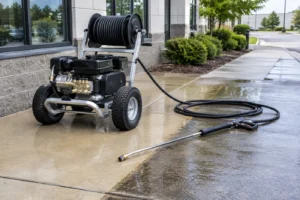
- A surface cleaner (optional). A round hood with a spinning bar of nozzles that rides on the concrete. It keeps the nozzles at a fixed height, which gives even results on large flat areas.
- A concrete cleaner or degreaser for oil and grease, and a stiff broom.
How to pressure wash concrete, step by step
- Clear the area. Move vehicles, furniture and planters. Sweep away loose dirt, leaves and gravel.
- Protect the surroundings. Close nearby windows, cover outdoor outlets and lights, and wet down plants next to the concrete. Keep a gas machine at least 4 feet from walls, vehicles and plants, as Simpson advises, because muffler heat can damage them.
- Pre-treat stains. Apply a concrete and driveway cleaner to oil and grease spots and let it dwell for the time on the label without drying. Krud Kutter’s concentrate, for example, says 3 to 5 minutes. Scrub heavy stains with the broom.
- Apply detergent to the whole area if needed, at low pressure with the soap nozzle. Our guide to pressure washer detergent covers dilution and the injector.
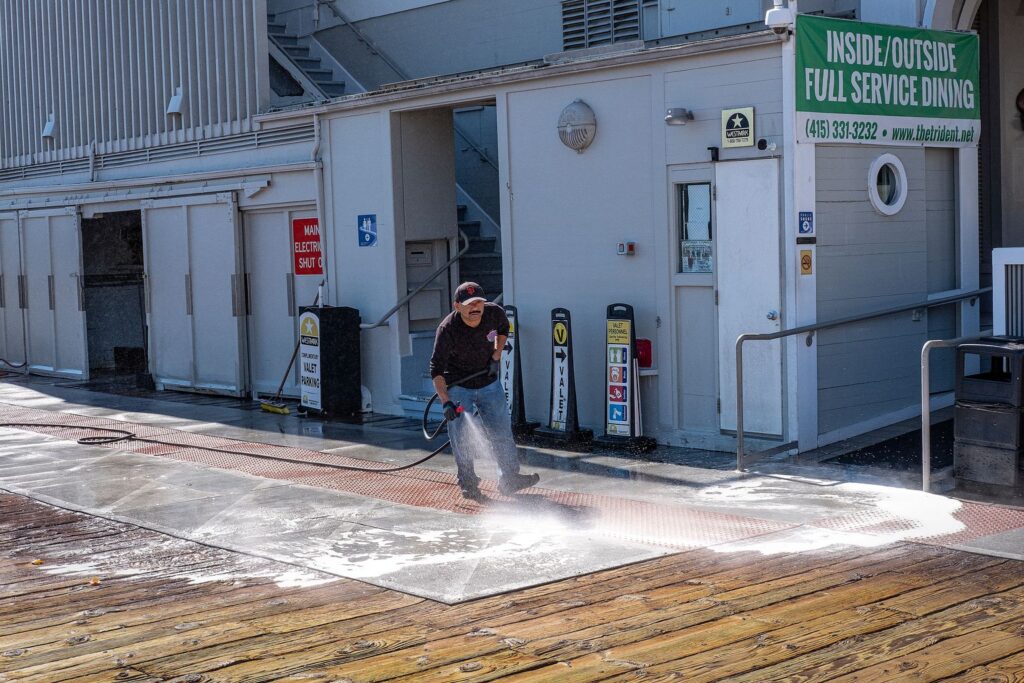
- Wash. Start in a corner and work in one direction. With a wand, hold the tip at a steady height, sweep side to side and overlap each pass so you do not leave lighter and darker stripes. With a surface cleaner, walk it slowly in straight, overlapping lanes.
- Rinse. Rinse the loosened dirt and detergent toward the drain or the lowest edge, working away from areas you have finished.
- Let it dry. Let the concrete dry fully before sealing it, and follow the sealer’s label for drying and cure times.
For bigger concrete jobs

Westinghouse 16.5 inch stainless steel pressure washer surface cleaner, 4400 PSI max
1/4 inch quick connect; fits most gas and electric machines. Even passes without stripes on driveways and pads.
Check price on Amazon
Zep driveway and concrete pressure wash concentrate, 1 gallon, case of 4
For oil stains on concrete, brick and asphalt. The label says not for wood or painted, sealed or stained surfaces.
Check price on AmazonAs an Amazon Associate we earn from qualifying purchases. Prices and availability change, so check the current price on Amazon.
Wand or surface cleaner?
| Factor | Wand and tip | Surface cleaner |
|---|---|---|
| Best for | Edges, steps, spots, small areas | Driveways, pads, sidewalks, garage floors |
| Even results | Depends on steady technique | Fixed nozzle height, fewer stripes |
| Speed on large areas | Slower | Faster |
| Overspray | More | Contained under the hood |
| Cost | Comes with the machine | Extra attachment |
A common approach is to use both: the surface cleaner for the open area and the wand for edges and corners. Check that the surface cleaner’s PSI and GPM ratings and its connector match your machine.
Mistakes that damage concrete
- Too much pressure or too close. Creative Concrete warns that too high a PSI can etch the surface, blowing away pieces of concrete and sealer and leaving it open to water damage. If dirt will not come off, use a concrete detergent rather than more pressure.
- The 0 degree tip. Wikipedia’s summary of pressure washing notes that the red 0 degree tip can injure people and damage surfaces. Keep it off concrete.
- Trying to blast off sealers, coatings or deep stains. Creative Concrete says these are usually chemical problems that need chemical products, not more force.
- Cleaning new concrete too soon. Concrete keeps gaining strength for weeks after it is poured. Ask the installer how long to wait before pressure washing it.
- Letting detergent dry. Work in sections small enough to rinse before the cleaner dries, especially in sun.
Oil stains and commercial concrete
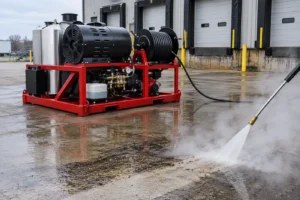
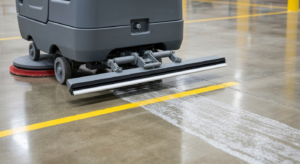
Oil and grease are where cold water struggles. Hotsy says that if oil or grease is present in any form, a hot water pressure washer removes it much more quickly, while cold water mainly pushes it around. For parking garages, drive-throughs and fuel stations, which Wikipedia’s summary lists as hot water jobs, a hot water machine is the usual choice; see hot vs cold water pressure washers. Indoor concrete in warehouses is a different job, usually done with a floor scrubber; see how to clean a warehouse floor.
Check local rules before washing detergent and oily water into storm drains; some areas require you to collect it. For a machine sized for concrete work, see our best commercial pressure washer picks.
Common questions
What PSI do you need to pressure wash concrete?
Creative Concrete, a concrete contractor, recommends 2,000 to 3,000 PSI. Lower may not clean deeply, and higher can etch the surface.
Should I use soap when pressure washing concrete?
Not always. Briggs & Stratton says a high-pressure wash alone is usually enough. Use a concrete cleaner or degreaser on oil, grease and mildew, applied at low pressure and left to dwell.
What nozzle is best for concrete?
A 15 to 25 degree tip. Creative Concrete suggests 15 to 20 degrees; never use the red 0 degree tip, which can damage the surface.
Can pressure washing damage concrete?
Yes, if the pressure is too high or the tip too narrow or too close. Creative Concrete warns this can etch the surface and strip sealer.
Do I need a surface cleaner for my driveway?
No, but it helps. A surface cleaner keeps the nozzles at a fixed height for even results and is faster on large flat areas. Use the wand for edges.
How do you get oil stains out of concrete?
Pre-treat with a concrete degreaser and let it dwell per the label, scrub, then pressure wash. Hot water removes oil much faster, according to Hotsy.
Bottom line: sweep, pre-treat oil, wash at 2,000 to 3,000 PSI with a 15 to 25 degree tip or a surface cleaner in even overlapping passes, rinse toward the drain, and never use the 0 degree tip on concrete.