How to Clean a Commercial Kitchen Floor (Food Code Rules)

Some links in this guide are affiliate links. If you buy through them we may earn a commission, at no extra cost to you. This never affects what we recommend or how we rank equipment. Read our disclosure.
How to clean a commercial kitchen floor: at the end of each shift, pull up the mats, sweep using a dustless method, apply a food-service degreaser, let it dwell, scrub with a deck brush or a floor scrubber, then pull the dirty solution to the floor drain with a squeegee or pick it up with a wet vacuum, rinse, and let the floor dry. The FDA Food Code sets the ground rules: clean as often as needed, do it when the least food is exposed, such as after closing, and use only dustless methods.
Clean after service or after closing. Remove and clean the mats. Sweep with a broom and dust-arresting compound or vacuum. Apply a degreaser labeled for food service floors, let it dwell, and scrub, paying attention to grout and under equipment. Squeegee the dirty solution to the drain or wet vac it, rinse with clean water and remove it the same way, and let the floor dry. Wash mops and tools in the mop sink, never in food or hand sinks.
The rules that apply
The 2022 FDA Food Code, the model that state and local health codes are built on, has several rules that shape how you clean a kitchen floor:
- When to clean: physical facilities shall be cleaned as often as necessary to keep them clean, and except for spills, cleaning shall be done when the least amount of food is exposed, such as after closing (section 6-501.12).
- How to clean: only dustless methods, such as wet cleaning, vacuum cleaning, mopping with treated dust mops, or sweeping with a broom and dust-arresting compounds (6-501.13).
- Where to clean tools: food preparation sinks, handwashing sinks and warewashing equipment may not be used to clean maintenance tools or to dump mop water (6-501.15).
- Mops: after use, mops must be placed so they air-dry without soiling walls, equipment or supplies (6-501.16).
- Mats: mats and duckboards must be removable and easily cleanable (6-201.15).
OSHA’s walking-working surfaces rule adds the safety side: floors must be kept clean and, so far as possible, dry, and where wet processes are used, drainage must be maintained and dry standing places such as mats provided where feasible. Check your local health department’s code, which may add to these.
What you need
- A degreaser or cleaner labeled for food service floors, mixed at the label’s dilution.
- A stiff deck brush, or a floor scrubber for larger kitchens.
- A floor squeegee with a one-piece blade for pulling water to the drain.
- A wet vacuum, or an auto scrubber that picks up as it scrubs.
- A mop bucket and wringer, mops or microfiber pads, and a mop sink to clean them in.
- Wet floor signs, and non-slip shoes for the crew.
Kitchen floor basics

Simple Green Pro food service cleaner, 1 gallon
NSF registered for food processing areas including floors, per the listing, with a clean-rinsing formula and no color or fragrance.
Check price on Amazon
Sparta 24 inch one-piece rubber floor squeegee head, red
One-piece rubber blade and rust-free plastic frame made for HACCP programs. Handle sold separately.
Check price on AmazonAs an Amazon Associate we earn from qualifying purchases. Prices and availability change, so check the current price on Amazon.
How to clean a commercial kitchen floor, step by step
- Time it. Clean after service or after closing, as the Food Code says, and cover or put away exposed food.
- Put out wet floor signs and keep traffic off the area.
- Pull up the mats. Take rubber mats outside or to a wash area and scrub and rinse them separately; let them dry before putting them back.
- Remove loose debris. Sweep with a broom and dust-arresting compound or vacuum, so you meet the dustless rule. Get under ranges, fryers and prep tables, where grease and food build up.
- Apply the degreaser. Mix it at the label rate and spread it over a section of floor. Do not flood it; the solution has to be removed.
- Let it dwell for the time on the label so it can loosen grease, without letting it dry.
- Scrub. Work the floor with a deck brush, scrubbing grout lines and corners, or run a floor scrubber over open areas.
- Remove the dirty solution. Squeegee it to the floor drain, pick it up with a wet vacuum, or let the scrubber recover it. Kaivac, which sells no-mop cleaning systems, argues that a mop on tile draws dirty water into porous grout, so removing the solution is the better habit.
- Rinse. Go over the floor with clean water and remove it the same way, so no cleaner residue is left to make the floor slippery.
- Let it dry, then put the dry mats back.
- Clean the tools. Rinse brushes, squeegees and mops in the mop sink and hang mops to air-dry.
Mop and bucket, or a floor scrubber?
| Method | Good for | Limits |
|---|---|---|
| Mop and bucket | Small kitchens, spot cleaning between deep cleans | Mop water gets dirty fast and can leave grease in grout |
| Deck brush and squeegee | Quarry tile and grout, kitchens with good drains | Physical work; needs a floor graded to a drain |
| Wet vacuum | Picking up solution where drains are few | Separate step after scrubbing |
| Floor scrubber | Larger kitchens and food courts, nightly cleaning | Upfront cost; needs space to maneuver |
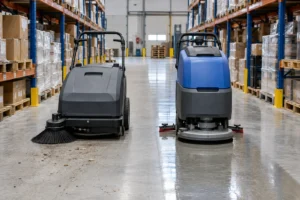
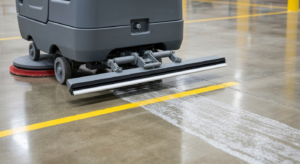
A floor scrubber puts down solution, scrubs and picks it up in one pass, which helps in larger kitchens. Our guide on how to use a floor scrubber covers the method, and best walk-behind floor scrubber covers machines small enough for a kitchen. If a scrubber leaves water behind, see floor scrubber not picking up water.
Daily, weekly and deep cleaning
- During service: clean spills right away. The Food Code allows spot cleaning of spills between normal cleaning times, including a small amount of absorbent compound on liquid spills just before spot cleaning.
- Every night: the full process above.
- Weekly: move equipment on casters where you can and clean under and behind it; scrub grout lines and floor drains more thoroughly.
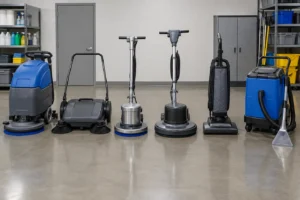
- As needed: restore stained grout and degrease heavily soiled areas with a machine. Our guide to commercial floor cleaning machines covers the options.
Common mistakes
- Using too much degreaser. More chemical than the label calls for can leave residue that makes floors slippery and attracts soil. Mix at the stated rate and rinse.
- Mopping with dirty water. Change the solution often, or use a method that removes the water instead of spreading it.
- Dumping mop water in the wrong sink. The Food Code bans emptying mop water into food prep, handwashing or warewashing sinks.
- Dry sweeping without a compound. Raising dust breaks the Food Code’s dustless rule.
- Putting mats back wet, which keeps the floor under them damp.
Common questions
What is the best way to clean a commercial kitchen floor?
After closing, remove mats, sweep with a dustless method, apply a food-service degreaser, let it dwell, scrub, remove the solution with a squeegee to the drain or a wet vac, rinse and let it dry.
What is the best cleaner for commercial kitchen floors?
A degreaser labeled for food service floors, used at the label dilution and rinsed. Some, such as Simple Green Pro’s food service cleaner, are NSF registered for food processing areas including floors.
How often should a commercial kitchen floor be cleaned?
The FDA Food Code says as often as necessary to keep it clean. A full clean after each day’s service, with spills cleaned as they happen, is a common routine.
Can you dry sweep a restaurant kitchen?
Not with an ordinary dry sweep. The Food Code requires dustless methods: wet cleaning, vacuuming, treated dust mops, or a broom with dust-arresting compound.
Where should you dump mop water in a restaurant?
In a mop sink or curbed cleaning facility. The Food Code says food prep sinks, handwashing sinks and warewashing equipment may not be used for mop water or cleaning tools.
How do you clean greasy grout in a kitchen?
Apply a degreaser, let it dwell, and scrub the grout lines with a stiff brush or a machine, then remove the dirty solution with a squeegee or wet vac instead of a mop, and rinse.
Bottom line: clean after service, pull the mats, sweep dustlessly, degrease, scrub, remove the dirty solution instead of mopping it around, rinse, and keep mop water out of food and hand sinks.