Pressure Washer Won’t Start: Causes and Fixes in the Order to Check Them

Some links in this guide are affiliate links. If you buy through them we may earn a commission, at no extra cost to you. This never affects what we recommend or how we rank equipment. Read our disclosure.
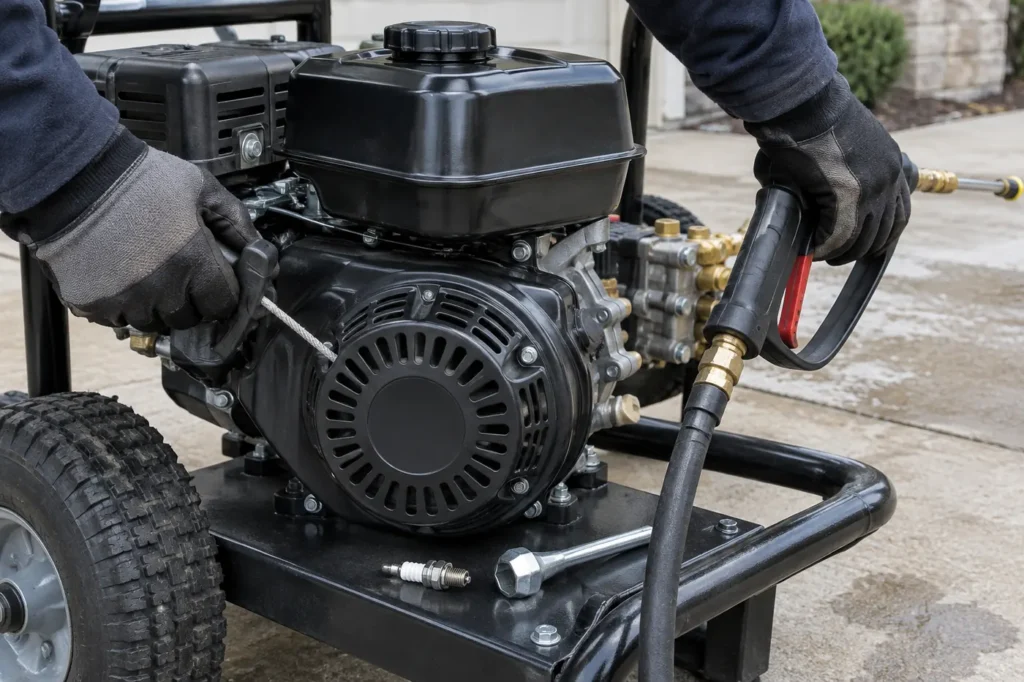
When a pressure washer won’t start, the cause is usually simple: the fuel valve, engine switch or choke is in the wrong position, the fuel is old, the oil is low, the spark plug or air filter needs attention, or pressure trapped in the pump is making the recoil too hard to pull. Generac lists a dirty air filter, old or low fuel, a bad spark plug or plug wire connection, and the choke in the wrong position as common causes. Work through the free checks before you suspect the carburetor or the pump.
Squeeze the spray gun trigger to release trapped pressure, then check in order: fuel valve open and engine switch on, choke set correctly (on for a cold engine, off for a warm one), fresh fuel in the tank, oil at the full mark with the machine level, a clean air filter, and a good spark plug with a firm wire connection. If it starts and dies, stale fuel has usually gummed the carburetor. For electric machines, reset the plug’s GFCI, check the outlet and extension cord, and squeeze the trigger, since many electric units only run while the trigger is held.
What is the machine doing?
| Symptom | Most likely causes | Check first |
|---|---|---|
| Recoil is very hard to pull | Trapped pump pressure; seized or frozen pump; hydro-locked engine | Squeeze the trigger, then pull again |
| Pulls normally but never fires | Fuel valve or switch off, no fuel, stale fuel, low oil shutdown, no spark | Valve, switch, fuel, oil level |
| Fires but will not keep running | Choke wrong, stale fuel, dirty carburetor, clogged air filter | Choke, fuel age, air filter |
| Starts, then stops after a few seconds | Low oil sensor, machine not level, fuel starvation | Oil level with the machine level |
| Electric unit does nothing | GFCI tripped, dead outlet, wrong extension cord, trigger not squeezed | GFCI reset, outlet, cord |
1. Release the trapped pressure
This is the pressure washer problem that small engines on other equipment do not have. When you shut the machine off, water pressure can stay locked between the pump and the gun. That pressure pushes back against the pump pistons, so the engine is very hard to turn over and the recoil feels stuck.
Point the gun in a safe direction and squeeze the trigger to bleed the pressure off, with the water supply on. Then pull the recoil again. Make a habit of squeezing the trigger every time before you start, and after you shut down.
If the recoil still will not move at all, the pump may be seized or frozen. Do not force it. See the pump section below.
2. Check the switches, fuel valve and choke
- Engine switch: many engines have an on/off switch or a combined switch on the throttle. It must be on.
- Fuel valve: if your engine has a fuel shut-off valve, it must be open.
- Choke: use the choke for a cold start, then open it as the engine warms. Generac lists the choke left in the on position as a reason a machine will not start or stay running; on a warm engine, too much choke floods it.
- Throttle: on engines with a throttle lever, set it as the manual says for starting, often partly or fully open.
3. Check the fuel
Old fuel is the most common reason a pressure washer will not start after sitting. Briggs and Stratton says gasoline goes stale in about 30 days, and ethanol blends break down and leave gum and varnish that block the carburetor’s tiny passages. Generac recommends draining the fuel before storing a pressure washer for more than 30 days.
- If the fuel has sat for more than a month without stabilizer, drain the tank and refill with fresh fuel.
- Check that there is actually enough fuel; a tank that looks wet may be almost empty.
- If the engine fires only with a little fuel added to the spark plug hole or air intake, fuel is not reaching the cylinder, which usually means a gummed carburetor.
A gummed carburetor needs cleaning or replacing. On most small engines a replacement carburetor costs little, and many owners swap it rather than rebuild it. Our guide on how to winterize a pressure washer covers fuel stabilizer so it does not happen again.
4. Check the oil level, with the machine level
Many pressure washer engines have a low oil sensor that stops the engine, or will not let it start, when the oil is low. Honda’s Oil Alert on its GX engines is a well-known example. These sensors can also trip when the machine sits on a slope, because the oil runs away from the sensor.
Put the machine on level ground, check the dipstick, and top up with the oil grade in the manual. If the engine starts and then stops after a few seconds, the low oil system is a strong suspect. Do not bypass the sensor to make it run; it is there to stop the engine destroying itself.
5. Check the air filter
A clogged air filter chokes the engine of air. Pressure washers often work in dusty, wet places, so the filter clogs faster than on many engines. Remove it, check it against a light, and clean or replace it as the manual says. Never run the engine without the filter.
6. Check the spark plug and wire
Generac lists a bad spark plug and a bad spark plug wire connection among the common no-start causes.
- Make sure the plug boot is pushed fully onto the plug.
- Remove the plug and look at it. A wet, black or heavily fouled plug, a cracked insulator or a worn electrode means replace it with the type in your manual.
- To check for spark, use an inline spark tester between the plug and the wire, then pull the recoil. No flash means an ignition problem, such as the switch, a kill wire grounding out, or the ignition coil.
7. Electric start units: check the battery
Commercial machines with electric start need a charged battery and clean, tight terminals. If the starter clicks or turns slowly, charge or replace the battery. Most of these engines also have a recoil you can use to start them while you sort out the battery.
8. Is the pump the problem?
If the recoil will not pull even after you release the pressure, take the pump out of the equation. On many machines you can remove the pump from the engine and pull the recoil again. If the engine turns freely without the pump, the pump is seized, often from freezing or from running without water. A frozen pump should be thawed slowly in a warm room and checked for cracks before you try again. Our guide to pressure washer pump replacement covers the signs and the swap.
If the engine is also hard to turn with the pump off, the engine itself may be hydro-locked with fuel or oil in the cylinder, or damaged. That is a job for a small engine shop.
Electric pressure washer won’t start
- Reset the GFCI. Most electric pressure washers have a GFCI built into the plug. Sun Joe’s instructions are to press RESET until the power light comes on.
- Check the outlet with another tool, and check for a tripped breaker or GFCI outlet.
- Check the extension cord. Long or thin cords starve the motor. One maker’s manual we read says not to use a cord over 50 feet, and to use 12-gauge or heavier. Follow your own manual.
- Squeeze the trigger. Many electric units have a total stop system that only runs the motor while the trigger is pulled, so the machine stays silent when you switch it on.
- Let it cool. If it stopped after a long run, the thermal overload may have tripped. Wait and try again.
Tools that help

Lisle 20610 inline spark tester
Fits between the plug and the wire and flashes when the ignition fires.
Check price on Amazon
STA-BIL storage fuel stabilizer, 16 oz
Label dose is 1 oz per 2.5 gallons; run the engine afterward to treat the fuel system.
Check price on AmazonAs an Amazon Associate we earn from qualifying purchases. Prices and availability change, so check the current price on Amazon.
How to stop it happening again
- Squeeze the trigger before every start and after every shutdown.
- Use fresh fuel, add stabilizer if it will sit, and drain the fuel before storage longer than a month.
- Check the oil with the machine level before each use.
- Clean the air filter regularly.
- Always connect and turn on the water before starting, so the pump never runs dry.
- Winterize before freezing weather.
If it starts but has weak pressure, see pressure washer losing pressure; if pressure pulses, see pressure washer surging or pulsing.
Frequently asked questions
What causes a pressure washer to not start?
The most common causes are pressure trapped in the pump, old or low fuel, the choke in the wrong position, low oil triggering the low oil sensor, a dirty air filter, and a bad spark plug or plug wire. On electric units, a tripped GFCI or the wrong extension cord is common.
How do you start a stubborn pressure washer?
Squeeze the trigger to release pressure, make sure the fuel valve is open and the switch is on, use the choke on a cold engine, check the oil with the machine level, and use fresh fuel. If it only fires with fuel added to the intake, the carburetor is likely gummed.
Why is my pressure washer pull cord so hard to pull?
Usually because pressure is trapped between the pump and the gun. Squeeze the trigger to release it. If the cord still will not move, the pump may be seized or frozen.
Why does my pressure washer start and then die?
Common causes are low oil or the machine not being level, which trips the low oil sensor, the choke left on, stale fuel or a partly blocked carburetor, and a clogged air filter.
Why won't my electric pressure washer turn on?
Reset the GFCI on the plug, check the outlet and breaker, use a short heavy-gauge extension cord, and squeeze the trigger, since many electric units only run while the trigger is pulled.
Bottom line: release the pressure, then check the switch, fuel valve, choke, fuel age, oil level, air filter and spark plug, in that order. Most no-starts are fixed there; a gummed carburetor or seized pump comes after.