Pressure Washer Surging or Pulsing: How to Find the Cause and Fix It

Some links in this guide are affiliate links. If you buy through them we may earn a commission, at no extra cost to you. This never affects what we recommend or how we rank equipment. Read our disclosure.
A pressure washer surging or pulsing while you spray almost always has a water problem: not enough supply, air getting in on the inlet side, a clogged inlet filter, or debris stuck in a pump valve. If it surges only when the trigger is released, the unloader is cycling because water is leaking somewhere after it. If the engine itself revs up and down, look at the fuel and carburetor. Find out which of the three you have first, because the fixes are different.
Pulsing while spraying: check the water supply, air leaks on the inlet, the inlet filter, a partly blocked nozzle and debris in the pump’s check valves. Surging with the trigger released: look for a leak after the unloader, such as a worn gun O-ring or a dripping fitting, then rebuild the unloader. Engine revving up and down: use fresh fuel and clean the carburetor.
Which kind of surging do you have?
“Surging” covers three different problems. Spend one minute working out which one you have before you buy parts.
| When it happens | What you notice | Most likely cause | First check |
|---|---|---|---|
| While spraying | Spray pulses hard and soft, hose kicks | Water supply, air leak, inlet filter, pump valves | Bucket test and inlet fittings |
| Trigger released | Pump or engine note rises and falls every few seconds | Unloader cycling from a leak after it | Drips at the gun, wand and hose ends |
| Engine at idle or under load | Engine revs up and down on its own | Stale fuel or a dirty carburetor | Fresh fuel, then the carburetor |
Cheap parts for the first checks

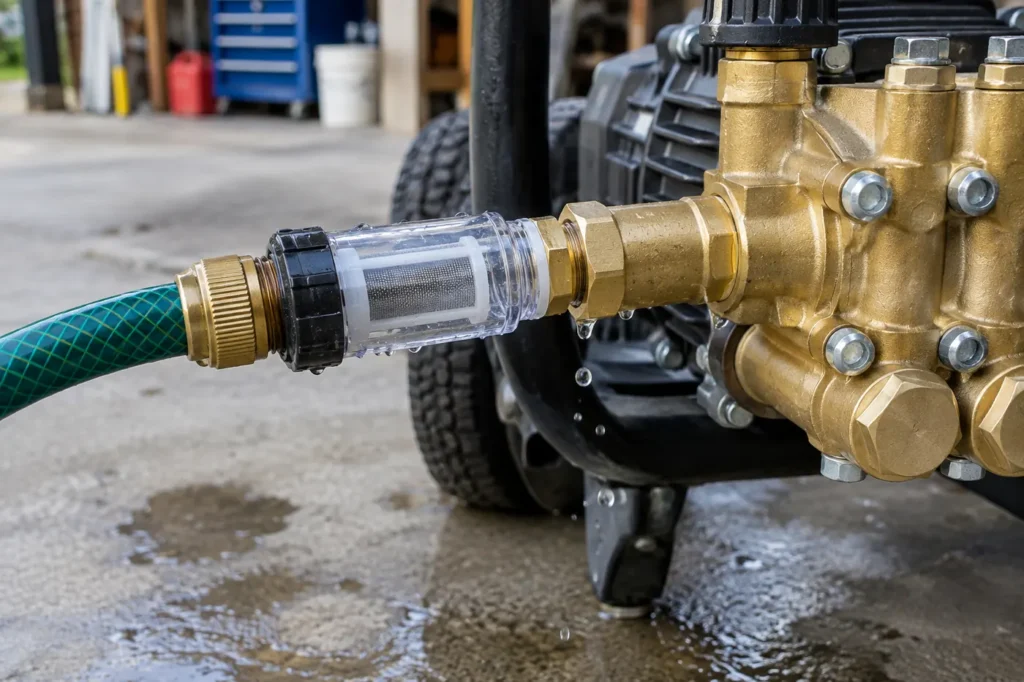
Inline inlet filter for pressure washers, 3/4 inch hose thread
40 and 100 mesh screens. Fits between the garden hose and the pump inlet.
Check price on Amazon
Pressure washer gauge kit, 0 to 5,000 PSI
Glycerin-filled gauge with 3/8 inch quick connects, for reading pressure at the pump.
Check price on Amazon
Sea Foam Motor Treatment, 16 oz, 2 pack
Fuel additive that helps clean varnish from small-engine fuel systems. A dirty carburetor may still need cleaning by hand.
Check price on AmazonAs an Amazon Associate we earn from qualifying purchases. Prices and availability change, so check the current price on Amazon.
Why does a pressure washer pulse while spraying?
A pump makes flow, and anything that interrupts that flow shows up as pulsing. Work through these in order.
1. The water supply cannot keep up
If the tap delivers less water than the pump wants, the pump starves for a moment, catches up, and starves again. Briggs & Stratton lists inadequate supply as a cause of pressure problems and gives 20 PSI and 4 GPM as the minimum supply for its standard models. Commercial machines need more.
Do the bucket test: time how long the tap takes to fill a 5-gallon bucket and divide 5 by the minutes. The result must be comfortably above your pump’s rated GPM. Use a short, wide supply hose and open the valve fully.
2. Air is getting in on the inlet side
A loose fitting, a flattened hose washer or a cracked supply hose lets the pump pull in air. Air bubbles compress, so the spray goes soft and hard. Tighten every connection between the tap and the pump, replace hose washers, and re-tape threaded fittings. Cat Pumps’ troubleshooting advice is to prevent air entry by checking hoses and fittings for leaks.
Also purge the air before you start: with the water on and the engine off, squeeze the trigger until a steady stream comes out of the gun.
3. The inlet filter is clogged
A partly blocked inlet screen starves the pump in pulses. Pull the screen, rinse it, and replace it if it is torn. If your water carries sand or rust, add an inline filter at the hose.
4. The nozzle is partly blocked
A grain of debris in the tip makes pressure spike and drop and the spray pattern spit. With the engine off, clear the orifice with a nozzle wire tool or fit a new tip of the same size.
5. Debris in the pump’s check valves
Each pump chamber has an inlet and an outlet check valve. Cat Pumps lists debris in the valves as a cause of pulsation, with the fix of removing, inspecting, and cleaning or replacing the valves and keeping proper filtration. On most triplex pumps the valves come out from caps on the manifold.
6. A failed pulsation dampener
Some larger commercial machines have a pulsation dampener, a small accumulator that smooths out the pump’s pulses. Cat Pumps notes that a ruptured bladder or the wrong charge pressure lets pulsation through, and the fix is to inspect it, recharge it to the factory setting, or replace it. Most smaller machines do not have one.
Why does it surge when the trigger is released?
When you let go of the trigger, the unloader valve sends the pump’s flow back to the inlet. If water is escaping anywhere between the unloader and the closed gun, pressure in the hose drops, the unloader switches back to sending flow to the gun, pressure builds again, and the cycle repeats every few seconds. You hear the pump or engine note rise and fall.
Cat Pumps’ unloader troubleshooting chart lists these causes when an unloader cycles:
- a leak downstream of the unloader
- a worn O-ring in the gun
- a worn O-ring or check valve in the unloader
- air in the system or a poor connection
- not enough flow through the unloader
Start with the easy part. With the machine running and the trigger released, look for drips at the gun, the wand joint and both ends of the high-pressure hose. A dripping gun is the most common culprit, and a gun rebuild kit or a new gun is cheap. If nothing drips, rebuild the unloader with a seal kit.
Do not try to fix cycling by turning the unloader adjuster. Our guide on how to adjust a pressure washer unloader valve explains the right way to set it with a gauge.
Why does the engine rev up and down?
If the engine itself hunts, revving up and down while the pump load stays the same, the cause is usually fuel, not water. Old gasoline leaves varnish that partly blocks the carburetor’s small passages, so the engine runs lean and the governor keeps chasing the right speed.
- Drain old fuel and fill with fresh gasoline.
- Try a fuel system cleaner if the engine has sat for a while.
- If it still surges, clean the carburetor, paying attention to the main jet and the idle passages, or have a small engine shop do it.
- Check the air filter. A blocked filter changes the mixture too.
A short dip in engine speed each time you squeeze or release the trigger is normal, because the load on the engine changes. Steady hunting with no change in trigger position is not.
Is surging bad for the pump?
Yes, if you leave it. Pulsing from a starved supply or air in the inlet makes the pump run partly dry, which wears the seals and can damage the valves. Constant unloader cycling wears the unloader and adds pressure spikes. Fix the cause rather than running through it. If you have also lost pressure, our guide to a pressure washer losing pressure covers the related checks.
Frequently asked questions
Why does my pressure washer pulse when I release the trigger?
Water is leaking somewhere after the unloader, so pressure drops and the unloader keeps switching on and off. Check the gun, the wand joint and the hose ends for drips. A worn gun O-ring or a worn unloader seal is the usual cause.
Can low water pressure cause a pressure washer to surge?
Yes. If the supply delivers less water than the pump needs, the pump starves and the spray pulses. Do a bucket test and make sure the tap delivers more than the pump’s rated GPM.
Why does my electric pressure washer turn on and off by itself?
Many electric machines stop the motor when the trigger is released and restart it when pressure drops. If it restarts on its own with the trigger released, pressure is leaking out, usually at the gun, a hose connection or the unloader.
Can a bad nozzle make a pressure washer pulse?
Yes. A partly blocked tip makes pressure spike and drop. Clean it with a nozzle wire tool or replace it with a new tip of the same size.
How do I get air out of a pressure washer pump?
With the water supply on and the engine or motor off, squeeze the trigger until a steady stream of water comes out of the gun. Then start the machine. Tighten any inlet fitting that lets air back in.
Bottom line: work out whether it pulses while spraying, surges with the trigger released, or the engine hunts. Water supply, air leaks and the inlet filter fix most pulsing; a leak after the unloader causes cycling; and fresh fuel and a clean carburetor fix engine surging.
[…] the gun, the hose fittings and the wand for drips before you touch the unloader. Our guide to a pressure washer surging or pulsing walks through every […]